
You've found the right place. The floor plan works. The street feels right. In Sydney, that might mean a family home near a good school catchment with ten groups through the first open. In Byron, it might be a light-filled house with real indoor-outdoor flow and a seller who's had strong early interest. Then the agent says the words buyers hate hearing: there are multiple offers.
At that point, buyers often focus only on price. Price matters most, of course. But a seller isn't judging a number in isolation. They're judging the whole package: certainty, conditions, timing, finance, and whether you look like the buyer who'll get to settlement without drama.
That's where a home buying offer letter can help. Not always. Not in every campaign. But in the right situation, it adds a human layer to a formal offer and helps frame you as organised, genuine, and low risk. The mistake is thinking the letter itself wins the home. It doesn't. It supports the offer.
Understanding Your Home Buying Offer Letter Strategy
- Why Your Offer Letter Matters in a Hot Market
- Anatomy of a Winning Australian Offer Letter
- How to Write Your Letter to Connect and Persuade
- Common Offer Letter Mistakes That Lose the Deal
- The Strategic Question When Should You Use a Letter
- From Letter to Keys Your Next Steps with a Buyers Agent
Why Your Offer Letter Matters in a Hot Market
A home buying offer letter matters most when the sale is close and the seller has a choice between buyers who all look reasonably credible. That's common in tightly contested markets. One mortgage source notes that home prices had risen 11.2% in the prior year and mortgage rates averaged 6.69% during its data collection period, which shows the kind of environment buyers were navigating when trying to stand out beyond price alone in competitive conditions as outlined by Fulton Bank.

In Sydney, I see this when two buyers are circling the same terrace or apartment and neither wants to overextend. In Byron, it often shows up when an owner-occupier seller cares who takes over the home, but still wants confidence that the deal won't unravel over finance or conditions.
It's a pitch, not a plea
The strongest letters don't beg. They position the buyer.
A seller and selling agent are asking practical questions. Can this buyer exchange cleanly? Are they finance-ready? Have they read the contract? Will they keep asking for extras? If a letter helps answer those questions in a clear, calm way, it has value.
Practical rule: If your letter makes the seller feel more certain about settlement, it's helping. If it only adds emotion, it's weak.
That's the key shift. A home buying offer letter isn't there to replace the offer. It's there to sharpen it.
Where it can tip the balance
When bids are close, sellers often look for reasons to choose one party over another. A concise letter can reinforce your professionalism and make your offer feel more complete. It can also show that you've understood what's special about the property, which matters more with owner-occupier vendors than with purely commercial sellers.
Here's the practical lens I use:
| Situation | Likely role of the letter |
|---|---|
| Multiple similar offers | Can help separate you from another buyer |
| Seller has emotional attachment | Can support a stronger personal connection |
| Your terms are clean and organised | Reinforces confidence |
| Your price is materially behind | Usually won't rescue the deal |
If you're buying in a fast campaign, the same logic applies whether you're in Sydney, Byron, or another sharp market. The letter isn't magic. It's one part of a disciplined offer package, the same way strategic guidance matters in other fast-moving property markets, as discussed in this piece on buying confidently in a fast-moving market.
Anatomy of a Winning Australian Offer Letter
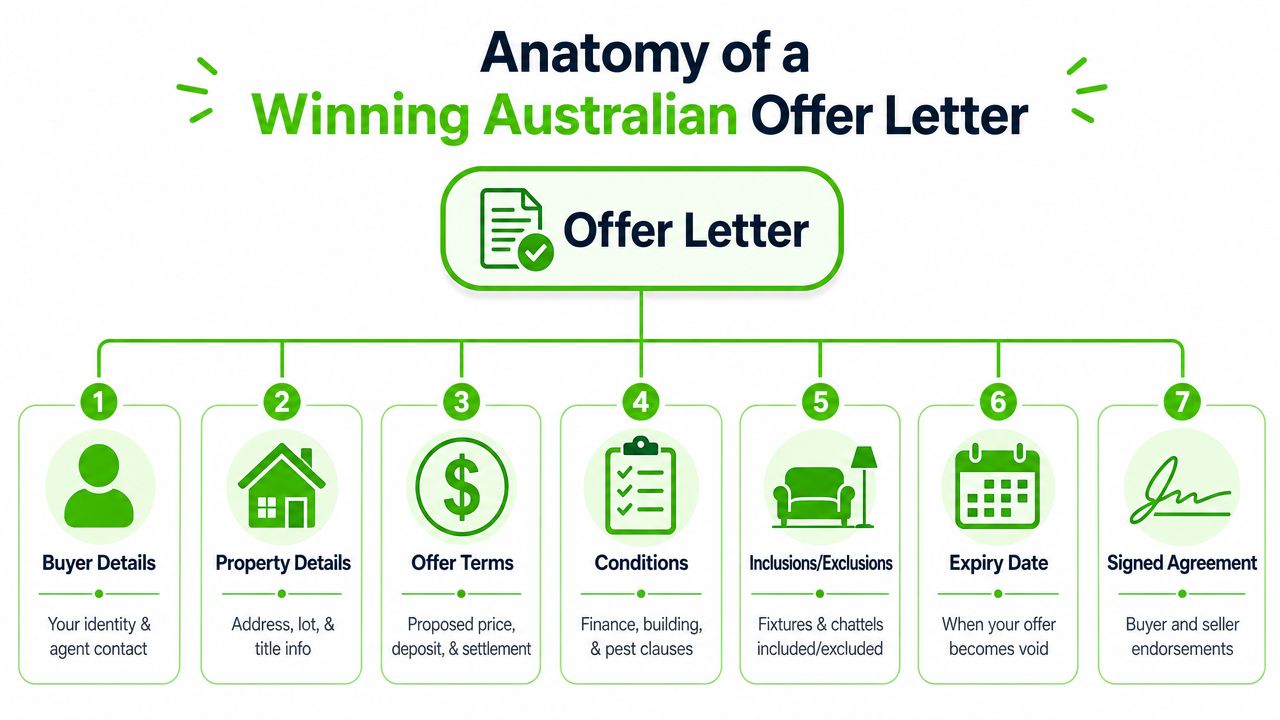
The best home buying offer letter is short, specific, and tied directly to the formal offer. Guidance on structure is clear. The strongest letters are usually a single typed page, often around 500 to 700 words, and they should include the property address, purchase price, financing plan, contingencies, and an expiration date according to this offer letter guide.
Keep it short and commercially useful
“A one-page typed letter is your goal” is the right mindset, even if you never write those exact words on the page.
Sellers and agents don't want a memoir. They want a fast read that supports the paperwork already in front of them. If your letter rambles, repeats the contract, or turns into a life story, you've missed the point.
A practical structure looks like this:
Open with the property details
State the address clearly. Name the buyers. If you're represented, make that obvious through your buyer's agent or solicitor details in the broader offer package.Confirm the offer in plain English
Reference the price and key commercial terms already reflected in the formal documents. Keep this aligned with the contract. Any mismatch creates doubt.Explain your finance position
Say whether you're buying with cash or finance. If finance is involved, note your pre-approval or readiness without over-sharing your personal finances.Acknowledge conditions and timing
Mention key contingencies and the proposed path to settlement. Include an expiry so the seller knows when the offer lapses.Add a short property-specific note
Allow yourself to sound human. Not sentimental for the sake of it. Just genuine and relevant to the home.
What the letter should actually contain
Most buyers overcomplicate this. The essentials are straightforward.
| Element | Why it matters |
|---|---|
| Buyer contact details | Shows professionalism and traceability |
| Property address | Removes ambiguity |
| Proposed purchase price | Anchors the note to the actual offer |
| Financing plan | Signals readiness and risk level |
| Contingencies | Shows transparency |
| Earnest money or deposit context | Reinforces seriousness |
| Expiration date | Creates a decision window |
In Australia, the exact mechanics of the offer package vary by state and transaction style, but the principle doesn't. Your letter must support the legal and financial terms, not compete with them.
A seller should be able to read your letter in a few minutes and understand two things immediately: you want the home, and you're capable of completing the purchase.
The best letters also sound like the buyer paid attention. If it's a renovated semi in the Inner West, mention the home itself, not generic lines that could apply to any listing. If it's a Byron property with a north-facing deck and a private feel, refer to that. Precision reads as sincere. Generic praise reads as recycled.
How to Write Your Letter to Connect and Persuade
Most buyers either write too little or far too much. The useful middle ground is simple. Be specific about the property, steady in tone, and disciplined enough to stop before the letter turns into oversharing.
Say what you noticed
A seller can tell when a buyer engaged with the home. That matters. If your note could be pasted onto any house in any suburb, it won't land.
Compare these:
Too generic: We love the beautiful kitchen and can see ourselves enjoying the house for many years.
Better: The kitchen island and open dining area feel like the centre of the home, and the layout suits the way we live and entertain.
Too generic: The home is perfect for the Byron lifestyle.
Better: The indoor-outdoor flow and private outdoor space are exactly what drew us to this property.
Too generic: We love the location.
Better: The quiet position and natural light in the living area stood out to us straight away.
The point isn't to be poetic. It's to show that you noticed what the owner created or cared for.
Sound calm, not desperate
Desperation weakens an offer. So does flattery that feels forced.
Avoid language that puts emotional pressure on the seller. Don't say this is your only chance, your forever dream, or that you'll be heartbroken if you miss out. That doesn't make you look committed. It makes you look volatile.
A better tone is measured and assured:
Say this: We're in a position to move forward promptly and have approached this purchase carefully.
Not this: We'll do absolutely anything to make this work.
Say this: We appreciate the care that has gone into the home.
Not this: No other buyer could possibly love this home the way we do.
Keep the letter warm, but keep your leverage. Sellers respect buyers who are enthusiastic and prepared.
If you're weighing how to present a stronger financial profile, especially in a market where a clean offer can matter more than a long note, this guide to competitive cash home buying strategies is useful background. Even when you're not paying cash, it helps to understand why sellers value simplicity and certainty.
A final writing rule. End cleanly. Thank the seller for considering the offer, confirm that your terms are set out in the formal documents, and leave it there. A strong close feels composed. A needy close usually costs more than it helps.
Common Offer Letter Mistakes That Lose the Deal
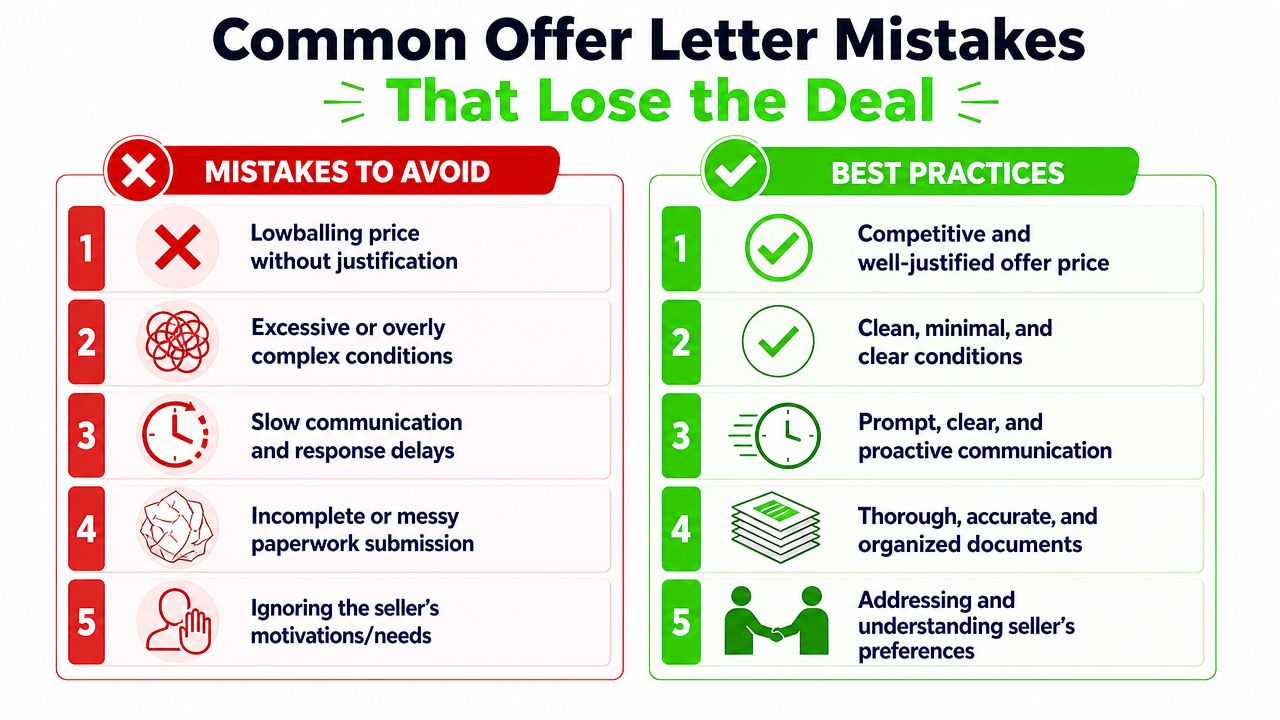
The biggest mistakes don't usually come from bad intentions. They come from buyers trying too hard. They think more detail means more persuasion. In practice, extra detail often creates extra risk.
Guidance on common pitfalls is blunt. Effective letters support strong legal terms, not replace them. Problems include omitting key deal terms, stuffing the note with irrelevant personal history, asking for unnecessary extras, or including family photos, which can create legal or fairness issues as noted in AmeriSave's guidance on making an offer.
Mistakes that create friction
Some errors are obvious once you know how agents read these letters.
Leaving out core terms
If the note doesn't align with the actual offer, or glosses over finance and conditions, the seller is left to guess. Guessing creates hesitation.Writing an autobiography
Your childhood, your work stress, and your long journey to home ownership don't help a seller assess execution risk.Requesting extras in the letter
Asking for furniture, tools, special access, or side arrangements makes you look harder to deal with.Talking about major renovations
Telling a proud owner you plan to rip out the kitchen or rework the garden can backfire badly.Including family photos or protected-characteristic details
This is one of the easiest ways to turn a well-meant letter into a fairness problem.
Sellers don't need more emotion. They need fewer reasons to worry.
What a cleaner letter looks like
Use this checklist before anything goes out:
| If your draft says this | Change it to this |
|---|---|
| We're stretching everything to make this happen | We're organised and ready to proceed on the terms set out in our offer |
| We want the dining table and outdoor setting included | Our offer is set out clearly in the contract documents |
| We're planning a big renovation after settlement | We appreciate the way the home has been presented and maintained |
| Here are photos of our family | Remove them entirely |
One point from the brief needs correcting. You asked for quotes from newspapers, but no verified newspaper quotes were provided. I won't invent one. That restraint matters here because buyers make the same mistake in letters. They add colour where precision would serve them better.
If you want a useful standard, use this one: every sentence should either increase seller confidence or be cut.
The Strategic Question When Should You Use a Letter
This is the part most buyers miss. A home buying offer letter is not automatically a smart move.
Independent guidance raises two serious points. First, personalised letters can create Fair Housing Act risk. Second, one housing-industry source said offer letters ranked dead last among effective buying strategies, which is why the smarter question is often whether to use one at all as discussed in this analysis of home offer letters.
When a letter can help
A letter has the best chance of helping when the seller is emotionally invested in the home and the commercial spread between offers is narrow.
That can happen with:
- Long-term owner-occupiers who care who buys the property
- Homes with clear personal pride of ownership, where buyers who notice specific features come across well
- Situations where your offer is already credible, and the letter reinforces confidence
- Campaigns where the selling agent indicates the seller will read buyer context
In these cases, the letter isn't leading the negotiation. It's supporting a solid bid and helping the seller feel comfortable choosing you.
When I would usually skip it
There are also plenty of scenarios where I'd be cautious or advise against it.
Investor-owned property
Investors usually care about price, conditions, and settlement certainty. Personal sentiment rarely moves the result.Bank sales or highly procedural sales
These are typically process-driven. The paperwork matters. The story doesn't.Deceased estate sales with multiple decision-makers
The decision often becomes commercial and administrative very quickly.Situations where the letter reveals too much
If the only way to make it “personal” is to disclose details that create legal or fairness concerns, don't send it.
The right question isn't “Should every buyer write a letter?” It's “Will this particular seller value one enough for it to be worth the risk?”
That's where local negotiation intelligence matters. A good buyers agent isn't just drafting words. They're reading the campaign, interpreting agent feedback, and working out whether a letter will sharpen the offer or clutter it. For buyers who want that broader strategic support, this explanation of why buyers agents in Australia are essential for home buyers lays out the role clearly.
From Letter to Keys Your Next Steps with a Buyers Agent
Saturday afternoon in Sydney. You have submitted what looks like a strong offer, the agent says there is interest from two other buyers, and now the question is no longer whether the letter was well written. The question is whether the whole offer stands up under pressure.
A home buying offer letter can help at the margin, but accepted deals are usually decided by execution. Contract review needs to be done early. Finance needs to be credible. Deposit terms, settlement timing, inclusions, and communication with the selling agent all need to line up. If any of those pieces are loose, a good letter will not save the deal.

What happens after the letter is sent
Once the offer lands, the tone changes fast. The selling agent may push for cleaner terms. The vendor may counter on price or settlement. Your solicitor may need to amend clauses quickly, and your broker may need to confirm capacity in writing.
That post-offer window is where buyers often lose momentum.
Insurance is part of that practical follow-through. Buyers regularly ask when cover should begin and what temporary proof of cover means, so this guide on the legal status of insurance cover notes is useful context once a deal starts moving toward exchange.
Where a buyers agent changes the outcome
Value lies in judgment. In Sydney's tighter, faster campaigns, and in Byron's more personality-driven negotiations, buyers need someone who can decide whether the letter should stay in the strategy, be shortened, or be left out altogether.
That work usually includes:
Testing the strength of the offer before emotion enters the conversation
Price, terms, deposit, settlement, and contract position need to be competitive on their own.Reading the selling side accurately
Some vendors respond to certainty. Some respond to a clean number. Some like a personal note. Others see it as noise.Handling agent pressure without compromising your advantage
A rushed verbal response can weaken your position more than a short, disciplined pause.Keeping the file moving after acceptance
Solicitors, brokers, building inspectors, insurers, and settlement deadlines all need coordination.
A service like We Are Buyers Agents handles search, negotiation, and acquisition support, which helps buyers decide if a letter should be part of the strategy at all. If you want a clear picture of how that works in practice, this guide to the step-by-step buyers agency process in Sydney is a useful reference.
Prepared with the Outrank app