
A buyer's agent is a licensed real estate professional who exclusively represents the property buyer's interests from search to settlement. In mainstream residential markets, that role is now firmly established, and in the United States more than 85% of homebuyers used a real estate agent in 2023, while 87% of buyers used an agent as their primary information source.
If you're trying to buy in Sydney, Byron Bay, or anywhere competitive, you're probably seeing the same pattern most buyers hit. Listings move fast, price guides aren't always enough to judge value, and every conversation with a selling agent leaves one question hanging in the air: who is on my side? That's where understanding what a buyers agent is becomes practical, not theoretical. A buyer's agent isn't just someone who opens doors. They represent your goals, protect your position, and help you make a better purchase decision, whether you're buying a home to live in or an asset to hold.
Table of Contents
- Your Professional Advocate in the Property Market
- Buyers Agent vs Selling Agent Understanding the Difference
- A Buyers Agents Key Roles and Legal Duties
- The Tangible Benefits for Homebuyers and Investors
- How the Buyers Agent Process Works Step by Step
- Typical Fees and Local Case Studies in NSW
- Frequently Asked Questions About Buyers Agents
Your Professional Advocate in the Property Market
A lot of buyers start in the same place. They're scrolling listings at night, trying to decode suburb differences, comparing sold results, and wondering whether they're about to overpay or miss out.
In that environment, a buyer's agent acts as your professional advocate. They're licensed to represent the buyer only, and their job is to align the search, the analysis, and the negotiation with your goals rather than the vendor's. That matters whether your brief is emotional, financial, or both.
Why buyers look for specialist help
The role didn't appear by accident. The buyers agent role became formally distinct from the seller's agent in many markets during the late 1980s and 1990s as agency laws evolved. In the United States, a 2022 NAR survey found that 87% of all buyers used a real estate agent as their primary information source, which shows how strongly buyers rely on specialist guidance in real transactions (NAR survey reporting).
That same dynamic shows up in Australia, especially in tightly held suburbs and lifestyle markets where stock is patchy and buyer competition is inconsistent. Some homes attract a crowd. Others sell discreetly. A buyer without representation often sees only the visible market, not the full decision context around it.
Practical rule: If you're making one of the largest purchases of your life, you want someone in the process whose instructions come from you alone.
A good buyer's agent does more than source property. They pressure test your brief, challenge emotional decisions, and tell you when a property looks good on the surface but doesn't stack up underneath. That's often where true value sits.
The role is broader than “finding listings”
For homebuyers, the role is about reducing mistakes. For investors, it's about choosing an asset that fits a strategy, not just buying something that feels active or fashionable.
That difference is why strong operators focus on communication and process as much as access. If you work in property or client services yourself, these unforgettable client experience strategies are a useful reminder that trust usually comes from clarity, speed, and follow-through, not sales talk.
Buyers Agent vs Selling Agent Understanding the Difference
The cleanest way to understand a buyer's agent is to compare them with the commonly known agent: the selling agent.
A selling agent is engaged to sell a specific property for the vendor. A buyer's agent is engaged to help a buyer acquire the right property on the right terms. Those sound similar until money, pressure, and negotiation enter the room.
The loyalty test
Consider legal representation. You wouldn't ask the other side's lawyer to casually protect your interests in a contract dispute. Property isn't identical, but the logic is close enough to be useful.
The selling agent can be helpful, responsive, and professional. Many are. But their duty runs to the seller's outcome. Your buyer's agent's duty runs to yours.
If you want a contract-side primer on how interests diverge in transactions, this overview of understanding buy side and sell side agreements is a helpful parallel.
Buyers Agent vs Selling Agent Key Differences
| Attribute | Buyers Agent | Selling Agent |
|---|---|---|
| Who they represent | The buyer | The seller |
| Primary objective | Buy the right property on the best achievable terms | Sell the listed property on the best achievable terms for the vendor |
| Property focus | Searches across suitable options | Promotes the property they're appointed to sell |
| Advice given | Buyer-focused strategy, pricing view, risk review | Vendor-focused sales guidance |
| Negotiation stance | Works to protect the buyer's price and conditions | Works to improve the seller's price and conditions |
| Conflict position | Meant to be aligned with the buyer's interests | Inherently aligned with the seller's interests |
One practical trade-off is convenience. Buyers sometimes stick with the selling agent because it feels faster. There's one point of contact, one person arranging access, one person returning calls.
But convenience can blur accountability. If you want a deeper local comparison, this guide on key differences between a buyers agent and a real estate agent lays out how those roles separate in practice.
The easiest mistake in property is assuming friendliness equals representation. It doesn't.
For Australian investors, that distinction matters even more. A selling agent can tell you a property is “great for investors.” A buyer's agent should be able to explain whether it suits your intended yield profile, holding costs, tenant demand, and resale path.
A Buyers Agents Key Roles and Legal Duties
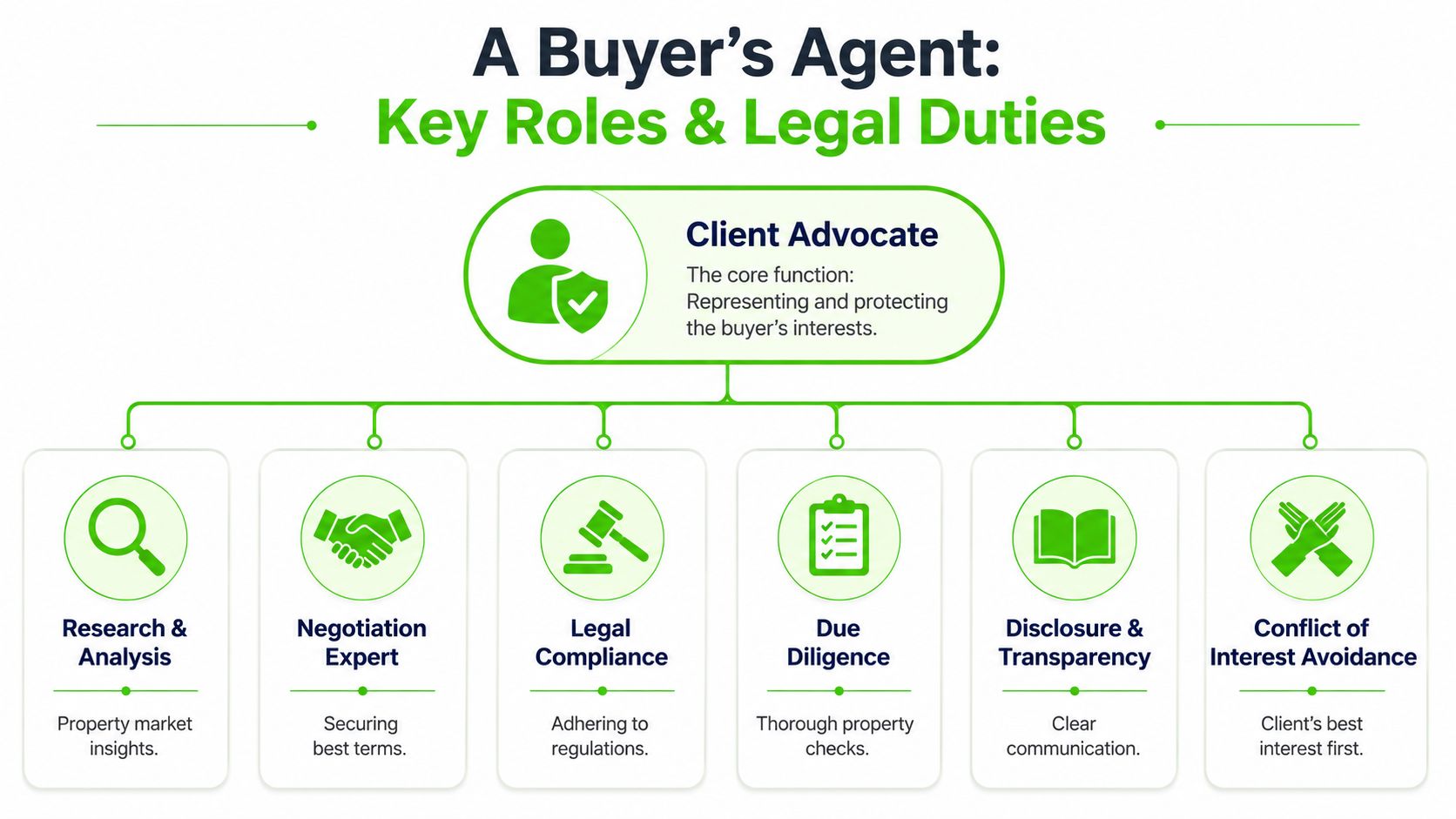
A buyer's agent has two jobs at once. One is practical. Find, assess, and secure a property. The other is legal and ethical. Represent the buyer properly.
What the work actually looks like
In practice, the role usually includes:
- Clarifying the brief: budget, borrowing position, suburb limits, essential requirements, and where flexibility exists.
- Sourcing stock: on-market, pre-market, and off-market opportunities where available.
- Running due diligence: reviewing contracts, checking strata material where relevant, and coordinating building or pest review.
- Assessing value: comparing recent sales, inspecting competing stock, and testing whether the guide reflects likely market value.
- Negotiating terms: price matters, but so do conditions, deposit structure, settlement timing, and clauses that reduce buyer risk.
- Managing the transaction: keeping solicitors, brokers, inspectors, and agents aligned so the deal doesn't drift.
What doesn't work is using a buyer's agent as a glorified search assistant. If all they do is forward listings you could have found yourself, you're not getting the core service.
Why fiduciary duty matters
A buyer's agent enters into a fiduciary relationship, creating enforceable legal duties such as loyalty, confidentiality, and full disclosure of material facts. That contrasts with a dual-agent role where obligations are shared, and case law has established that failing to disclose latent defects or zoning risks can amount to negligence or breach of duty (fiduciary duty explanation).
That sounds legalistic, but the effect is practical. It means the buyer's agent isn't meant to gloss over problems to keep a deal alive.
A good buyer's agent should be willing to kill a deal when the asset is wrong.
For Australian buyers, that often shows up in ordinary decisions:
- Apartment purchase: Is the strata history pointing to future special levies?
- House purchase: Does the renovation look cosmetic, or is there a deeper building issue?
- Investor purchase: Does the rent estimate hold up, or is it optimistic relative to comparable stock?
- Lifestyle market purchase: Is the property attractive to you, but awkward for resale or leasing later?
In practice, the strongest buyer advocacy comes from disciplined process. That means written criteria, documented checks, and clear conflict boundaries. If an agent can't explain how they avoid conflicted recommendations, that's a problem.
The Tangible Benefits for Homebuyers and Investors
Saturday morning. Three inspections booked, two more added overnight, and a selling agent telling you there are "multiple strong buyers" circling. That is usually the point where homebuyers and investors start making rushed decisions. A good buyer's agent brings the process back to evidence, pricing discipline, and fit for purpose.

For owner occupiers
For owner occupiers, the first gain is focus. Instead of spending weekends chasing every polished listing, buyers inspect a narrower group of properties that fit the budget, location, and likely resale profile.
The second gain is better judgement under pressure. Research discussed by Bankrate on buyer agent outcomes suggests buyers with representation can be better placed to negotiate and avoid overpaying in the right conditions. In practice, that advantage comes from preparation, not magic. A buyer's agent should know the comparable sales, the vendor's likely position, and where a contract term matters as much as price.
That matters most in competitive parts of Sydney and other tightly held suburbs across Australia. Good properties still attract strong demand. The benefit is not a guaranteed discount. The benefit is reducing expensive errors, overbidding on emotion, stretching for features that do not hold value, or accepting terms that favour the seller more than they need to.
A useful benchmark is whether the advice improves the quality of your decision, not just whether it saves time. For a practical breakdown, see the benefits of using a buyers agent in property purchases.
For investors
Investors need more than search support. They need asset selection tied to performance.
Many general guides miss the point: an investment-grade brief is not just "buy me something in a good suburb." It needs clear targets around yield, cash flow tolerance, capital growth drivers, and the role that purchase will play in the wider portfolio.
A buyer's agent working for an investor should be testing questions such as:
- Yield fit: Does the likely rent support the holding costs and strategy?
- Capital growth prospects: Is there genuine scarcity, owner-occupier demand, and resale depth?
- Portfolio role: Does the property diversify your current exposure by geography, price point, or dwelling type?
- Cash flow pressure: Will strata costs, maintenance, insurance, vacancy periods, or future works weaken returns?
- Exit logic: Who is the likely buyer at resale, and will that buyer pool stay broad?
In the Australian market, that framework matters because two properties with the same asking price can produce very different long-term outcomes. One may rent easily, appeal to future owner occupiers, and sit in a suburb with constrained supply. The other may look attractive on a listing portal but carry weak tenant demand, heavy strata costs, or limited resale appeal. Those differences do not show up clearly in the marketing copy.
The investor test is simple. Remove the sales pitch and check whether the numbers, the asset, and the location still work together.
Some firms, including We Are Buyers Agents, position their service around search, negotiation, and acquisition support in markets such as Sydney and Byron Bay. The fundamental measure is whether the agent can connect suburb selection, property type, and buying strategy to your investment objectives, then explain the trade-offs clearly before you commit.
How the Buyers Agent Process Works Step by Step
A strong process makes the service tangible. You should know what happens before an offer, during negotiation, and after the contract is signed.
Early in the engagement, many buyers are surprised by how much work happens before the first inspection shortlist is finalised.
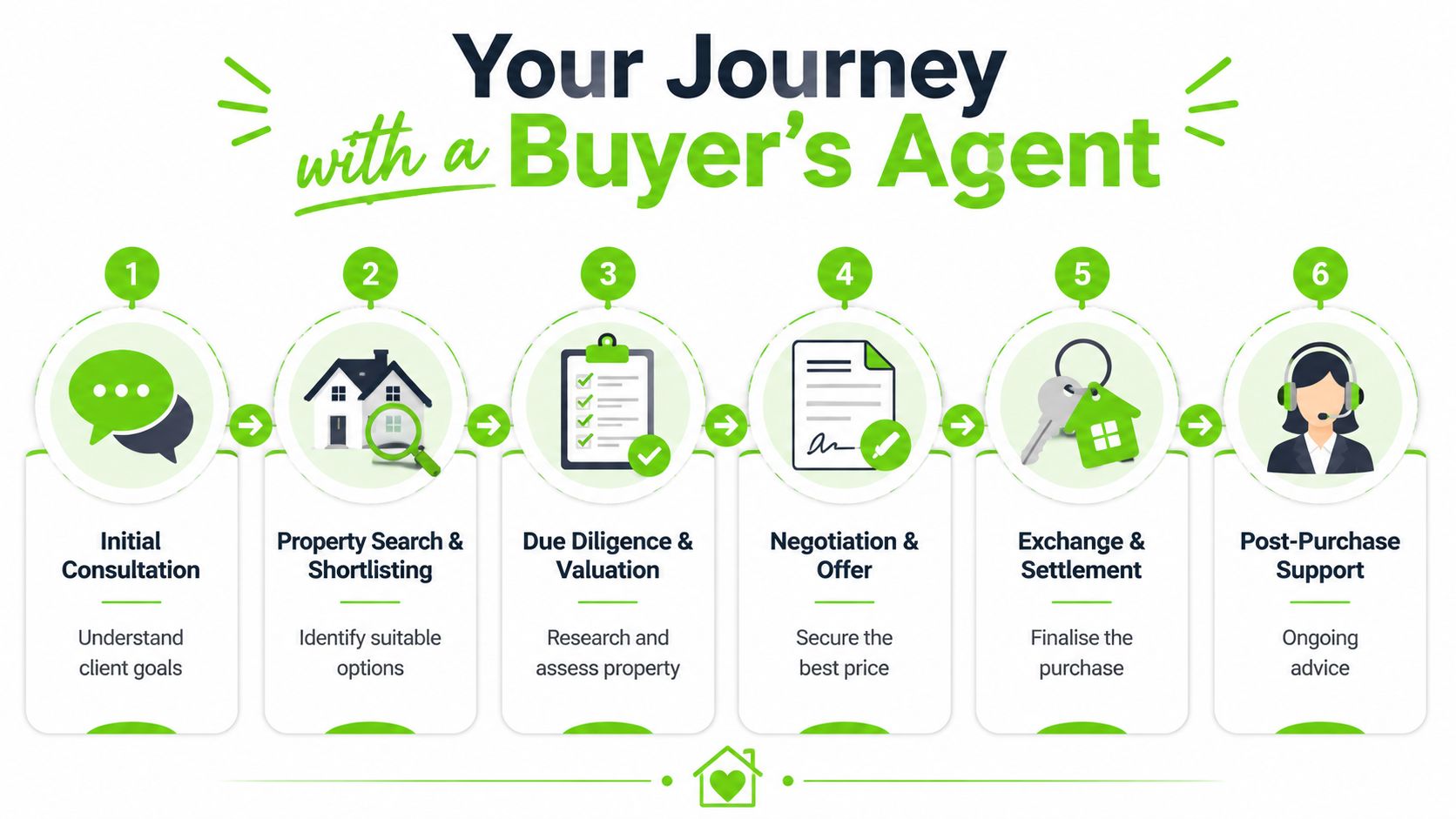
The workflow from brief to settlement
Initial consultation
The brief gets defined properly. Budget, timing, intended use, risk tolerance, suburb boundaries, and walk-away points all need to be clear.Search and shortlisting
The agent filters stock, speaks with selling agents, screens opportunities, and removes properties that don't fit the brief or the budget reality.Inspections and assessment
Suitable options are inspected with a sharper eye. Layout flaws, street position, renovation quality, strata concerns, and resale appeal all get tested.Due diligence and valuation
Comparable sales, contract review, building issues, and market positioning are checked before emotion takes over.
A local walkthrough of that workflow appears in this guide to the buyers agency Sydney process from brief to settlement.
This video gives a useful visual sense of how buyer representation works in practice:
What buyers often underestimate
The final stages are where many private buyers lose control.
- Offer strategy matters: A strong price with poor terms can still be weaker than a cleaner offer.
- Auction planning matters: Bidding without a ceiling and a sequence is asking for trouble.
- Transaction management matters: After acceptance, someone still has to keep momentum through exchange and settlement.
- Post-purchase support helps: Buyers often need referrals, next-step guidance, or a second view on immediate works and leasing decisions.
The best buyer's agents don't make the process feel dramatic. They make it feel organised.
Typical Fees and Local Case Studies in NSW
Fees matter because they shape how buyers judge value. The right way to look at them is not “What does this cost?” but “What work is being done, how is conflict managed, and what risk am I outsourcing?”

How buyers agents usually charge
In Australia, fee structures vary, but two models are common:
- Fixed fee: A set amount for search, assessment, negotiation, and purchase support.
- Percentage-based fee: A success fee linked to the final purchase price.
Globally, buying agents may charge a small upfront retainer fee and a success fee that is a percentage of the final purchase price, typically paid at exchange of contracts. In some markets, that fee is 1–3% of the purchase price, depending on the complexity of the transaction (buying agent fee structure reference).
What works best for buyers is usually fee clarity. You should know when the retainer is due, whether it's credited toward the final invoice, what triggers the success fee, and whether auction bidding or extensive due diligence sits inside or outside the quoted scope.
Ask one blunt question: “How do you get paid, and is there any payment from another party connected to my purchase?”
Two NSW examples
Sydney homebuyer example
A homebuyer targeting an inner-ring Sydney suburb may start with a broad brief and too many compromises. A buyer's agent often improves that by narrowing the asset type, screening out poor floorplans, and moving quickly when a strong off-market or pre-market option appears. The value in that scenario usually isn't just “finding something hidden.” It's recognising which quiet opportunity is good and which one is being avoided for a reason.
Northern Rivers investor example
An investor looking around Byron Bay or the broader Northern Rivers often arrives with a headline-driven brief. They want lifestyle appeal, but they also want rental performance and a sensible long-term hold. A disciplined buyer's agent reframes the search around tenant demand, holding costs, likely vacancy profile, and resale pool. Sometimes that means buying slightly outside the obvious prestige pocket because the portfolio outcome is stronger there.
These examples are intentionally anonymous because the lesson isn't the suburb brag. It's the process. Good buying decisions come from brief discipline, valuation discipline, and negotiation discipline.
Frequently Asked Questions About Buyers Agents
Is a buyers agent worth it on a lower priced property
Sometimes yes, sometimes no. If the purchase is straightforward, the market is transparent, and you've got the time and confidence to do the research well, you may not need full representation. But if one mistake would be costly for you, the fee can still make sense.
Can't I just search online myself
You can, and most buyers do. The issue isn't access to listings. The issue is filtering quality, judging value, reading agent tactics, and doing proper due diligence under time pressure.
What's the difference between an exclusive and non-exclusive agreement
An exclusive agreement usually means one buyer's agent is appointed to represent you for a defined scope or term. A non-exclusive agreement gives you more flexibility, but it can also reduce commitment and urgency on both sides. Read the authority carefully, especially around fees and what counts as an introduced property.
How do I choose the right buyers agent for my needs
Ask practical questions, not branding questions.
- Process: How do they shortlist and reject properties?
- Investment thinking: If you're an investor, can they discuss yield, holding costs, and exit strategy clearly?
- Negotiation approach: How do they handle private treaty versus auction?
- Conflict management: Do they accept any referral payment or developer incentive?
- Fee clarity: Is the fee fixed, percentage based, or mixed, and when is each part payable?
The right agent should make you feel more informed, not more dependent.
Are buyers agents only for wealthy buyers
No. They're often most useful for buyers who can't afford a poor decision, whether that's a first home buyer stretching into Sydney or an investor trying to build a portfolio without carrying a bad asset for years.
If you're weighing up whether buyer representation makes sense for your next purchase in Sydney, Byron Bay, or elsewhere in Australia, We Are Buyers Agents outlines how a dedicated buyers agency works and what that support looks like for homebuyers and investors.