
You've probably already done the Sydney buyer routine.
You set alerts on Domain and realestate.com.au. You spend Saturdays driving between inspections. A place looks good online, then turns out to back onto a main road, sit over a noisy retail strip, or feel overpriced the moment you step inside. You finally find one that fits, only to watch the campaign shift toward an auction where the selling agent controls the pace, the information flow, and the emotional temperature.
That's the point where many buyers start asking a different question. Not “what suburb should I buy in?” but “do I need someone in my corner?”
That's where a buyers agency in Sydney becomes useful. Not as a luxury extra, and not just for prestige homes, but as a practical way to cut through noise, source better opportunities, and make fewer expensive mistakes. In a city where property values recently rose 0.6% over the quarter and 1.1% annually to a record high, according to this Sydney market snapshot, small errors can become very costly very quickly.
A good buyer's agent doesn't just “find property”. They shape the brief, test value properly, manage due diligence, and negotiate when the pressure is on. They also provide key guidance on when the fee is justified and how to use professional help for a real financial advantage.
Table of Contents
- Introduction Why Sydney Property Buyers Are Turning to Professionals
- What Is a Buyers Agent and What Do They Actually Do
- How a Buyers Agency Conquers the Sydney Market
- Unpacking Buyers Agency Fees and Calculating Your Return
- The Buyer's Journey A Step-by-Step Case Study
- How to Choose and Vet Your Sydney Buyers Agent
- Frequently Asked Questions About Sydney Buyers Agencies
- Is a buyer's agent only worth it for expensive purchases?
- Can't I just find everything myself on Domain and realestate.com.au?
- How long does the process take with a buyer's agent?
- Is the fee tax-deductible for investors?
- What if the market is softer and competition is lower?
- Is using a buyers agency in Sydney always the right move?
Introduction Why Sydney Property Buyers Are Turning to Professionals
Sydney has always punished hesitation and rewarded preparation.
That isn't just a feeling from buyers who've lost a few auctions. It's built into the shape of the market itself. Sydney remains one of Australia's most expensive and tightly contested markets, and its land constraints and established suburbs mean good homes in good positions don't come along in endless supply. When stock is limited and the better pockets are tightly held, buyers need more than enthusiasm.
The shift toward buyer representation reflects that pressure. One published estimate puts the number of buyer's agents in Australia at about 1,000, and a cited survey found 40% of first-time buyers had considered using one, up from 10% in 2013, a fourfold increase over roughly a decade, as outlined in this industry overview of buyer's agents in Australia.
For a first-home buyer, the appeal is usually clarity. For an upgrader, it's time and negotiation control. For an investor, it's access and disciplined assessment.
Practical rule: A buyer's agent is most useful when the cost of one mistake is larger than the fee.
That mistake might be overpaying. It might be buying in the wrong pocket of the right suburb. It might be missing a property that never reached the major portals. It might be chasing ten mediocre listings when one quiet off-market opportunity would have solved the problem.
Sydney buyers aren't hiring help because they can't search online. They're hiring help because online search is only a small part of what determines the result.
What Is a Buyers Agent and What Do They Actually Do
A buyer's agent is a licensed property professional who acts for the buyer through the purchase process. That sounds simple, but the practical difference is huge.
A selling agent is paid to represent the vendor's interests. Their job is to run a campaign, create competition, and secure the best terms for the seller. A buyer's agent sits on the other side of that equation. Think of them as a personal property coach combined with a transaction strategist. They help define the target, separate good stock from bad stock, and handle the pressure points that catch inexperienced buyers.
They work for the buyer, not the seller
This is the part buyers need to get straight early.
If you meet an agent at an open home and they seem helpful, they may still be excellent at their job. But their job is to sell that property on behalf of the owner. They aren't your adviser in the legal or practical sense buyers often assume. They can guide the campaign, answer questions, and manage negotiations, but their duty isn't to protect you from overpaying or from choosing the wrong asset.
A buyer's agent fills that gap.
That matters more in Sydney than in simpler markets, because the local process can be fast, emotional, and opaque. Buyers face mixed-quality stock, sharp pricing, and suburb-by-suburb differences that aren't obvious from the listing photos.
The four jobs buyers usually underestimate
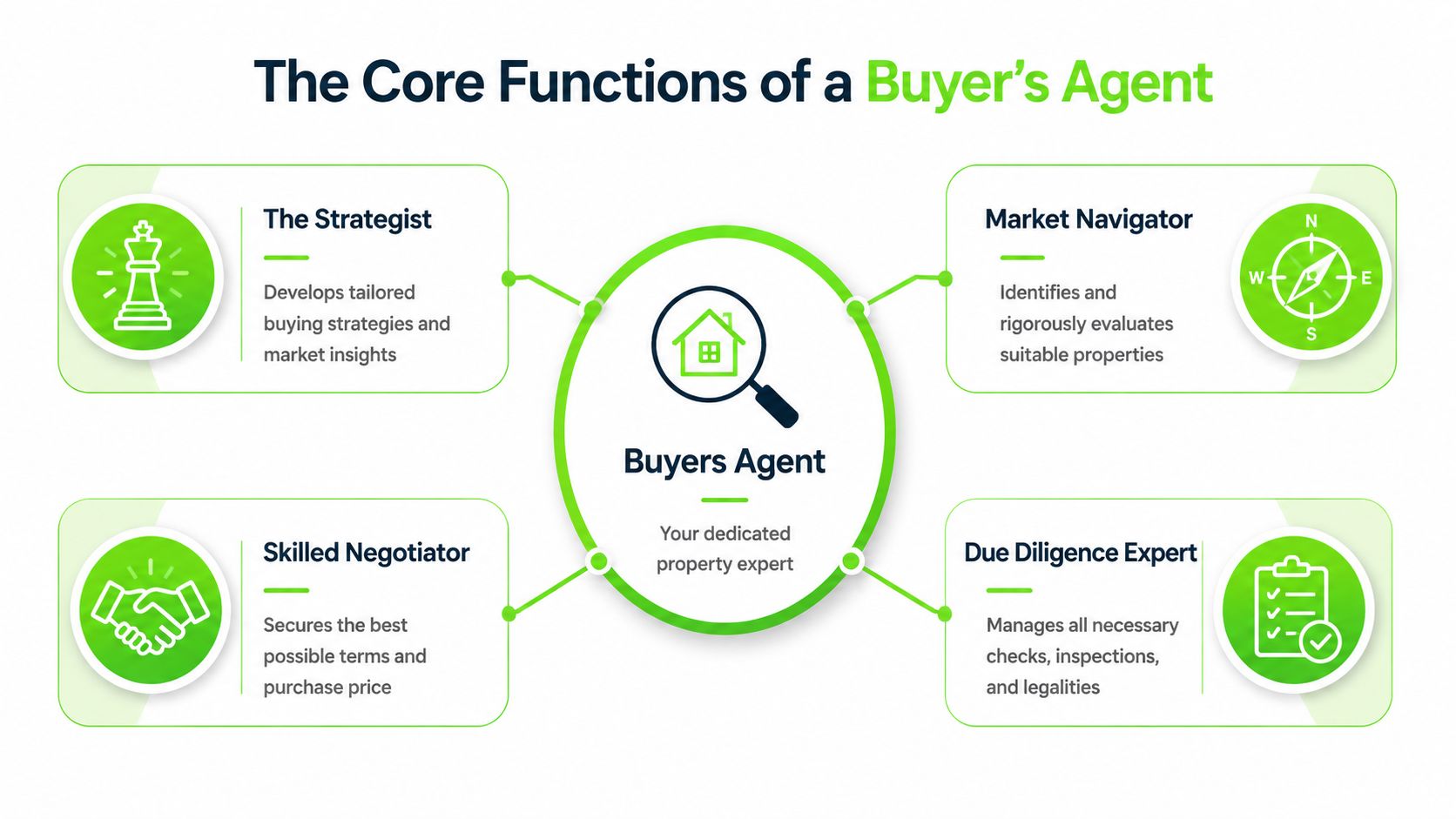
The easiest way to understand a buyers agency in Sydney is to break the work into four jobs.
The strategist sets the brief properly. That means more than bedrooms and postcode. It includes trade-offs between land and renovation, school catchment and transport, owner-occupier appeal and resale depth, or yield and future scarcity for investors.
The researcher searches beyond public listings. They shortlist, inspect, compare, and reject. Most buyers underestimate how much value comes from ruling properties out quickly and for the right reasons.
The negotiator handles offers, auction tactics, and agent relationships. In this process, emotion can become expensive. A good negotiator creates structure, not drama.
The administrator keeps the process moving. Contracts, solicitors, building and pest inspections, strata checks, finance timing, cooling-off decisions, and pre-settlement issues all need coordination.
Here's what that looks like in real life:
| Function | What it looks like in practice | Why it matters |
|---|---|---|
| Strategy | Tightening the brief and removing contradictions | Stops buyers wasting weeks on unsuitable stock |
| Research | Shortlisting and value assessment | Improves decision quality |
| Negotiation | Offer management or auction bidding | Reduces emotional overreach |
| Process control | Due diligence through settlement | Lowers the chance of procedural mistakes |
A buyer who says “I can do the search myself” is usually talking about only one quarter of the job.
The service has also become more mainstream because buyers have started to recognise that complexity. As noted earlier, consideration among first-time buyers has risen materially over time. That isn't because buyers suddenly became less capable. It's because the process became harder to manage well.
A capable buyer can absolutely purchase alone. Plenty do. But the more complex the brief, the tighter the market, or the less time you have, the more useful specialist representation becomes.
How a Buyers Agency Conquers the Sydney Market
A buyer spends three Saturdays chasing the same result. They inspect six properties, lose two at auction, overpay on a pest report for a third they never had a real chance of buying, and end the month more confused than when they started.
That pattern is common in Sydney because the market rewards precision, not just effort. Suburb averages are too blunt. Listing photos hide flaws. Agent price guides are only one input. A buyers agency earns its fee when it changes the timing and method of the search, then applies discipline at the moments where buyers usually make expensive decisions.
Sydney is also not one market. It is a chain of micro-markets shaped by transport, school catchments, topography, zoning, new supply, and buyer depth. The gap between a good purchase and a mediocre one often sits at street level, sometimes building level.
The value tends to show up in three places. Auction execution, suburb and asset selection, and access to properties before the broader buyer pool piles in.
Auctions reward preparation, not confidence
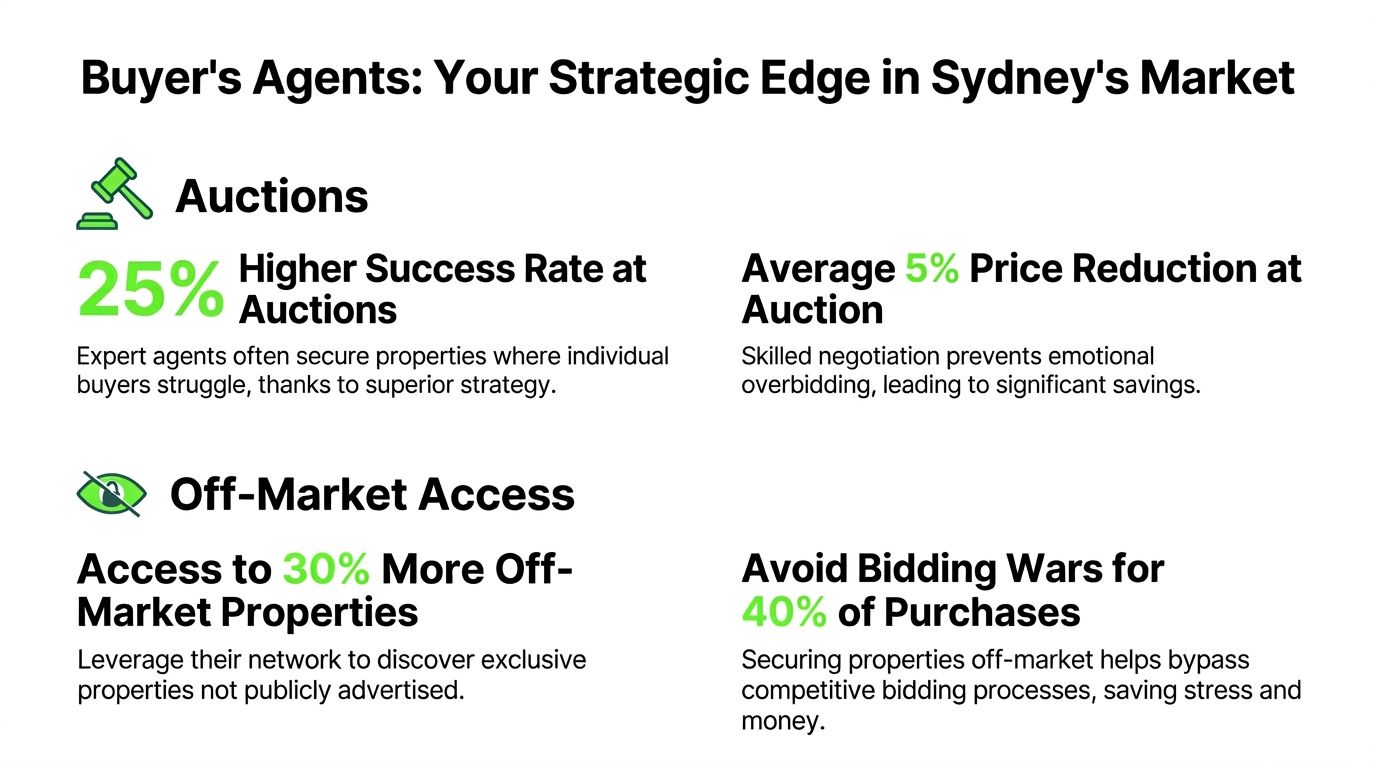
Sydney buyers do a large share of their buying through auction campaigns, particularly in family-house markets and tightly held inner and lower north shore pockets. That matters because auctions compress risk into one short window. There is no cooling-off period for most successful bidders. If the contract or the asset has a problem, the mistake is already yours.
A capable buyers agent does the hard work before auction day. That means checking recent comparable sales, calling through the campaign, pressure-testing the guide against actual buyer interest, reviewing the contract early, and setting a limit that reflects the property rather than the atmosphere. Auction day then becomes an execution job.
Buyers acting alone usually trip over the same points:
- They confuse competition with value. A loud crowd can push price, but it does not prove quality.
- They treat the guide like a fair value marker. In practice, it is part of the campaign.
- They revise their ceiling under pressure. That usually means the original number was not based on enough evidence.
- They focus on winning instead of buying well. Those are different outcomes.
As noted earlier, Sydney values have been pushing into record territory. In that kind of market, even a small overpayment has a large dollar cost. A buyers agent does not remove competition. They reduce the chance of paying a premium that was never necessary.
Good suburb selection starts with a buying thesis
Buyers often begin with a shortlist of familiar suburbs. Professionals start by asking a harder question. What type of property is likely to hold demand, suit the brief, and still make sense at today's price?
That shifts the analysis. Instead of chasing suburb reputation, the work becomes asset selection inside the suburb. Analysts and property professionals commonly examine variables such as supply pipeline, demographic mix, vacancy pressure, comparable sales, and the balance of owner-occupier demand against investor stock, as outlined in this guide to analysing data like a buyer's agent.
In practice, that means testing questions like these:
- Is scarcity real? Some suburbs look tightly held until you separate quality stock from generic stock.
- What could dilute future demand? A wave of similar new apartments can cap upside for older units.
- Who is the likely next buyer? A property with broad appeal usually gives you more protection on resale.
- What sits below the headline? Main roads, aircraft noise, flood overlays, poor strata history, and awkward floorplans can all affect value more than newcomers expect.
This is also where experienced buyers agents save clients from false positives. A polished campaign can make an ordinary property feel rare. A better process strips that away. For buyers who want to see how that sourcing process works in practice, this article on how a Sydney buyers agency finds hidden property gems gives a useful example of the search logic behind the scenes.
Access changes the odds before negotiation starts
The public portals show only part of the market. Many Sydney sales are discussed privately first, through agent databases, prior buyer relationships, or sellers testing price without committing to a full campaign.
One industry case study reported a high share of off-market transactions within its own client book in 2023, according to this buyer-agent portfolio update on off-market transactions. That figure should not be treated as a market-wide benchmark, but it does reflect a real feature of Sydney. Access is uneven, and well-connected buyers agents often see opportunities earlier than individual buyers.
Earlier access helps in two ways. It widens the shortlist, and it can improve buying conditions.
A quieter sale does not automatically mean a bargain. Sometimes the seller still wants a premium. But the process is different. Buyers usually get more time to assess the property, review the contract properly, and negotiate terms without a public crowd shaping the result. For time-poor professionals, relocating families, and buyers targeting tightly held pockets, that shift in process is often where the fee starts to make financial sense.
The inside game is straightforward. Better access improves the shortlist. Better shortlists produce better decisions. In Sydney, that is usually where the primary return sits.
Unpacking Buyers Agency Fees and Calculating Your Return
Fees are where many buyers hesitate, and that's reasonable. The mistake is treating the fee as a standalone cost rather than comparing it against the problem it solves.
A buyers agent can be poor value if your brief is simple, your schedule is flexible, your market knowledge is strong, and you're comfortable negotiating directly. They can be excellent value if you're buying in a contested pocket, juggling work and family, or one wrong decision would have long-term consequences.
The two fee models buyers usually see
Most Sydney buyers will come across two common fee structures. A fixed fee or a percentage-based fee. Some firms also split this into an upfront engagement component and a success component on purchase.
Because no verified Sydney-wide fee benchmarks were provided here, it's better to think about structure rather than chasing an “average” that may not reflect your brief.
| Fee Model | How It Works | Pros for Buyer | Cons for Buyer |
|---|---|---|---|
| Fixed fee | One agreed amount for the service scope | Clear budgeting, no link to purchase price | Scope needs to be well defined |
| Percentage of purchase price | Fee moves with the final buy price | Can align with full-search service on larger briefs | Buyers may worry about incentives if not clearly discussed |
The right model depends on the task.
A full-service home search may suit one structure. Auction bidding only may suit another. A negotiation-only engagement after you've already found the property is different again.
For buyers comparing proposals, this breakdown of buyer's agent fees in Sydney and what you're really paying for is a practical reference because it frames the work behind the invoice, not just the invoice itself.
When the fee makes sense
There are three reliable ways to think about return.
First, price outcome. If the agent helps you buy well below where your own emotional ceiling would have drifted, the fee may be covered immediately. This doesn't need a dramatic win to matter. In Sydney, on a high-value asset, small improvements count.
Second, mistake avoidance. This is the most underrated return. Avoiding the wrong property can be worth more than shaving a little off the right one. Buyers often focus on “did the agent get a discount?” when the bigger question is “did the agent stop me from buying a compromised asset at full market pricing?”
Third, time and search efficiency. Some buyers enjoy the search. Others lose months to it. A good buyer's agent compresses the process by killing weak options early, organising inspections intelligently, and keeping due diligence moving.
Here's a straightforward decision framework:
- Use a buyer's agent if you're entering auctions regularly, need access beyond public listings, or don't trust your own valuation discipline.
- Consider limited-scope help if you can find property but want negotiation or auction support.
- DIY may be enough if your brief is broad, the local market is slow, and you already know the target area thoroughly.
Reality check: The fee is easiest to justify when the buying process is likely to be expensive even without it.
That expense doesn't have to show up as a line item. It can show up as overbidding, buying tired stock in a better postcode than the fundamentals justify, or burning months on a search that keeps resetting.
The best way to judge value is not to ask “what does a buyer's agent cost?” Ask “what is the likely cost of doing this badly?”
The Buyer's Journey A Step-by-Step Case Study
Saturday, 11:40am. Chloe has already been to two Inner West inspections, missed one pre-auction opportunity during the week, and is now standing in a third property that looked far better online than it does in person. The floor plan is tight, the strata report raises questions, and the agent is hinting at a price guide that does not line up with recent comparable sales.
That is the point where many first-home buyers lose discipline. Not because they are careless, but because Sydney rewards speed and punishes hesitation. A structured buying process matters most when the market is moving and the cost of one bad call is high.
Step 1 to Step 3 from overwhelm to a workable brief
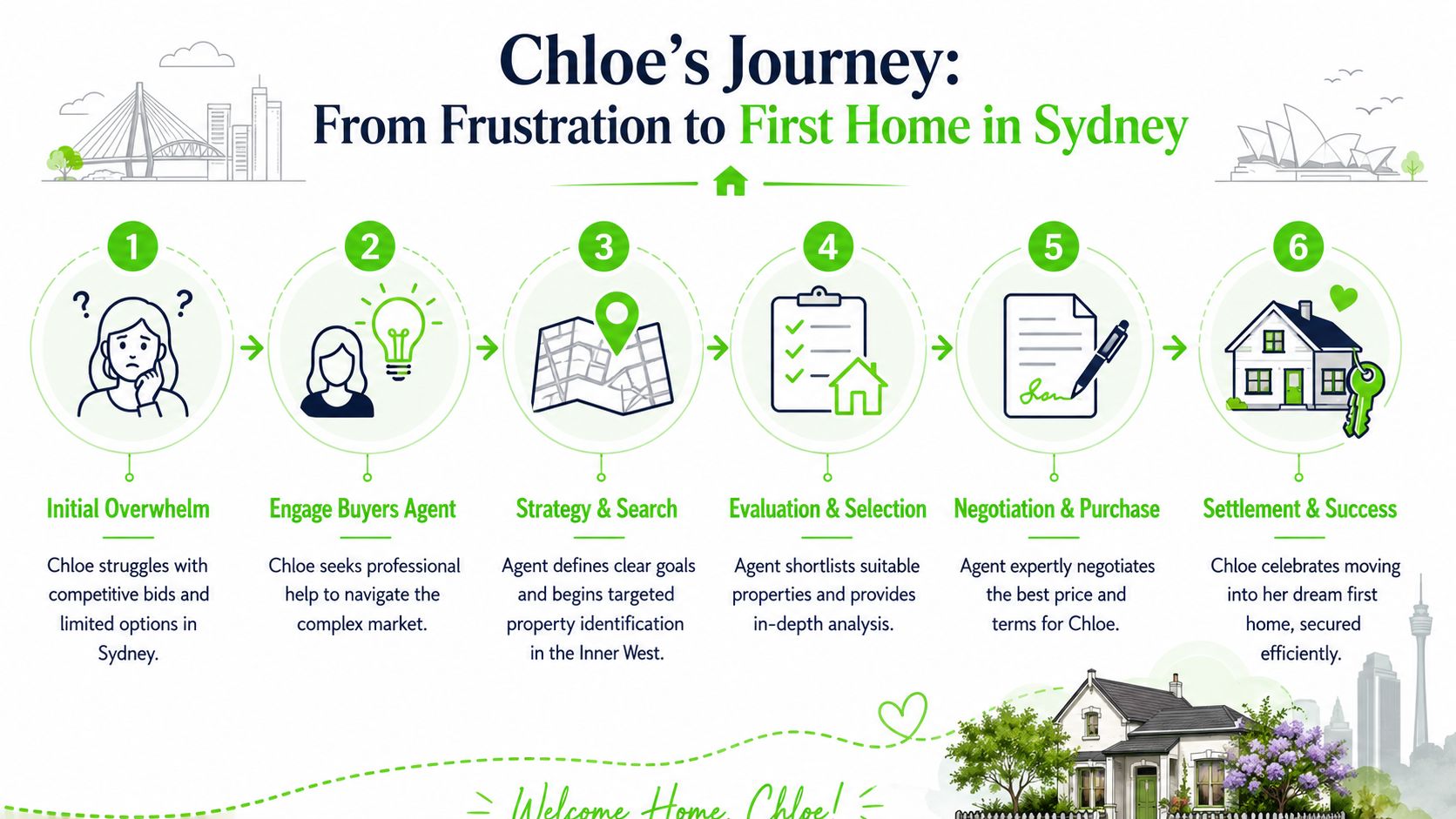
Step 1: Initial overwhelm
Chloe is a first-home buyer with finance approval and a clear target area. She wants the Inner West for lifestyle, but she also wants low maintenance, solid resale appeal, and room to stay put for a few years. Her budget is real, and so are her expectations. The conflict is that Sydney stock rarely gives you all of that at once.
This is usually where the search gets expensive. Buyers keep inspecting properties that are vaguely suitable, hoping one will somehow make the numbers work.
Step 2: The brief gets tightened
A good brief is not a wish list. It is a filter.
For Chloe, that means ranking suburbs in order, separating must-haves from preferences, setting a hard ceiling instead of a hopeful one, and agreeing on the compromises she can live with. For example, she may accept an older kitchen in Dulwich Hill, but not a poor floor plan in Marrickville. She may stretch on strata if the building is well run, but not on a compromised position near a major road.
That shift sounds simple. It saves weeks.
Step 3: Search and shortlist
Once the brief is clear, the search changes shape. The agent stops reacting to listings and starts screening the market with intent. That includes portal stock, quiet campaigns, agent call-arounds, and properties that may sell before a full advertising push.
As noted earlier, some buyer's agents secure a meaningful share of deals away from the main portals. The exact mix varies by brief, price point, and suburb. The practical value is straightforward. Chloe now sees fewer properties, but the hit rate improves because the options match the strategy.
To see the process from another angle, this short walkthrough is worth watching:
Step 4 to Step 6 evaluation negotiation and handover
Step 4: Due diligence and evaluation
One off-market apartment gets through the filter. Good location. Functional layout. No obvious cosmetic trap. That still does not make it a good buy.
Discipline is how the fee is earned. Contract review starts early. Comparable sales are checked against the seller's expectations. The strata records are read closely. Renovation quality is tested, not admired. The building's owner-occupier ratio, upcoming capital works, and resale depth all matter.
I have seen buyers overpay for "rare" stock that was only rare because informed buyers passed on it. Access means very little without judgment.
If a property only works when you ignore its weak points, the price is wrong or the property is.
Step 5: Negotiation and secure
Chloe's target property has not yet gone into a full auction campaign. That changes the negotiation settings. The seller wants certainty and a clean path. Chloe wants price discipline and enough time to complete due diligence properly.
The agent's job here is part pricing, part timing, part pressure management. Set the offer too low and the deal dies. Bid emotionally and the fee is wasted. The right move is usually a credible number supported by evidence, clean terms, and a clear deadline that tests whether the seller is serious.
For a buyer like Chloe, the value is not just in shaving money off the headline price. It is in avoiding the common Sydney mistake of stretching because the process feels scarce and urgent.
Step 6: Pre-settlement and handover
After exchange, there is still plenty that can go wrong through inattention. Conditions need to be tracked. The solicitor, broker, and selling agent need consistent follow-up. Final inspection issues need to be picked up before settlement, not after.
For an inexperienced buyer, this part is easy to underestimate because the hard part seems finished. It is not. A good buyer's agent keeps the file moving and closes the loop properly.
What changed for Chloe was not just that she bought. She bought with a clear brief, a tested price view, and fewer emotional decisions. That is when a buyer's agency adds value in Sydney. Not at the abstract "service" level, but at the moments where timing, access, and judgment change the outcome.
How to Choose and Vet Your Sydney Buyers Agent
A buyer interviews three agents in one week. The first promises off-market access but cannot explain how they price property. The second knows the suburb but hands most of the work to junior staff. The third asks sharper questions about budget stretch, school catchments, renovation tolerance, and exit risk than the buyer has asked themselves.
That difference matters. In Sydney, the wrong adviser does not just waste time. They can steer you into overpaying in a tight pocket, missing a better street one block away, or chasing stock that was never a fit.
Treat the selection like hiring for judgment under pressure. You want someone who can search well, price well, negotiate well, and tell you to walk away when the numbers or the risk do not stack up.
Questions that expose whether an agent is good
Start with questions that force specifics, not polished sales talk.
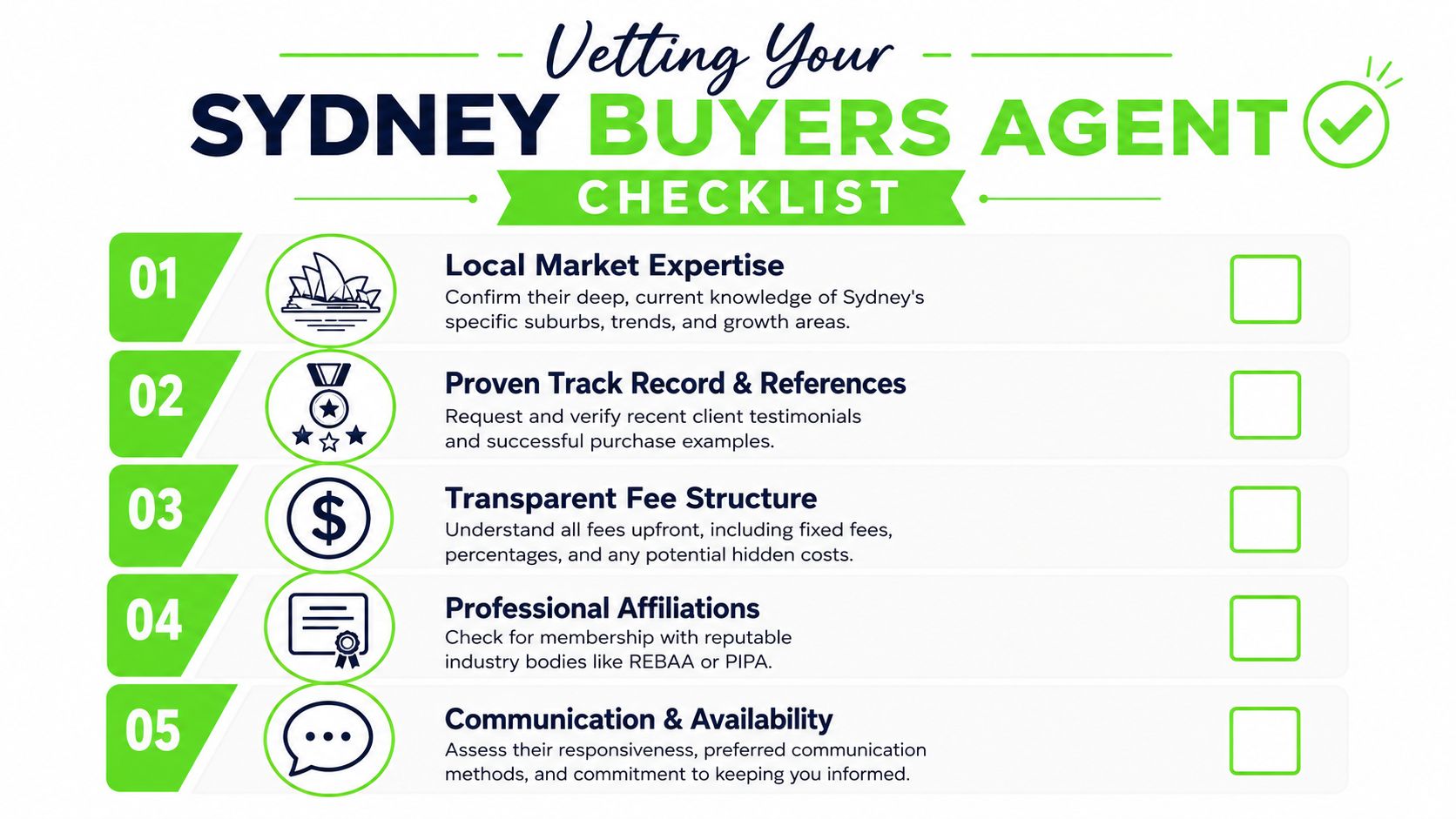
- Ask about recent suburb work. An agent should be able to discuss deals, buyer competition, and price tension in your target areas right now, not rely on old wins.
- Ask how they assess value. Good answers include comparable sales, street-level differences, renovation premiums, supply coming to market, and the buyer pool likely to compete on that type of property.
- Ask how current their pricing view is. In Sydney, a fast-moving pocket can shift quickly. If they are relying on stale comparables or broad median figures, that is a problem.
- Ask how they source off-market and pre-market opportunities. You want a clear process built on agent relationships, repeat contact, and buyer readiness. Vague claims about exclusive stock are not enough.
- Ask for an example of a property they advised a client not to buy. This is one of the best tests of discipline. A strong agent can explain the flaw, the pricing risk, or the resale issue without hesitation.
Then test the operating model.
Who will inspect properties? Who speaks to selling agents? Who gives the pricing advice? Who attends the auction? If a principal wins your trust on the call but the file is handed to someone less experienced, you need to know that before signing.
A practical screening framework like this guide on what to look for when finding a buyers agent in Sydney can help you compare firms on the same criteria.
Warning signs buyers should take seriously
Red flags usually appear early.
| Warning sign | Why it matters |
|---|---|
| They speak in broad suburb clichés | It suggests weak micro-market knowledge and little feel for street-by-street pricing |
| They cannot explain methodology clearly | You may be paying for confidence rather than process |
| They promise easy off-market wins | Good opportunities exist, but sourcing them is selective and relationship-driven |
| They avoid discussing properties they have rejected | Sound judgment includes saying no, often |
| They sound instantly available for everything | Capacity affects service quality. An overloaded agent becomes reactive |
Required check: if an agent cannot explain how they use current evidence to form a price view, you are being asked to trust instinct with your money.
The strongest agents are usually measured. They do not need to perform certainty. They show their reasoning, explain trade-offs, and stay consistent when a campaign gets noisy.
The final test is simple. After the first call, do you have a clearer decision framework than before? You should better understand where your budget works, where it breaks, and when professional representation is likely to pay for itself. If the conversation leaves you with only confidence and no method, keep looking.
Frequently Asked Questions About Sydney Buyers Agencies
Is a buyer's agent only worth it for expensive purchases?
No. The better question is whether the service changes the outcome enough to justify the fee. For some buyers with smaller budgets, full-service representation may not be the best fit, but negotiation-only or auction-only support can still be worthwhile. The fee has to be weighed against the risk of overpaying, choosing the wrong property, or missing better options because the search is too narrow.
Can't I just find everything myself on Domain and realestate.com.au?
You can find a lot there. You just can't assume that's the whole market or the whole job. Public portals are useful for search, but buying well also depends on filtering, valuation discipline, due diligence, and negotiation. If you're new to the process, it also helps to get fluent in the language around contracts, settlement, and investment metrics. A plain-English glossary like mastering real estate investing terms can help buyers make faster sense of the jargon.
How long does the process take with a buyer's agent?
There's no single timeline that fits every brief, and it would be misleading to pretend there is. The process depends on stock quality, suburb selection, budget realism, and whether you're open to off-market opportunities. Some buyers move quickly because their brief is tight and execution is decisive. Others need more time because they're balancing trade-offs or waiting for the right asset.
Is the fee tax-deductible for investors?
That's a tax question, not a marketing question. The correct answer depends on your structure, the nature of the expense, and current tax treatment. Speak to your accountant before assuming anything about deductibility. A good buyer's agent should be comfortable saying that tax advice belongs with your tax adviser.
What if the market is softer and competition is lower?
That can be when a buyer's agent becomes more selective rather than less useful. In easier conditions, access matters a bit less and judgment matters more. Buyers can have more room to negotiate, but they can also be tempted by stock that's cheap for good reason. In those periods, the value often comes from property selection and disciplined pricing, not just speed.
Is using a buyers agency in Sydney always the right move?
No. Some buyers are organised, experienced, and buying in an area they know very well. They may not need full representation. The smart approach is to match the service to the problem. If you need help with strategy, sourcing, and negotiation, full service may make sense. If you've found the property and only want bidding support, keep the scope narrower.
If you're weighing up whether professional representation makes sense for your search, We Are Buyers Agents is one Sydney-based option that works with homebuyers and investors on research, property search, negotiation, and purchase support.