
A buyers agent in Australia has moved from niche adviser to mainstream strategic partner. A 2023 PIPA survey found that 40% of Australians buying property considered using a buyer's agent, up from 10% a decade earlier, while industry reporting says the number of buyer's agents grew from about 500 in 2016 to more than 1,000 today, according to The Property Baron's reporting on the surge of buyers agents in Australia.
That shift matters because the modern buying problem isn't just finding listings. It's filtering risk, reading local planning settings, handling pressure in competitive campaigns, and deciding when a property is worth pursuing at all. In Sydney, Byron Bay, and other tightly held markets, a significant edge often comes from disciplined screening and negotiation, not from the fantasy that there's always a hidden perfect property no one else knows about.
Table of Contents
- What a Buyers Agent Does and Why They Are in Demand
- The Strategic Edge Gained with a Buyers Agent
- The Property Buying Journey with an Agent
- Understanding Buyers Agent Fees and Costs
- How to Choose the Right Buyers Agent for You
- Navigating Specific Markets Sydney and Byron Bay
- Is a Buyers Agent Worth It for Your Next Purchase
What a Buyers Agent Does and Why They Are in Demand
A buyers agent represents the purchaser only. That changes incentives, negotiation posture, and the quality of advice a buyer receives.
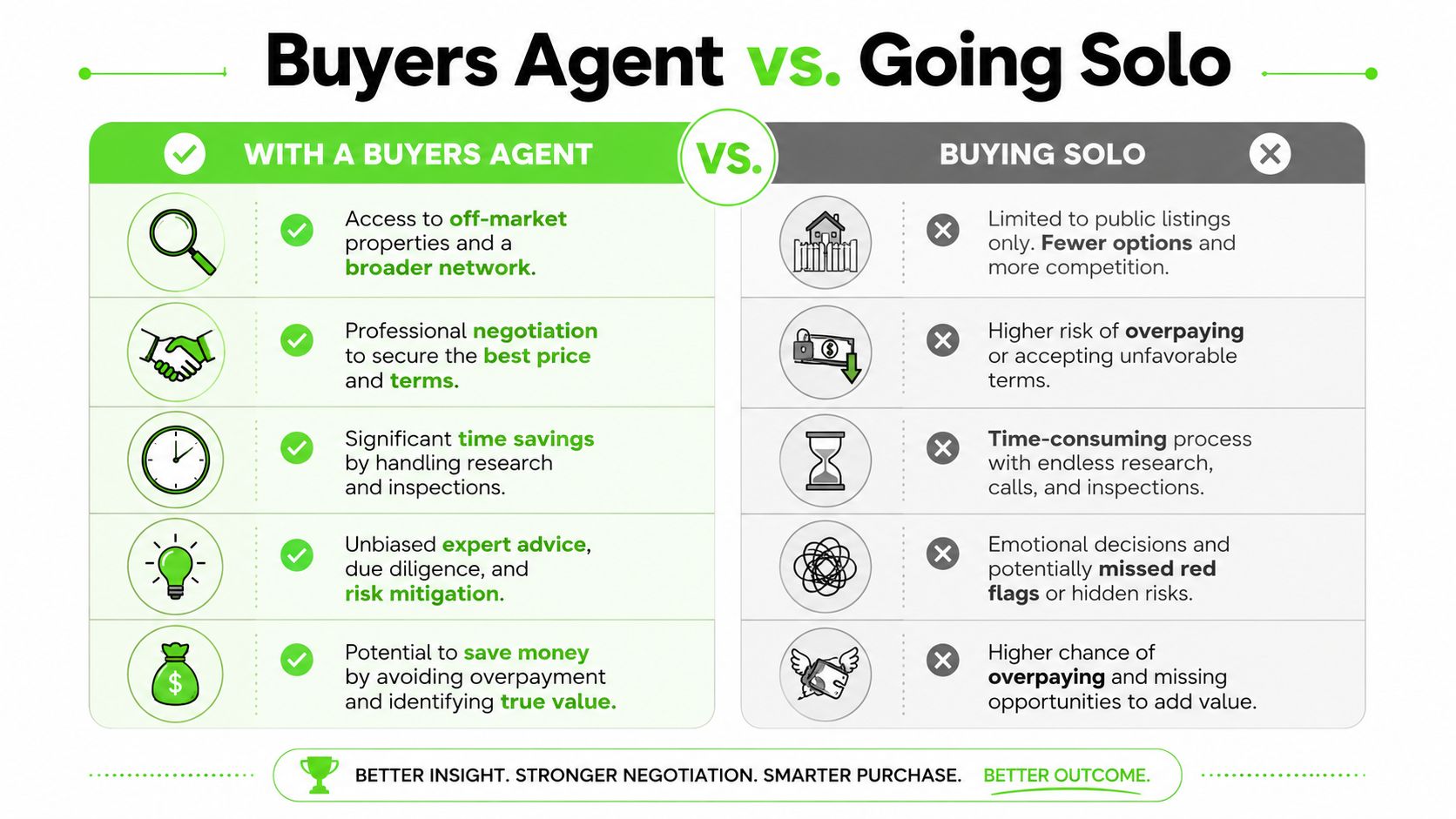
The selling agent is paid to protect the vendor's outcome on one asset. A buyers agent is engaged to assess options across the market, reject unsuitable stock, and secure a property that fits the client's brief, budget, and risk settings. For a clear breakdown of that distinction, this guide on buyers agent vs real estate agent differences is a useful reference.
Why demand has risen
Buyers have become more aware of the imbalance built into residential property transactions. In many deals, the best-informed professional in the conversation is working for the vendor, while the buyer is trying to make a high-value decision under time pressure.
Demand has also risen because the service is broader than many people assume. It is not limited to finding listings or opening doors. Discerning buyers want a second layer of commercial judgment before they commit capital, especially in markets where presentation can hide planning risk, flood exposure, poor strata records, or a weak resale profile.
That matters more in places like Sydney and Byron Bay, where mistakes are expensive and competition can push buyers into rushed decisions.
The core value of the service
Clients are paying for disciplined acquisition work.
A capable buyers agent will usually handle:
- Brief definition: turning a loose wish list into clear buying criteria, budget limits, and walk-away rules.
- Search and filtering: removing stock that looks acceptable online but fails on location, floor plan, zoning, condition, or long-term appeal.
- Due diligence: checking the asset, the street, the planning context, and the likely risks before emotion takes over.
- Price and terms assessment: working out what the property is worth to that buyer, under current conditions, with evidence behind the number.
- Negotiation and execution: managing agent dialogue, offer structure, contract timing, and bidding strategy where needed.
The overlooked issue is competence. Licensing standards and experience vary across Australia, and buyers often assume anyone using the title has the same training, process, and market judgment. They do not. In higher-stakes markets, I would treat licence checks, state-specific compliance, and recent transaction experience as part of due diligence on the adviser, not an administrative afterthought.
Practical rule: if an agent leads with off-market access but cannot explain how they screen out bad assets, test pricing, or assess local risk, keep looking.
Operational speed also plays a part in demand. Good agencies are expected to respond quickly, manage enquiries cleanly, and keep buyers informed while multiple properties are under review. Teams using tools like the LeadBlaze chatbot solution for real estate are trying to reduce response lag and qualify enquiries earlier, which helps on the service side. The investment value still comes from judgment, due diligence, and execution.
The Strategic Edge Gained with a Buyers Agent
The biggest advantage today is not secrecy. It's structure.
In a transparency-heavy market, most buyers can find listings. The harder task is deciding which properties deserve serious attention and which ones carry avoidable risk. That's where an experienced buyers agent creates value.
Better inputs lead to better property decisions
A technically robust workflow draws from multiple layers of information, not just listing portals and recent sales. The most useful inputs include listings, planning databases, flood-zone maps, demographic data, historical sales, and infrastructure updates. The result is context-aware risk and upside screening, not just a rough comparable-sales estimate, as outlined in this actuarial discussion of integrated property data analysis.
That changes the questions you ask.
Instead of “Is this cheap for the suburb?”, the better questions are:
- Planning risk: Is nearby zoning likely to change the character or supply profile?
- Hazard exposure: Does the site sit within a flood or other environmental constraint area?
- Demand quality: Are buyers and tenants drawn to the area for durable reasons such as amenity and liveability?
- Supply pressure: Are development applications pointing to future stock expansion that could cap performance?
Suburb selection is where many mistakes begin
A lot of poor purchases start with a lazy suburb thesis. Buyers hear a location is “hot” and then force a deal inside it.
That's backwards. Strong buyers agents build a cross-checked suburb selection model using sold-price data, census demographics, rental-demand indicators, planning portals, development applications, and demand-to-supply ratios. That process helps identify growth potential while avoiding false positives created by short-term hype, as described in this industry guide to buyers agent research tools.
Good acquisition work starts before the property search. If the location thesis is weak, the shortlist will be weak too.
The edge is often negative selection
Clients sometimes expect the value to appear in the property they buy. Often it appears in the properties they don't.
For investors, that can mean passing on an apparently attractive dwelling because future stock expansion could dilute scarcity. For owner-occupiers, it can mean rejecting a polished home on a busy road because resale depth looks thinner than the campaign suggests. For both, it can mean stepping back from a property where the numbers seem acceptable but the planning and hazard profile don't.
A buyer doesn't need an agent to be enthusiastic. A buyer needs someone who can say no for the right reasons.
Negotiation still matters, but not in the old simplistic way
The old promise was “we'll find an off-market deal and save you money.” Sometimes access helps. But in tight markets with many practitioners chasing limited stock, relying on that promise alone is thin.
The durable edge usually comes from:
| Advantage | What it looks like in practice |
|---|---|
| Calmer bidding | Holding to a ceiling and refusing to let auction theatre rewrite the brief |
| Faster filtering | Deciding quickly which listings deserve full due diligence |
| Sharper offer structure | Using terms, timing, and clean communication to improve position |
| Risk control | Avoiding assets with hidden legal, planning, or physical issues |
That's why an expert buyers agent Australia service is less about glamour and more about disciplined selection. Over time, that's what protects capital and improves outcomes.
The Property Buying Journey with an Agent
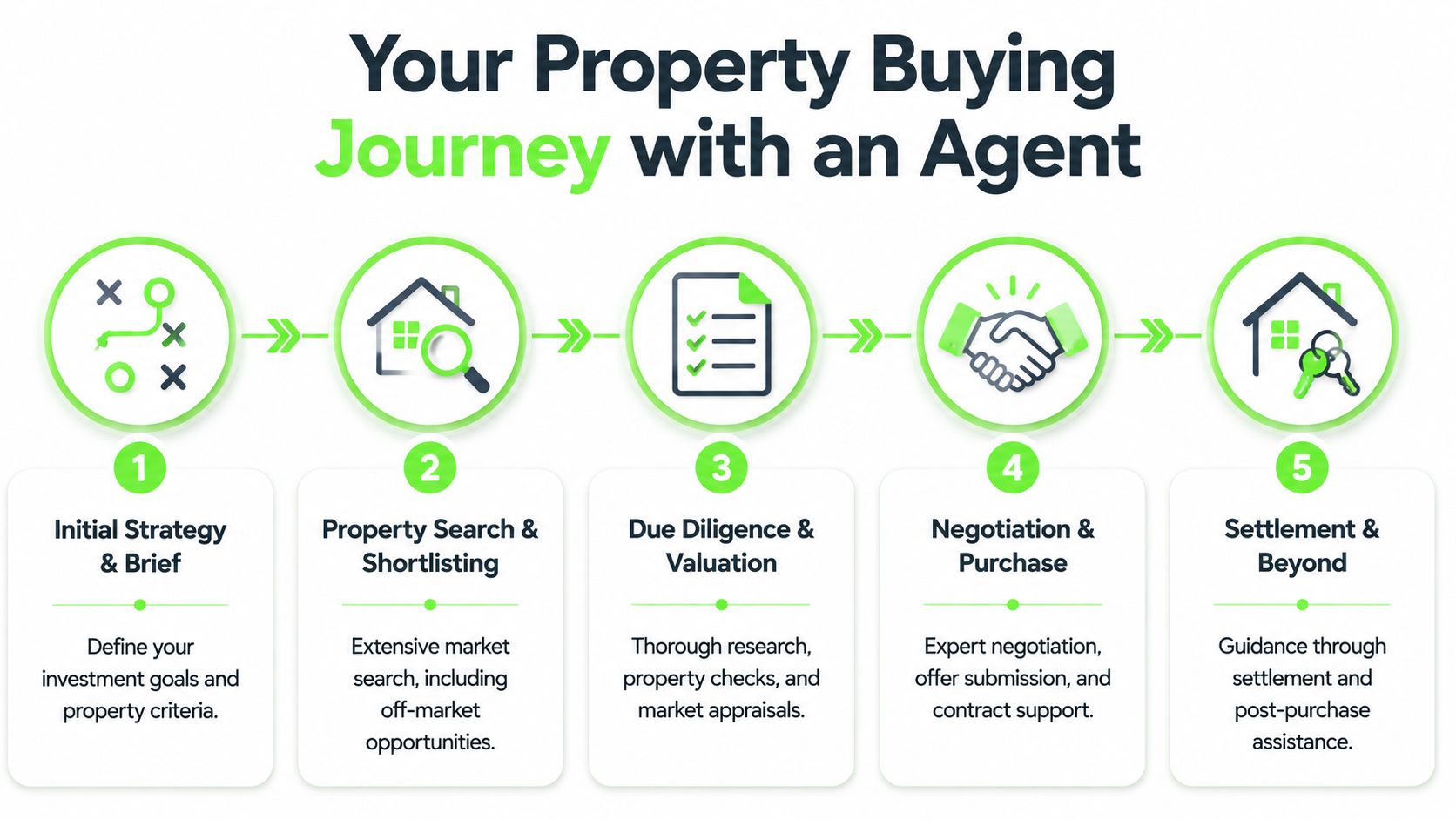
A good process should feel methodical, not mysterious. Clients shouldn't wonder what happens between signing an engagement and receiving keys.
Set the Brief Before Looking at Property
The first job is to define the mandate clearly. That means price range, preferred locations, essential requirements, acceptable compromises, ownership structure, and the purpose of the purchase.
This stage matters because many buyers arrive with a wishlist, not a strategy. An investor might think they want a certain suburb when what they need is a different supply-demand profile. A homebuyer may think they need a detached house and later realise the smarter move is a well-positioned townhouse with stronger liveability and resale depth.
Search Broadly and Cull Hard
Once the brief is set, the search begins. The key isn't seeing more property. It's eliminating the wrong property faster.
A strong search phase usually includes:
- Live market monitoring: watching new listings, agent networks, and campaign changes.
- Shortlist discipline: only advancing properties that fit the brief and pass initial screening.
- Early pricing sense-checks: deciding whether the guide looks realistic or deliberately aspirational.
- Inspection triage: prioritising the stock worth deeper investigation.
Clients should expect regular communication here, but not noise. Ten weak options don't equal progress.
Investigate the Asset, Not Just the Photos
Once a property moves into contention, the work deepens. At this stage, inexperienced buyers often rush.
Due diligence can include contract review with the solicitor or conveyancer, sales evidence analysis, planning checks, local context review, and coordination of building or specialist reports where needed. The right depth depends on the property type and market.
A clean kitchen and strong staging tell you almost nothing about legal risk, planning constraints, or long-term resale position.
At this point, the buyer's involvement should be focused. You're not meant to manage every moving part yourself. You're meant to make informed decisions at the right moments.
Negotiate With Structure, Then Manage the Run to Settlement
When the right property is identified, execution becomes the priority. Some acquisitions suit a private treaty offer. Others require auction bidding or pre-auction positioning.
The negotiation phase commonly involves:
- Offer strategy: deciding the opening position, terms, and timing.
- Agent communication: controlling information flow with the selling side.
- Auction representation: bidding to a pre-set ceiling if the campaign goes under the hammer.
- Contract coordination: keeping legal and finance work aligned to the transaction timetable.
After exchange, good service doesn't disappear. There's usually a run of practical steps before settlement, including check-ins with legal advisers, finance milestones, and pre-settlement inspection arrangements.
The handover should feel orderly because the project has been managed properly from day one.
Understanding Buyers Agent Fees and Costs
Fees matter, but the wrong question is “What's the cheapest quote?” The better question is “What am I paying this person to prevent?”
In property, one weak purchase can cost more than the professional fee you were trying to save. That doesn't mean every quote is justified. It means the fee discussion has to be tied to process, independence, and capability.
The Two Main Fee Models
Most buyers agent fee structures fall into two broad categories: fixed fee and percentage-based fee. Both can be legitimate. Both can be poor value if the service behind them is vague.
| Fee Model | Typical Cost Range (2026) | Best For |
|---|---|---|
| Fixed fee | Qualitative only. Usually presented as a set project fee agreed upfront. | Buyers who want pricing clarity from the start |
| Percentage of purchase price | Qualitative only. Usually calculated as a share of the final acquisition price. | Buyers comfortable aligning fee size with transaction value |
A fixed fee can work well when the scope is clear and the client wants certainty. A percentage model can make sense when the search complexity and purchase range vary, but it also creates a reasonable question: does the adviser have any incentive to stretch the budget?
That's why the fee conversation should include more than the headline number.
For a market-specific breakdown, this guide on what buyers agent fees in Sydney are really paying for is worth reviewing before you compare proposals.
What Good Fee Discussions Actually Sound Like
A competent buyers agent should explain:
- What the engagement covers: full search, appraisal, negotiation, auction bidding, or a narrower service.
- When fees are payable: whether there's an initial engagement amount, milestone payments, or success-based timing.
- What is excluded: legal fees, inspections, strata reports, and other third-party costs.
- How the search is managed if the brief changes: especially if you pivot suburbs, asset type, or budget.
If an agent can explain their process clearly, they can usually explain their fee clearly too.
A weak fee conversation tends to rely on broad promises. A strong one ties cost to concrete work: sourcing, screening, due diligence, negotiation, and project management. That's the level of clarity discerning buyers should expect.
How to Choose the Right Buyers Agent for You
The biggest mistake buyers make is assuming all buyer representation is roughly equal. It isn't.
That matters more now because rapid industry growth has brought more variance in competence. In 2025, ABC reported that REBAA warned inexperienced buyer's agents were creating headaches for customers, linking that growth to licensing loopholes and mutual-recognition arrangements that can allow agents to operate across states without deep local legal knowledge, as covered in ABC's report on concerns over underqualified buyers agents.
Verify the Basics First
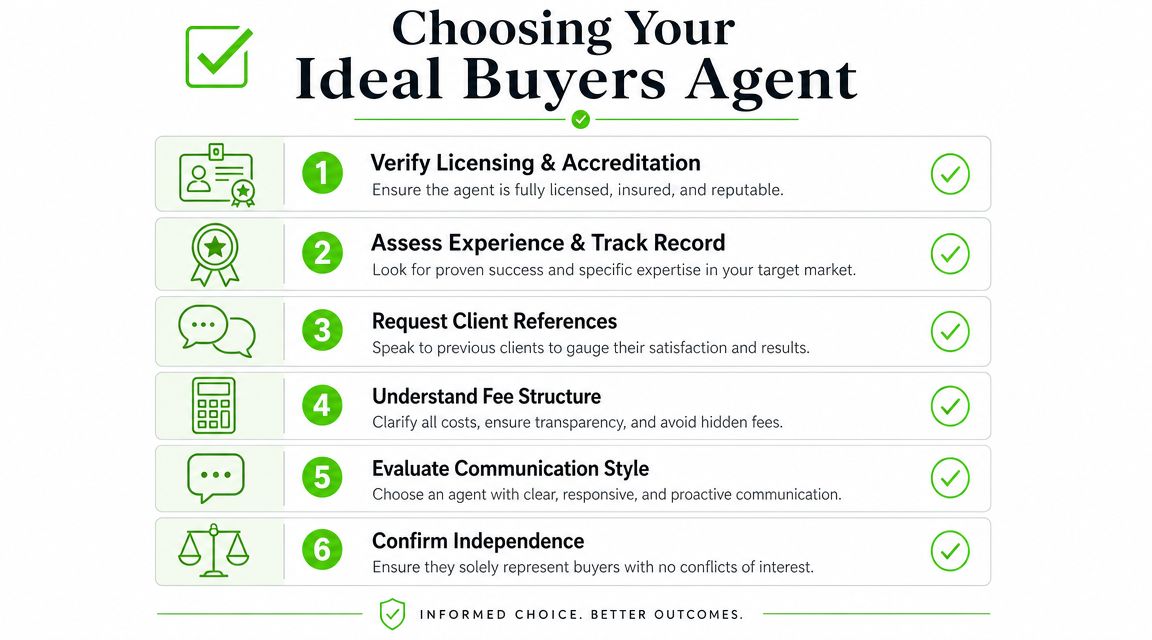
Start with the essentials. Before you ask about suburb views or negotiation style, confirm they can legally and competently do the work.
Check for:
- Relevant licensing: the agent should hold the licence required for the state in which they operate.
- Insurance: ask whether they carry professional indemnity cover.
- Buyer-only representation: confirm they don't take developer incentives or operate with conflicts that dilute independence.
- Local competence: ask how often they transact in your target area and what local contract or planning issues commonly arise there.
Presentation can mislead here. Many agents look polished online. Marketing materials, strong branding, and even Elevate real estate agent headshots can make anyone appear established, so don't confuse visual polish with acquisition skill.
Here's a useful discussion point before hiring anyone:
Ask Questions That Expose Process
Most interviews are too soft. Buyers ask how long the agent has been in business, then stop there.
Ask better questions:
- How do you decide a suburb is worth targeting? Look for an answer grounded in evidence, not general sentiment.
- What would make you reject a property that looks attractive on first inspection? This reveals their risk filters.
- How do you assess fair value in a fast campaign? You want a method, not instinct dressed up as expertise.
- How do you handle auctions versus private treaty? The tactics should differ.
- Who do you typically work with on the client side? Solicitors, conveyancers, building inspectors, and brokers all affect execution.
- Can you explain a recent situation where you advised a client not to buy? This is one of the strongest tests of independence.
The right agent doesn't just find property. They narrow uncertainty.
Watch for the Wrong Signals
Several red flags show up early if you know where to look.
| Red flag | Why it matters |
|---|---|
| They promise easy off-market wins | It suggests salesmanship is doing more work than analysis |
| They're vague on licensing or local rules | That's a direct risk in state-based property systems |
| They avoid discussing failed deals | Good agents walk away from unsuitable property |
| They talk more about volume than fit | Your brief can get lost in a production-line model |
| They pressure fast commitment | Urgency often hides a thin process |
A capable buyers agent Australia adviser should make you feel informed, not rushed. Confidence is useful. Pressure isn't.
Navigating Specific Markets Sydney and Byron Bay
General buying principles only get you so far. Sydney and Byron Bay both demand local judgment, but for different reasons.

Sydney Requires Auction Discipline and Fast Assessment
Sydney is often unforgiving to hesitant buyers. Campaigns move quickly, pricing guides can be tactical, and auctions punish people who haven't settled their ceiling before bidding starts.
A typical Sydney scenario looks like this: a buyer sees strong competition at the first open, assumes they need to stretch, and starts rewriting their criteria in real time. That's how budgets drift and compromises compound.
An effective agent in this market usually helps by:
- Testing the guide early: checking whether the quoted range aligns with comparable evidence.
- Assessing pre-auction options: deciding whether an early offer is sensible or just exposes the buyer.
- Running a bidding plan: setting the ceiling, increments, and walk-away point before auction day.
- Coordinating local specialists: using trusted legal and inspection support fast enough to match campaign speed.
For buyers focused on investment rather than owner-occupation, a local rental market analysis for property decisions adds another layer of discipline. Purchase logic should connect to tenant demand and holding risk, not just recent sale prices.
Byron Bay Demands Lifestyle Judgment and Harder Due Diligence
Byron Bay and the broader Northern Rivers present a different problem. Buyers are often drawn in by lifestyle first, then try to justify the asset second.
That's understandable, but it's dangerous. In lifestyle-heavy markets, emotion can easily overpower scrutiny. Buyers may overlook council issues, building irregularities, access constraints, or a mismatch between presentation and long-term utility.
Consider a common Byron-style case. A buyer falls for a character home with strong visual appeal and broad buyer interest. A disciplined review then raises practical questions about improvements, approvals, surrounding use, and the actual resale audience. The purchase may still proceed, but only after the romance has been tested against evidence.
In lifestyle markets, the nicest property to visit is not always the safest property to own.
The best local agents know when scarcity is genuine and when a campaign is feeding on aspirational demand. That distinction is where a lot of money gets saved.
Is a Buyers Agent Worth It for Your Next Purchase
For some buyers, no. If you have deep market knowledge, time to inspect broadly, strong negotiation control, and the patience to run your own due diligence properly, you may not need representation.
For many others, the answer is yes. A buyers agent earns their place when the purchase is high stakes, the market moves quickly, or the buyer can't afford a poor decision. That applies especially to time-poor professionals, interstate investors, and buyers entering competitive or unfamiliar locations.
The strongest reason to engage one isn't convenience. It's risk management paired with better decision quality. A capable agent helps define the brief properly, reject weak property early, assess local issues that don't appear in glossy marketing, and negotiate without emotional drift.
That's also why choosing the right adviser matters as much as choosing the right property. The service only works if the agent is licensed, locally competent, independent, and disciplined in how they assess opportunities. Without that, you're just outsourcing the search, not improving the decision.
If you're weighing up your next move in Sydney, Byron Bay, or another Australian market, start with a proper strategic conversation. Clarify the brief, the risks, and the acquisition criteria before the next open home pulls you into someone else's campaign.
If you want a practical discussion about your next purchase, We Are Buyers Agents offers licensed buyer representation for homebuyers and investors in Australia, with a focus on researching, negotiating, and securing property in markets including Sydney and Byron Bay.