
You've found a property that looks right on paper. The photos are polished, the agent says demand is strong, and you're already picturing the next step. Then the doubt creeps in. Is the block exactly what it seems? Are the outgoings manageable? Is there something in the official record that the marketing glosses over?
That's where property search tax records become useful. Not exciting. Useful. They won't tell you everything, and they won't replace a title search, legal review, or building inspection. But they do give buyers something rare in a property campaign: information that wasn't written to sell you the home.
In practice, I treat tax and rating records as a grounding document. They help test the story around a property. They can reveal whether the property identifiers line up, whether the land details make sense, whether the holding costs are likely to fit your budget, and whether further digging is needed before you make an offer. For Australian buyers, that's often the difference between informed confidence and expensive assumptions.
Navigating Official Property Tax and Rating Records
- Beyond the Brochure Why Property Tax Records Matter
- Where to Find Property Tax Records in Australia
- Decoding the Data What Key Fields Mean for You
- Using Tax Records for Smarter Due Diligence
- Red Flags and Warning Signs for Buyers and Investors
- Conclusion Your Property Tax Record Checklist
Beyond the Brochure Why Property Tax Records Matter
A sales campaign is built to create momentum. Tax records are built to administer land, assessments, and local charges. That difference matters.
When buyers rely only on the brochure, they tend to absorb the property as a lifestyle product. Big kitchen. Quiet street. Development upside. Strong rental appeal. Those may all be true. But none of them should be accepted until the underlying records support the basics.
What the official record does better
Property search tax records are useful because they strip away presentation. They help you check the property's formal description, land-related identifiers, valuation context, and rates position. If something doesn't line up there, it usually means one of two things: the listing is incomplete, or your due diligence needs to go deeper.
A simple example is the property that's marketed as ideal for renovation or extension. If the official material points to constraints, odd land dimensions, or a record that doesn't match the improvements shown in marketing, your project may be more complicated than it first appeared.
Practical rule: If the sales wording sounds broad and optimistic, the record should become more important, not less.
Why buyers miss the value
Many buyers treat these searches as admin. They pull a rates notice, glance at the amount due, and move on. That misses the true value.
The better use is comparative. Check the record against the contract, the agent's description, the floor plan, the survey if available, and what you can physically observe. The tension between those sources is where useful questions appear.
A tax record also helps with negotiation discipline. If the numbers around land value, outgoings, or assessed use don't support the asking narrative, you can negotiate from a firmer position. Not because the record gives you a magic answer, but because it helps you stop paying for assumptions.
What it won't do
There's an important limit here. Official assessor-style portals are primarily for tax assessment, not market estimates, and they don't give a complete ownership history or full title picture. Los Angeles County's public assessor portal makes that distinction explicitly in its assessment portal guidance. The same caution applies in Australia. A tax or rating record can support due diligence, but it can't replace title, conveyancing, or legal checks.
Where to Find Property Tax Records in Australia
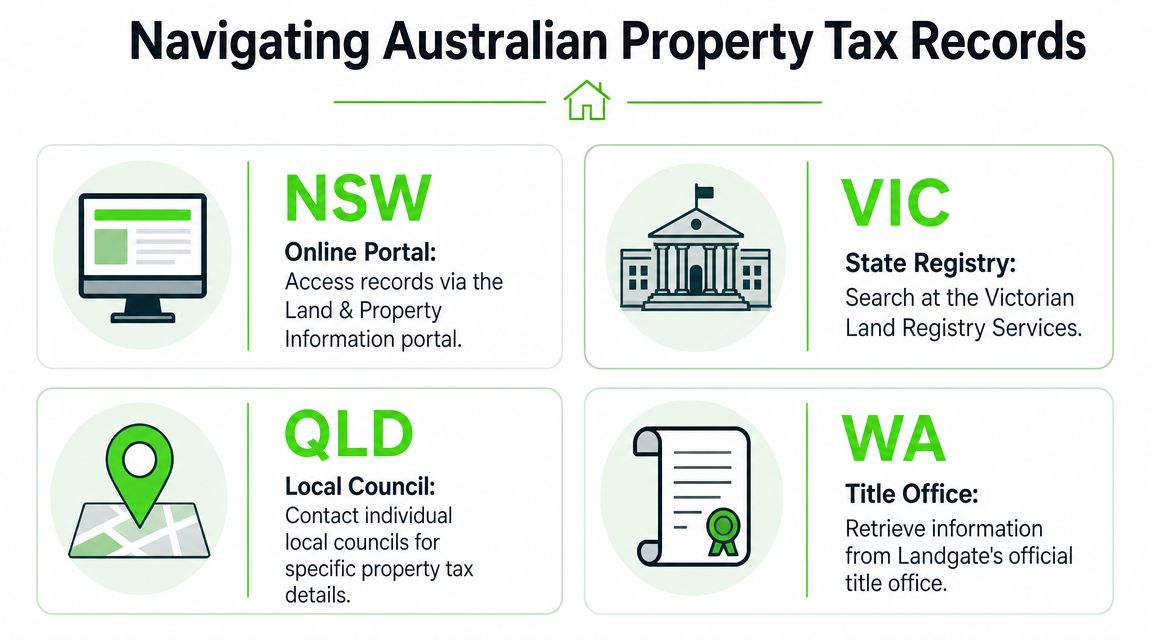
Australian buyers often assume there's one central search for everything. There isn't. You usually need a mix of state land registry data, local council rates information, valuation references, and sometimes paid property platforms to get a workable picture.
Start with the right identifier
The first mistake buyers make is searching only by street address. Addresses are useful, but formal property systems are built around parcel or title identifiers.
In Los Angeles County, the assessor uses a unique 10-digit Assessor's Parcel Number and allows public search by APN or street address through the county portal. The APN is the core index connecting valuation, parcel details, and tax assessment data across the system, as outlined by the Los Angeles County property appraiser reference. The Australian equivalent is the same idea in local form: title references, lot and plan numbers, and similar parcel identifiers.
If you can get the lot and plan details early, your search gets cleaner fast. You reduce the chance of pulling the wrong record, especially for battle-axe blocks, subdivided sites, units in larger complexes, or properties with awkward addressing.
A practical state-by-state path
Here's the method I'd use in practice.
| State or territory | First stop | What you're usually looking for |
|---|---|---|
| NSW | NSW land registry and local council records | Title reference, lot and plan, council rates details, land value context |
| VIC | Victorian land registry and council records | Title details, site and capital value references, municipal charges |
| QLD | Titles registry and local council searches | Lot on plan, rates position, property and planning overlays |
| WA | Landgate and local government records | Title and parcel detail, rates, land-related restrictions |
| SA, TAS, ACT, NT | State land titles office plus local council | Title identifiers, rating details, land data, planning overlays |
That table is intentionally broad because the exact path varies by property type and local authority. A freestanding house is usually easier than a mixed-use asset or a rural parcel. Strata lots can also require an extra layer of checking because the unit entitlement and common property context matter.
Free portals versus paid data tools
Free sources are useful for initial screening. They're rarely enough for a serious acquisition decision.
Use free access points when you want to confirm:
- Basic identification: the correct address, parcel reference, or lot and plan
- Local charges: the rates position or rating authority details
- Planning clues: zoning references, overlays, and local map layers
- Surface consistency: whether the public-facing details broadly match the campaign
Paid tools become useful when speed and aggregation matter. CoreLogic, Pricefinder, registry search products, and professional search services can consolidate title, sales history, maps, and valuation context into one workflow. That doesn't make them more authoritative than government records. It makes them faster to work with.
For buyers who don't want to stitch those layers together themselves, a service such as full property search support can sit alongside your solicitor and broker as part of the acquisition process.
Don't pay for depth before you've confirmed identity. A paid report on the wrong parcel is still the wrong report.
Decoding the Data What Key Fields Mean for You
A buyer reviews a rates notice, sees an official value, and assumes they've found a pricing anchor. That mistake can cost real money. Tax records are useful, but only if you read them for what they are: an administrative record that helps you verify risk, ownership detail, and holding costs.
Assessed value is not market value
As noted earlier, assessor and rating records exist for tax purposes, not to tell you what to pay. In Australia, that means council, statutory, or site values can help frame rates, land tax exposure, and sometimes the split between land and improvements. They do not replace market evidence, recent comparable sales, or a proper appraisal.
That distinction matters most in competitive conditions. I've seen buyers talk themselves into overpaying because the asking price looked close to an official figure, and I've seen others dismiss a sound purchase because the statutory value sat well below market. Both were reading the wrong number for the wrong job.
If you want a simple primer on how assessed figures relate to tax charges, county property tax rate explained gives useful context. It is US-focused, but the core lesson still holds. Tax records are designed to support revenue collection, not acquisition strategy.
The fields that deserve real attention
The best use of a tax record is not valuation. It is verification.
These are the fields I check first because they affect whether the property suits the brief and whether the rest of the due diligence is built on the right parcel:
- Property identifier: lot and plan, title reference, parcel number. If this does not match the contract, listing, or council mapping, stop and reconcile it first.
- Land value or site value: helps assess how much of the asset's worth sits in the land. That matters for scarcity, redevelopment logic, and land-tax planning.
- Improved value or capital improved value: useful as a rough signal of how the record attributes value between site and dwelling. It can also prompt questions about whether the improvements shown align with what is standing on the block.
- Zoning and overlays references: these shape what you can do next. Extensions, secondary dwellings, demolition, subdivision, tree removal, parking changes, and even simple renovations can all be affected.
- Rates and charge references: a practical input for cash flow. Owner-occupiers often overlook this. Investors should not.
- Description of improvements: worth checking against the marketing campaign, approvals trail, and what you physically inspect.
Different buyers should weight these fields differently. Investors usually care more about land content, holding costs, and use constraints. Owner-occupiers often focus on layout and presentation, then get caught later by overlay controls or a mismatch between the approved dwelling and the advertised one.
That is one reason a buyer's agent does more than collect records. The work is in the interpretation. A detailed Byron Bay buyers agency approach to off-market opportunities, due diligence and smarter negotiation shows how this kind of record-checking fits into a broader acquisition process.
What to compare before you rely on the record
A tax record is one reference point. It becomes useful when you compare it against the other documents that carry legal, planning, and physical detail.
Check it against:
- The contract details
- The agent's floor plan and advertisement
- Council planning maps
- Any building or pest findings
- Your intended use of the property
The practical question is always the same. Does everything point to the same asset, with the same boundaries, improvements, and constraints?
A heritage overlay found early can change the numbers on a renovation. A rates reference that does not align with the contract can signal an identity issue. An improvement description that falls short of the marketing can justify more questions before you spend money on reports and legal work.
Catching a mismatch in the record before exchange is cheaper than discovering it after settlement.
A short explainer can help if you want to see the broader mindset in action:
Using Tax Records for Smarter Due Diligence
The value of property search tax records becomes apparent when you use them to challenge assumptions. That's the shift from passive reading to active due diligence.
Use the record to test the sales pitch
If an agent says the property has broad appeal for extension, dual occupancy, or future upside, start by checking whether the formal land details and rating context support that story. Then compare the property description in the official record with what's physically there.

I also compare the rates notice and land identifiers against the contract package. If those don't reconcile cleanly, I slow down. Deals rarely improve when basic records are messy.
A few practical uses stand out:
- Check improvements: If the marketing shows an extra room, studio, or enclosed area, look for signs that the record and approvals trail may need checking.
- Review outgoings early: Rates and associated charges affect serviceability and cash flow. Buyers often leave this too late.
- Watch land assumptions: A large advertised block still needs to be confirmed by the legal and parcel documents, not just the listing copy.
Older properties need a wider search
Historical property work often breaks the simple search model. In Los Angeles County, recorded documents from September 2009 onward are indexed by the 10-digit AIN/APN, while documents recorded between 1977 and August 2009 require alphabetical searching in the older index, according to county-referenced guidance discussed in this historical indexing overview. The practical lesson for Australian buyers is straightforward: older properties often need different search methods, including manual or historical title work.
That matters for period homes, rural holdings, long-held family properties, and sites with prior subdivisions or easements. The newer digital file may be tidy, while the older story sits elsewhere.
For readers trying to understand deed transfers and why ownership-related paperwork can differ from tax and assessment records, this guide to filing a quitclaim deed in 2026 is a useful background read. It's not an Australian process guide, but it helps clarify why deed records and tax records solve different problems.
Build a working due diligence file
The buyers who stay composed under pressure usually work from a checklist and a file, not memory.
A practical file should include:
- Identity documents: title reference, lot and plan, contract details
- Financial documents: current rates notice, levies if strata applies, expected holding costs
- Planning layer: zoning, overlays, local restrictions
- History layer: prior transfers, older title references where relevant
- Risk notes: anything that needs solicitor, valuer, or council clarification
If the property is in a tightly held market and time is short, that file lets you move fast without becoming careless. That's often where a local acquisition specialist helps, particularly in regional or lifestyle markets where due diligence can be less standardised, such as Byron Bay buyers agency support for off-market opportunities and due diligence.
Red Flags and Warning Signs for Buyers and Investors
Some issues in a tax record are minor. Others are the early sign of a problem that gets expensive after settlement. Buyers need to know the difference.
Mismatched records are never a small issue
If the address, lot and plan, land description, or assessment references don't align across your documents, stop and reconcile them before doing anything else. A mismatch can be clerical. It can also point to a subdivision issue, a boundary question, or a simple case of someone relying on the wrong property file.
I'm also cautious when the marketing description and the official property description feel materially different. An extra improvement, a use that isn't clearly supported, or inconsistent land references all deserve proper checking.
Buyers lose leverage when they discover these issues after they've already committed emotionally.
Cost warnings that hit after settlement
A lot of buyers focus on purchase price and overlook the running position. Tax and rates records help expose that.
Look hard at:
- Rising local charges: not because a rise automatically kills the deal, but because it changes your holding-cost reality
- Exemptions or concessions: some current settings may not transfer to you
- Classification issues: if the property use or rating category is unusual, get advice before exchange
- Strata and local authority overlap: units can carry cost layers that don't show up in a single line item
The bad outcome here isn't drama. It's slow budget erosion. The property still settles, but it performs worse than expected because the carrying cost was never modelled accurately.
Restrictions that can kill the upside
The harshest surprises usually sit in the restriction layer, not the headline numbers.
Watch for:
- Easements: sewer, drainage, access, and service easements can affect extension plans, pool placement, and even landscaping.
- Covenants and encumbrances: these can limit use, design, building envelope, or subdivision options.
- Overlay conflicts: planning controls may reduce the value of a renovation concept the buyer assumed was straightforward.
- Record gaps: if the official trail feels incomplete, especially on an older property, expect more work before confidence is justified.
The key point is simple. A property can be attractive, well located, and still be the wrong buy if the record limits your intended use.
Conclusion Your Property Tax Record Checklist
Property search tax records won't make the decision for you. They will make your decision cleaner.
That matters because buying mistakes often start with confidence unsupported by documents. The polished campaign creates urgency. The record forces verification. Used properly, it helps you confirm identity, understand costs, test development assumptions, and spot when the property needs deeper legal or planning review.
Buyers who handle this well usually do three things. They search using the correct parcel or title identifier. They read the valuation and rates material with caution rather than treating it as market truth. And they compare every official data point against the contract, the listing, and their intended use.
Your working checklist
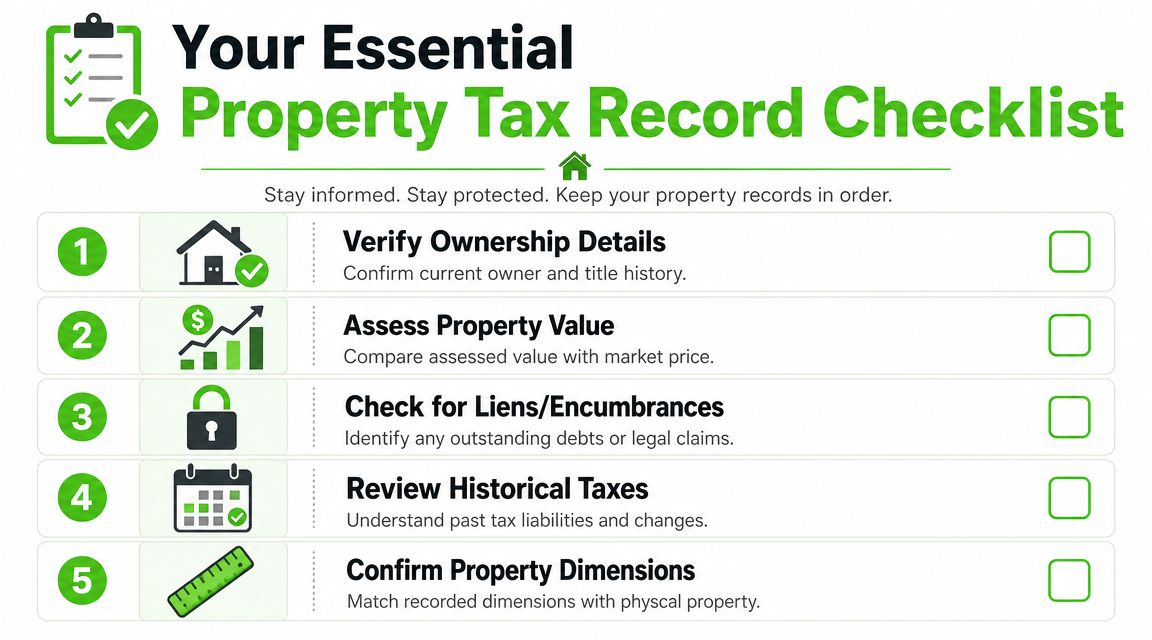
Take this list into your next search:
- Confirm the identifier: match the address to the correct lot and plan or title reference.
- Check the latest rates and charges: understand the holding cost before you negotiate.
- Read assessed values carefully: use them for context, not as a substitute for market value.
- Compare the record to the campaign: watch for missing approvals, inconsistent descriptions, or overstated potential.
- Review zoning, overlays, easements, and covenants: these shape what you can do with the property.
- Treat older properties differently: expect extra historical searching where the modern digital trail is incomplete.
- Escalate gaps early: involve your solicitor, conveyancer, valuer, or planner before exchange, not after.
- Keep a single due diligence file: one place for title references, rates, planning notes, and risk items.
If you're buying your first investment or next home, a broader acquisition checklist helps tie those pieces together. This Australian first investment property checklist is a sensible companion to the records work above.
If you want help assessing a property before you commit, We Are Buyers Agents works with home buyers and investors in Australia to support search, due diligence, and acquisition decisions with a clear, document-led process.