
At roughly 0.62 km² with a 2021 census population of 7,183, Potts Point is one of the smallest and most tightly held residential markets near the Sydney CBD. Size matters here because small geographic footprints tend to magnify the effect of building quality, street-level amenity, and planning limits on price performance.
Most coverage of Potts Point stops at lifestyle. Cafes, late trading, walkability, and harbour access are real drawcards, but they are not the main reason values can diverge sharply between apartments only a few blocks apart. Buyers who read this suburb well usually focus on constraints first: heritage controls, limited redevelopment pathways, older strata schemes, and the fact that a large share of stock sits in buildings that cannot be materially altered without cost, delay, or both.
That combination gives Potts Point an investment profile that is more complicated than the usual inner-city shorthand suggests.
The upside is structural scarcity. New supply is limited, many buildings carry architectural significance, and the suburb has a built form that would be difficult to reproduce under current planning settings. The trade-off is practical. A lively village atmosphere can come with noise, compromised parking, smaller floorplans, higher strata exposure in older blocks, and inspection outcomes that vary far more than suburb medians imply. For owner-occupiers and investors alike, Potts Point rewards selective buying, not broad-brush suburb optimism.
Guide to This Potts Point Property Report
- Potts Point A Unique Inner-City Micro-Market
- The Two Faces of Potts Point Past and Present
- Decoding the Potts Point Property Market
- Lifestyle Allure and Livability Trade-offs
- Planning Development and Future Trajectory
- Investment Analysis A Buyer's Framework
- Practical Playbook for Buying in Potts Point
Potts Point A Unique Inner-City Micro-Market
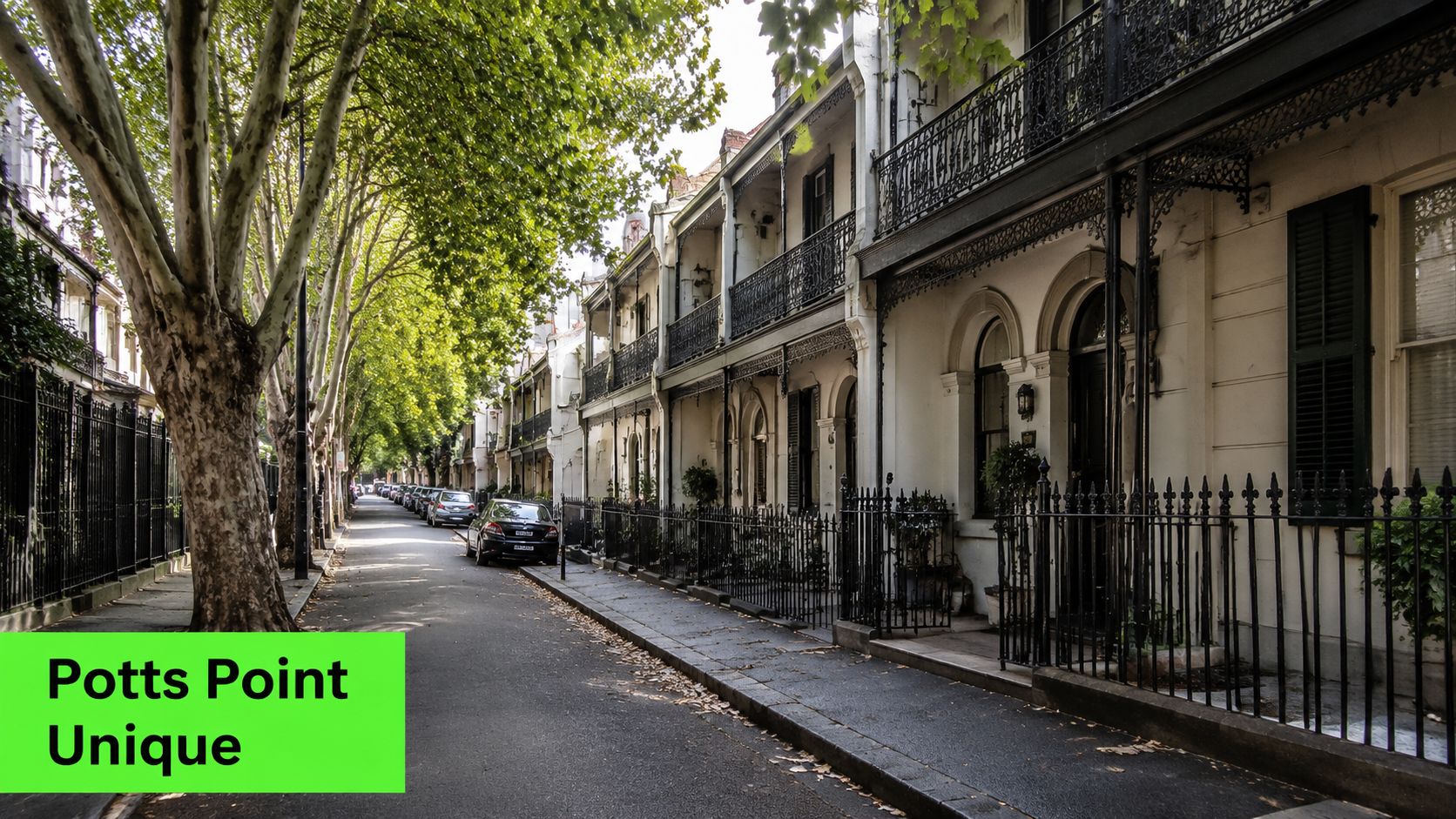
Potts Point is best understood as a micro-market, not a suburb in the usual Sydney sense. The Potts Point Preservation Group describes the Potts Point and Elizabeth Bay enclave as only about 1 sq km, with 98% of residents living in apartments and a long-standing low-rise historic profile in its local character overview. That combination is unusual. It creates a market where apartment stock dominates, but not in the glass-tower way many investors expect.
Why standard suburb logic breaks down
In outer or middle-ring Sydney, buyers often ask the same questions. How much land is left. What new supply is coming. How quickly can density increase. Potts Point doesn't fit that script.
Its scarcity is structural. The footprint is tight. The built form is already intense. Much of the appeal sits in older, character-rich buildings that can't be replicated easily. That means your real competition isn't just from nearby listings. It's from the fact that buyers who want a particular kind of Art Deco one-bed, a specific terrace conversion, or a quiet rear apartment in a low-rise block have very few substitutes.
Practical rule: In Potts Point, the asset class is often the building before it's the unit.
That's why broad “units in Sydney” thinking tends to mislead. Two apartments with similar internal area can trade very differently in buyer appeal because the building fabric, common areas, window quality, renovation controls, and street energy are completely different.
What scarcity looks like on the ground
Scarcity here isn't only about limited land. It's also about limited interchangeable stock.
A buyer looking for:
- Classic Art Deco character won't see a modern infill building as a substitute.
- Quiet owner-occupier streets won't treat a Kings Cross-adjacent address as equivalent.
- Value-add potential may find that heritage and strata rules sharply limit what “value-add” entails.
Potts Point Sydney Australia rewards buyers who can separate cosmetic charm from durable scarcity. Some buildings have scarcity because they're architecturally distinctive and tightly held. Others merely look atmospheric in photos.
The critical distinction is this. In many apartment suburbs, new supply can dilute the premium on older stock. In Potts Point, older stock is often the premium, provided the building has been maintained and the strata hasn't deferred too much capital work.
The Two Faces of Potts Point Past and Present
From Woolloomooloo Hill to apartment suburb
Potts Point's current property DNA makes more sense once you understand how early its layers formed. It was originally known as Woolloomooloo Hill and became fashionable in the early 1800s, when wealthy merchants and politicians built homes there, as outlined in Laing+Simmons' historical summary. Later, from the 1920s through World War II, the area saw major apartment construction well before apartment living became standard across Australia.
That early shift matters. Potts Point didn't become dense because of a recent rezoning wave. It became dense because it had already adopted apartment living generations earlier. You can still see that in the streetscape. Grand terraces sit near compact apartment blocks. Art Deco buildings sit beside altered former houses. The suburb reads like a history of Sydney's urban housing preferences compressed into a short walk.
The same source notes the 2021 census population of 7,183, down from 9,423 in 2016, a decline of about 23.8%. For buyers, that's not a simple “less demand” story. In a compact inner-city market, population contraction can reflect household composition, occupancy shifts, and stock use patterns as much as straightforward weakness.
Why the past still shows up at inspection
History in Potts Point isn't decorative. It's operational.
Older buildings bring benefits that newer stock often struggles to match. Better proportions. More visual identity. Solid common spaces in some blocks. A stronger sense of address. But the same history can also show up as tired services, awkward floorplans, heritage controls, and strata records full of recurring building issues.
Buyers usually notice the charm first. They should also notice the building logic behind it:
- Terrace conversions can produce unique layouts, but they may carry complex strata arrangements.
- Older apartment blocks can feel superior in scale and design, yet hide expensive common property works.
- Interwar buildings often deliver the Potts Point look people pay for, while limiting what can be altered later.
The suburb's appeal comes from layered history. The buyer's job is to work out whether that history is creating value or future cost.
A polished renovation can distract from the deeper question. Is the whole building ageing well, or has one owner upgraded a single apartment while the wider block remains underfunded?
This marks the split between Potts Point's past and present. The past creates the suburb's premium. The present determines whether that premium is safe to pay for.
Decoding the Potts Point Property Market
In Potts Point, price is only half the question. The harder question is what can be replicated, what cannot, and which assets carry hidden building risk behind a polished renovation.
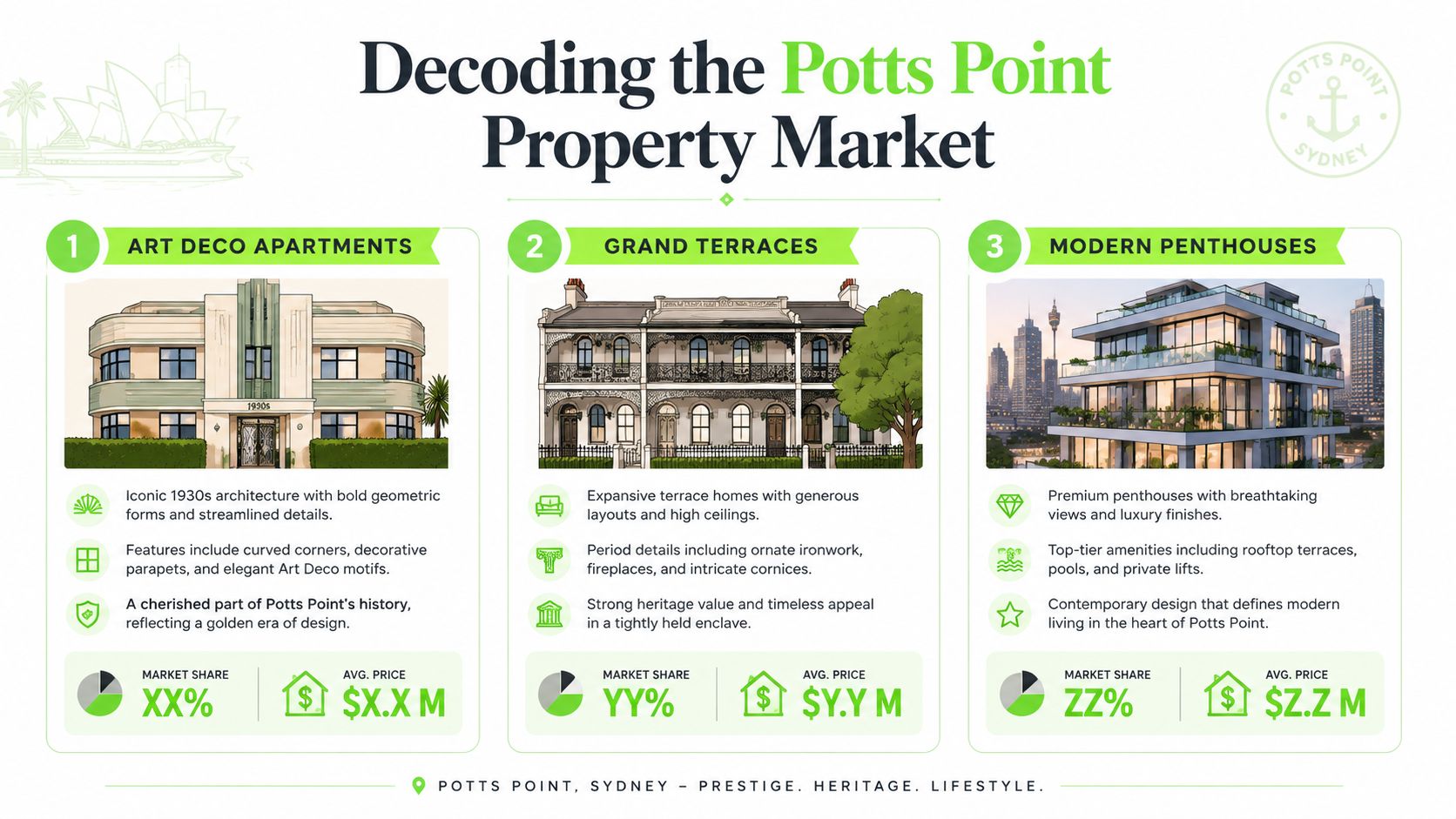
Three property types buyers keep comparing
This suburb trades more like a set of micro-markets than a single apartment precinct. Stock sits in three broad groups. Art Deco apartments, grand terraces or terrace conversions, and modern infill or penthouse-style product. They do not compete on equal terms, and buyers who treat them as substitutes often misread value.
The reason is structural scarcity. Potts Point is small, tightly held, and heavily shaped by older built form. Heritage constraints limit how easily existing character stock can be altered or replaced. That matters for capital growth. It also matters for costs, because the same buildings that create scarcity can carry expensive services, waterproofing, roofing, and facade issues.
Art Deco apartments usually attract owner-occupiers chasing scale, ceiling height, and architectural identity. The premium here is not just charm. It sits in a format that newer projects rarely reproduce well. The risk sits at building level. A strong apartment in a weak block is still a weak acquisition if the strata has deferred major works or lacks cash reserves.
Grand terraces and terrace conversions appeal to buyers who want a house-like footprint close to the CBD. They are rare, but rarity alone does not make them safe value. These properties often involve heritage controls, shared walls, bespoke alterations, and strata structures that need careful legal and physical review. Small title complications can have an outsized effect on future resale and renovation flexibility.
Modern infill and penthouse-style apartments draw buyers who prioritise lift access, parking, security, and simpler day-to-day ownership. In practical terms, this stock can be easier to hold. It often suits investors and time-poor owner-occupiers. The trade-off is that some buildings are easier to substitute. If the product feels generic, pricing power can weaken faster when competing stock comes to market nearby.
A fourth filter matters for family buyers. Potts Point is not usually bought for school catchment first, but access to the wider inner-east education network still shapes demand at the margin, particularly for owner-occupiers comparing nearby suburbs and reviewing school options across Sydney.
Potts Point Property Typology Comparison 2026
Because verified suburb-wide pricing, yield, and market share figures were not provided, the table below stays qualitative.
| Property Type | Typical Size (sqm) | Est. Price Range (2026) | Est. Gross Yield | Key Appeal |
|---|---|---|---|---|
| Art Deco Apartments | Varies widely | Depends heavily on building quality, aspect, renovation level, and strata health | Usually assessed case by case | Character, period detail, recognisable Potts Point identity |
| Grand Terraces | Varies widely | Typically highly segmented due to rarity, condition, and heritage constraints | Usually assessed case by case | Space, prestige, house-like living, historical appeal |
| Modern Penthouses and Infill Apartments | Varies widely | Depends on views, parking, building specification, and scarcity within the project | Usually assessed case by case | Convenience, lift access, parking, lower perceived maintenance complexity |
How to compare stock when hard pricing data is patchy
Suburb medians flatten the very features that drive value here. A renovated studio in a famous building, a compromised one-bedroom above a noisy strip, and a tightly held terrace conversion can all sit inside the same headline data while behaving very differently at resale.
A better method is the same discipline used in market analysis without MLS. Build the view from comparable buildings, transaction quality, street conditions, and replacement constraints rather than a broad median alone.
In Potts Point, that means weighting:
- Building reputation more heavily than bedroom count
- Strata cash position and works history more heavily than cosmetic renovation
- Noise exposure and mixed-use adjacency more heavily than straight-line CBD proximity
- Floorplan usability more heavily than nominal internal area
- Owner-occupier depth more heavily than investor appeal alone
The core mistake buyers make here is paying for visual scarcity instead of functional scarcity. A dramatic facade, a quirky plan, or a one-off renovation can feel special at first inspection. Long-term outperformance usually comes from stock that is hard to replicate, easy to live in, and supported by a building that has been maintained with discipline.
That is the Potts Point split. Heritage and scarcity create the premium. Strata quality and livability determine whether the premium holds.
Lifestyle Allure and Livability Trade-offs
Potts Point sells itself easily. The neighbourhood energy is obvious the moment you walk it. Dining, bars, boutique retail, theatre, harbour adjacency, and strong walkability are central to its identity, as reflected in Sydney's official visitor guide to Potts Point and Woolloomooloo. But buyers who plan to live there full-time need a second lens. Amenity and livability aren't always the same thing.
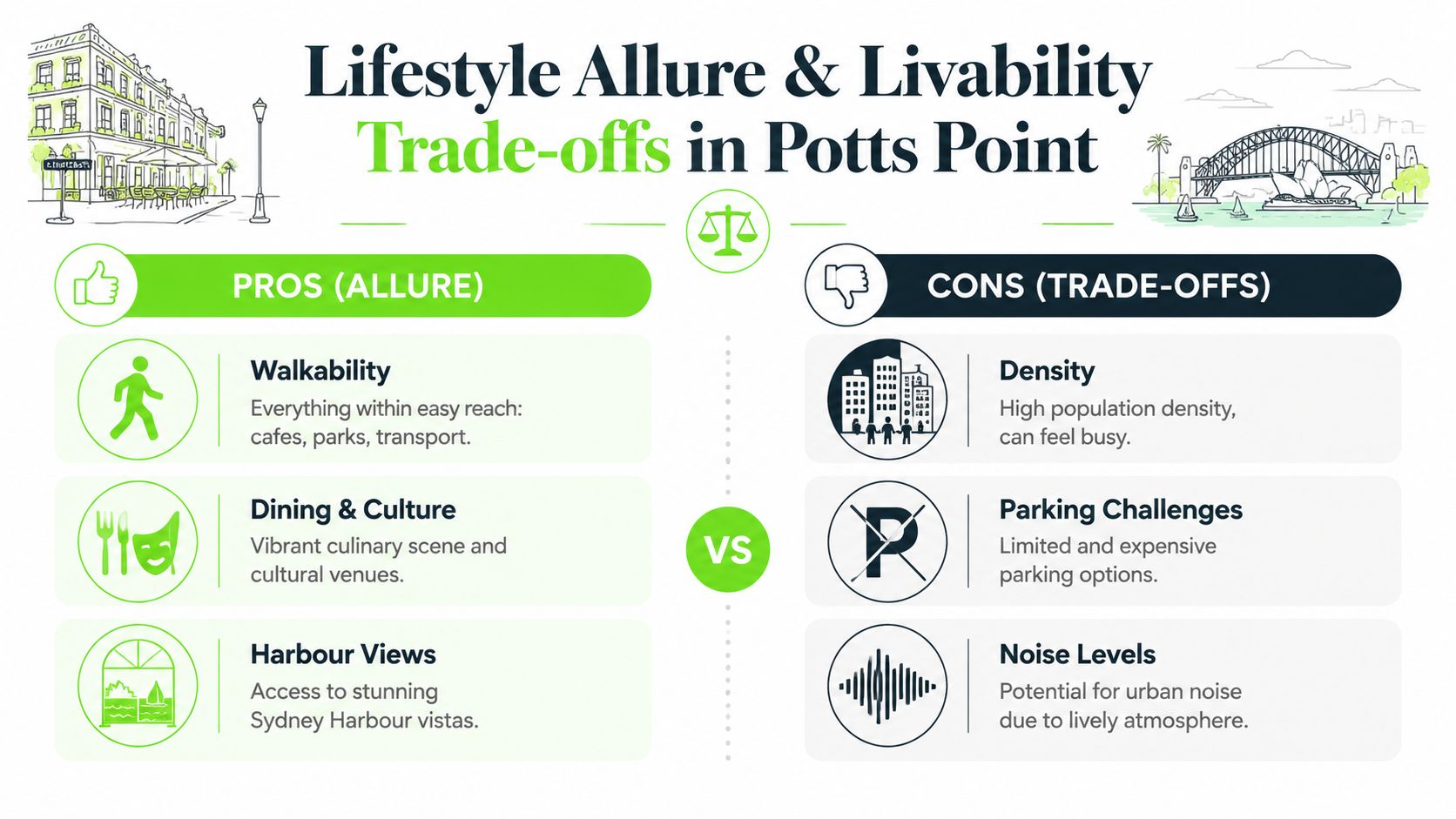
What residents are really buying into
The suburb works brilliantly for people who value walkability and daily convenience over suburban calm. You can live a largely pedestrian life. That's a genuine quality-of-life advantage, especially for professionals, downsizers, and buyers who spend a lot of time in the CBD or the eastern harbour precinct.
The trade-off is friction. Noise carries differently in mixed-use streets. Visitor activity changes the feel of a block by time of day. Older windows and older buildings don't all buffer street life equally. And parking, where relevant, is part of the asset, not a side issue.
For some buyers, that energy is the point. For others, it becomes the reason they sell.
Which pockets suit owners and which suit investors
The practical distinction often comes down to micro-location.
- Leafier, more residential-feeling pockets usually suit long-term owner-occupiers better, especially buyers sensitive to noise and transient activity.
- Kings Cross-adjacent or nightlife-oriented stretches can make more sense for investors who prioritise ongoing demand from tenants who value location intensity over tranquillity.
- Mixed-use frontages need closer inspection of acoustic performance, entry experience, and late-night conditions.
- Rear-positioned apartments in active precincts can outperform their address because they capture amenity without wearing the full street impact.
A related household question often gets missed. Buyers planning a longer owner-occupier hold should also think about nearby schooling options and daily family logistics. A suburb can be highly walkable and still not fit every stage of life. That's where a broader guide to schools in Sydney can help frame whether inner-city convenience aligns with household priorities.
Some Potts Point buyers should choose the quietest street they can afford, not the busiest one they can brag about.
That's especially true if the apartment will be a primary residence. In this part of Sydney, “close to everything” can mean “exposed to everything” unless the building and aspect protect you.
Planning Development and Future Trajectory
Why future supply is about alteration not expansion
Potts Point's future won't be defined by suburban-style growth. There isn't a broad land release story here. There's a curation story.
The market sits inside a physically constrained inner-city setting, with a long-established apartment pattern and a strong heritage presence. That usually means future change arrives through renovation, adaptive reuse, building upgrades, and selective redevelopment, not through wide-scale expansion. For buyers, that tends to preserve character while making approvals, construction, and compliance more consequential.
The practical result is simple. If you buy in Potts Point, your value isn't only tied to your own apartment. It's tied to how the planning framework shapes the block, the street, and the competing stock around you.
The planning lens buyers should use
A buyer assessing future value should focus less on “what can be built nearby” in the abstract and more on what controls are likely to affect actual outcomes:
- Heritage status and streetscape protections can preserve visual character while restricting additions and facade changes.
- Building-level constraints can limit how much an owner can reconfigure, extend, or modernise.
- Compliance obligations in older stock can create unavoidable future spending even where no dramatic redevelopment occurs.
- Mixed-use interfaces can preserve amenity and activity, but they also maintain the tension between vibrancy and quiet enjoyment.
One of the mistakes buyers make is assuming constrained supply automatically equals simple upside. It doesn't. Constraint supports scarcity, but it can also raise the cost and complexity of maintaining the asset base.
That's why the best Potts Point opportunities often aren't the properties with the most ambitious renovation dream attached. They're the ones where the planning reality, heritage context, and building condition already align. In this market, certainty carries a premium of its own.
Investment Analysis A Buyer's Framework
Potts Point can be a strong long-term hold, but only for the right buyer profile. The core thesis isn't complicated. Scarcity is real. Character stock is hard to replicate. Tenant and buyer demand for walkable inner-city living remains durable. The complication sits in execution.
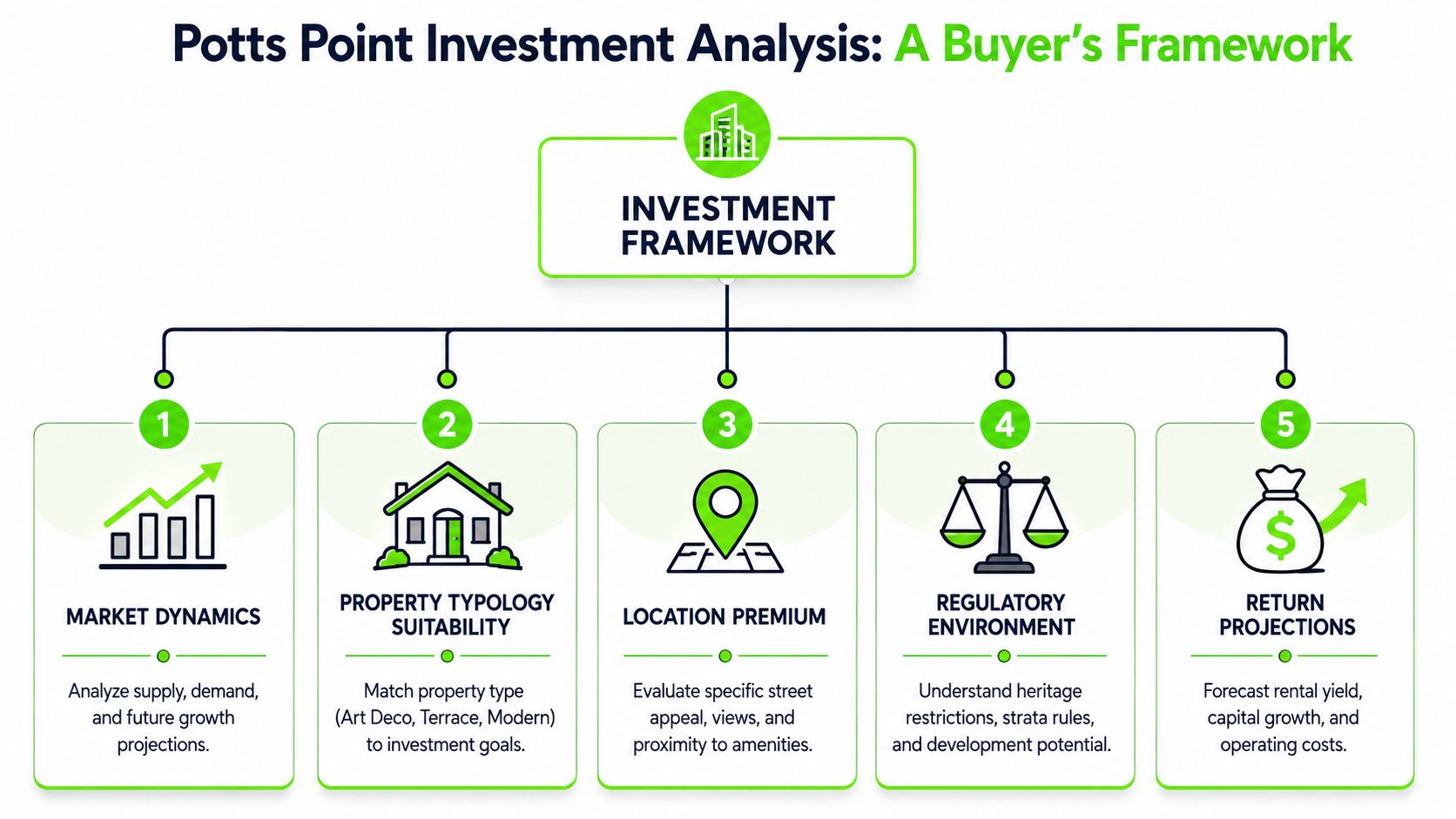
The core investment case
Potts Point's heritage-heavy profile creates a type of scarcity that many apartment markets don't have. The Dictionary of Sydney's place entry highlights significant nineteenth-century buildings and some of Sydney's earliest Art Deco apartment buildings, and that same heritage profile carries practical implications: higher variance in maintenance capex, more frequent compliance upgrades, tighter renovation constraints, but also premium occupancy appeal for buyers who value character.
That last point matters. Character doesn't only affect resale. It affects who wants to live there and why. The strongest buildings in Potts Point often draw people who aren't just choosing “an apartment near the city.” They're choosing a specific built environment and lifestyle pattern.
Three parts of the investment logic stand out:
Structural scarcity
Potts Point's stock isn't easily reproduced, especially the better low-rise character blocks.Location utility
The suburb sits close to the CBD and functions as part of a wider inner-city lifestyle and employment catchment.Emotional demand
Buyers often form strong preferences for certain buildings, streets, or periods of architecture.
The risks buyers underestimate
The best-looking apartment in a weak building can still be a weak investment.
Common risk areas include:
- Deferred maintenance in older common property
- Special levies linked to works that owners avoided for years
- Renovation limits where strata or heritage settings narrow what can be changed
- Noise exposure that affects tenant quality or owner-occupier resale depth
- Overpaying for fit-out while ignoring building fundamentals
A disciplined investor should also model operating reality, not brochure appeal. For buyers working through cash flow assumptions and tenant demand, a broader rental market analysis framework helps stress-test the income side against the kind of holding costs older stock can produce.
Key takeaway: Potts Point usually rewards buyers who can absorb complexity, not buyers who need frictionless ownership.
Who Potts Point suits best
This market suits buyers who are comfortable making a judgement call on older buildings after reviewing strata, condition, and street context closely. It tends to fit:
- owner-occupiers who value character and can tolerate some urban intensity
- investors who understand building-level risk
- downsizers who want amenity and are selective about noise, access, and strata quality
It suits buyers less well if they want simple, low-touch ownership with minimal surprises. Potts Point's premium stock can be excellent. It's rarely passive.
Practical Playbook for Buying in Potts Point
Potts Point is a market where building quality often matters more than apartment presentation. That is a direct consequence of the suburb's structure. Much of the stock sits in older strata schemes, adapted terraces, and buildings affected by heritage controls or tightly constrained sites. Those factors support scarcity, but they also shape maintenance risk, approval timelines, and the buyer pool at resale.
A polished renovation can distract from the wrong variables. In this precinct, the stronger investment thesis usually sits with an ordinary interior in a well-run building than a designer fit-out in a block carrying unresolved capital works, weak records, or hard-to-fix physical issues.
Inspection checklist for older apartment stock
Start with elements that are expensive, slow, or impractical to rectify.
Windows are high on that list. In buildings with heritage influence, replacement can involve longer approval pathways, higher costs, and stricter limits on materials or design changes. They also affect daily livability in a way many inspections understate. An apartment can read well at 11am and feel materially different once traffic noise, venue spillover, or poor acoustic sealing shows up at night.
Water ingress is the next filter. Check ceilings, window junctions, common corridors, roof-adjacent areas where access is possible, and walls tied to external masonry. In Potts Point, surface presentation can conceal old waterproofing failures, facade fatigue, or repairs deferred because owners could not agree on timing or cost.
Services deserve the same scrutiny. Ask what has been upgraded inside the lot, then compare that with the building-wide position on plumbing, electricals, fire compliance, hot water, and common-area lighting. A new kitchen adds little if the wider block is still carrying ageing infrastructure and a likely works program.
Shared spaces usually reveal more than the sales campaign does. Foyers, stairwells, lifts, bin areas, roof condition, and mail zones show whether the owners corporation plans ahead or reacts late.
Terrace conversions need a separate lens. Their scarcity is real, but scarcity does not remove physical compromise. Irregular lot boundaries, awkward service runs, weaker acoustic separation, and inconsistent documentation are all more common in converted stock than buyers often assume from the street appeal alone.
How to read the strata report properly
A strata report is best read as evidence of decision quality over time.
The aim is to judge whether the owners corporation understands the building it owns and funds it accordingly. Four questions usually frame that assessment:
- Are defects identified early, or only after repeated complaints and patch repairs?
- Are levies and sinking fund balances consistent with the age and complexity of the block?
- Do meeting minutes show recurring conflict that delays necessary works?
- Have owners accepted the practical limits created by heritage controls, access constraints, and older construction methods?
Patterns matter more than isolated incidents. Repeated references to waterproofing, facade repairs, roofing, cracking, windows, fire compliance, or by-law disputes often indicate a building that has been managed reactively for years.
Access should be tested before exchange, not after. Many older Potts Point buildings have narrow stairs, limited lift protection, poor loading conditions, and difficult kerbside parking. Those constraints affect move-in cost, renovation logistics, and day-to-day convenience. This Sydney removalist pricing breakdown gives a practical benchmark for the cost impact of awkward access in older apartment blocks.
Negotiating in a tightly held character market
Negotiation in Potts Point works best when you separate true scarcity from well-marketed scarcity. Some apartments are hard to replace because they combine scale, quiet positioning, architectural pedigree, and a building with a credible maintenance history. Others trade on styling, a scarce-looking floor plan, or the suburb's general prestige, despite weaker fundamentals.
Three arguments usually hold up in negotiation:
- Building evidence. Pending capital works, underfunded sinking funds, heritage-related repair complexity, and restrictive by-laws all affect value.
- Micro-positioning. Stock on a quieter residential strip appeals to a deeper owner-occupier pool than apartments exposed to nightlife, heavy traffic, or persistent pedestrian noise.
- Substitutability. Buyers should ask whether the property is genuinely rare, or simply one of several similar offerings dressed better than the rest.
Professional representation can help where that distinction is hard to price in real time, particularly for buyers comparing older strata records, street conditions, and renovation limits across similar stock.
Potts Point rewards buyers who understand the trade-off at the centre of the suburb. Its scarcity is structural, supported by heritage constraints, built-form limits, and a tightly held location close to the CBD. Those same features can reduce flexibility, raise maintenance complexity, and narrow livability in ways generic suburb guides rarely address. Buy with the building first, the apartment second, and the risk-reward equation becomes clearer.