
You've found a house that fits the budget, the commute looks manageable, and the floor plan works. Then the school questions start. Is the address inside the catchment or just outside it. Is the local public school oversubscribed. Should you pay more for a house in-zone, or less for a house and more for private fees. And if a school has a strong reputation today, will that still matter when you want to sell?
That is the core Sydney housing conversation for a large share of family buyers. In this city, schooling isn't a side issue after the purchase. It's often one of the reasons a property becomes more liquid, more contested, and more resilient in softer conditions.
A lot of school content treats the topic like a parent ranking exercise. That misses the bigger point. School choice in Sydney is also a property strategy problem. Buyers aren't just selecting a classroom. They're choosing access, competition, neighbourhood composition, and future resale appeal. If you're relocating across the city, a practical moving guide like this Guide for moving to Eastern Suburbs can help with the suburb transition, but the harder judgement is usually which school ecosystem you're buying into.
Navigating Sydney’s School Catchment and Selection Process
- The Sydney Homebuyer's School Dilemma
- Decoding the Four Main Types of Sydney Schools
- How School Catchments Drive Property Demand
- Evaluating School Quality Beyond the Rankings
- The Unmistakable Link Between Schools and Property Prices
- Your Step-by-Step School Research Checklist
- Using a Buyer's Agent to Secure Your School Zone Home
The Sydney Homebuyer's School Dilemma
A couple starts with a simple brief. They want a family home with a bit of land, a train line within reach, and a school their child can grow into. After a few inspections, the language changes. Agents mention school zones. Friends mention selective entry. Ranking sites throw up lists that don't explain whether the local culture is stable, whether enrolment pressure is rising, or whether the area still makes sense as a long-term hold.
That's where many Sydney buyers get stuck. They think they're comparing homes, but they're comparing education pathways attached to different parcels of land. Two similar houses can produce very different outcomes if one gives cleaner access to a sought-after public school, another relies on private-school fees, and a third sits in a catchment with changing demand.
The scale of the school system explains why the decision feels so consequential. Australia had 4,160,918 students enrolled across 9,673 schools in 2025, and the national apparent retention rate for full-time students from Years 7/8 to 12 was 81.3%, according to the Australian Bureau of Statistics schools release. This isn't a fringe issue inside housing. It's a large, structured market that shapes where families compete.
Strategic lens: A Sydney home isn't just shelter. For many buyers, it's an access pass to a particular school network, peer group, and resale audience.
The buyers who handle this well usually stop asking, “Which school is best?” They start asking sharper questions. Which school model fits our budget over time. Which location gives us flexibility if our plans change. Which suburb attracts future buyers for the same schooling reasons we have today.
Those questions produce better property decisions than school rankings alone.
Decoding the Four Main Types of Sydney Schools
A buyer in Sydney can inspect two similar houses on the same Saturday and walk away with two very different financial commitments. One address buys access to a local public school. The other pushes the family toward private fees or a longer commute to a preferred campus. That is why school type matters in property terms. It shapes both the upfront price of the home and the ongoing cost of keeping the education plan intact.
Sydney families generally weigh four broad school options. Government, Catholic, Independent, and Selective. Each runs on a different access model, and each changes how buyers should assess value, risk, and resale demand.
Why the sector mix matters to buyers
The core distinction is simple. Government schools are usually tied to address. Catholic and independent schools depend more on application, availability, and fee tolerance. Selective schools sit inside the public system but use academic entry, which means they can weaken the usual link between one street address and one school outcome.
For a property strategist, that difference is substantial. A family relying on a sought-after government school may need to pay more for a precise location. A family open to Catholic schools may gain a wider search area, but must budget for recurring fees. A family targeting independent schools is often buying for transport convenience, community fit, and long-term lifestyle rather than strict catchment access. A family aiming for selective entry may accept more location flexibility, but also takes on the uncertainty of exam-based admission.
The result is four different demand patterns, not one.
A practical way to compare them is to focus on the mechanism that drives housing pressure.
- Government schools usually create the clearest link between address and demand. If the local school is well regarded, nearby housing often attracts stronger competition from family buyers.
- Catholic schools can soften catchment pressure because enrolment is application-based, often shaped by parish ties, sibling preference, and school-specific priorities.
- Independent schools shift the property question from catchment security to affordability over time. Buyers may accept a higher total household education cost in exchange for more suburb choice.
- Selective schools draw applicants from a broad geography. They can reduce the need to buy into one exact zone, but they also introduce admission risk that a property purchase alone cannot solve.
Sydney school types at a glance
Fee comparisons are often presented as if they settle the issue. They do not. Buyers need to assess the structure behind the decision: how access works, how predictable that access is, and whether the property still appeals to future buyers if the family's schooling plan changes.
| School Type | Typical Annual Fees (2026 est.) | Enrolment Basis | Key Characteristic |
|---|---|---|---|
| Government | Varies by school costs and contributions. No verified fee figure provided | Usually residential catchment for local enrolment | Strong link between address and school access |
| Catholic | Varies. No verified fee figure provided | Application-based, often considering parish and sibling factors | Midpoint between public access and private choice |
| Independent | Varies widely. No verified fee figure provided | School-based application and selection processes | Greater brand differentiation and less catchment dependence |
| Selective | Public-school model, with no verified fee figure provided | Academic selection | High demand concentration from education-focused households |
One caution matters here. Buyers often treat selective schools as a substitute for catchment strategy. That is only partly true. Selective entry can reduce the premium attached to one local public-school zone, but it does not remove school-driven property pressure. It instead shifts the pressure from address certainty to preparation, performance, and fallback options.
The better comparison is capital allocation. How much are you committing to the purchase price. How much are you committing to annual school costs. How much flexibility do you keep if enrolment rules change, a child's needs change, or resale demand shifts? Buyers who answer those questions clearly usually make stronger school and property decisions than buyers who chase prestige alone.
How School Catchments Drive Property Demand
A school catchment is one of the few invisible features of a property that can change the buyer pool immediately. Renovations are visible. Orientation is visible. A catchment isn't, but families will pay close attention to it because public-school eligibility often depends on that address.
A catchment is a property feature
In practical terms, a catchment works like a zoning attribute attached to the title's location, not to the marketing copy. If a family wants a particular public school, being inside the relevant boundary can matter as much as an extra bedroom. In some parts of Sydney, buyers will compromise on finishes, parking, or block shape if the school access is right.
New South Wales has the largest school market in Australia, with more than 3,000 schools in 2023, including nearly 2,100 primary schools and just over 500 secondary schools, according to Statista's count of Australian primary and secondary schools. A Deakin University commentary also noted that Sydney's top public high schools passed 2,000 students for the first time. The property implication is direct. Even with deep school supply, demand is concentrated enough that some popular public schools operate at very large scale.

That's why catchments shape bidding behaviour. They compress demand into boundary-defined pockets. Buyers who need a specific public option don't view adjacent suburbs as perfect substitutes if those suburbs break school eligibility.
What buyers should verify before they bid
A surprising number of buyers treat “in catchment” as an agent's selling phrase. That's risky. School boundaries can be technical, and enrolment rules can include conditions and exceptions that aren't obvious from a listing.
Use a verification process:
- Check the official school finder rather than relying on advertising language.
- Confirm the exact address being assessed, including unit number where relevant.
- Ask the school directly about local enrolment, sibling priority, and any capacity pressures.
- Read the suburb map street by street if you're buying near a boundary.
Buyers shouldn't treat catchment access as probable. They should treat it as something to verify before exchange.
The property lens changes the school conversation. A catchment isn't only about whether your child can attend. It's also about whether the next buyer will want the property for the same reason.
Evaluating School Quality Beyond the Rankings
Rankings flatten schools into a single hierarchy. Buyers need a broader view than that. A school can rank well academically and still be a poor fit for a particular child, or a weaker long-term property signal if the school's appeal depends on a narrow cohort rather than broad family demand.
The due diligence framework
When I assess schools in Sydney from a property angle, I separate headline reputation from durable demand.
Start with the obvious data points. Parents often look at HSC outcomes, school profiles, and community reputation. Those can be useful as opening indicators, but they don't tell you how a school operates day to day, how stable its enrolment demand is, or whether the buyer pool for that catchment is broad or niche.
Then pressure-test the less visible factors:
- School culture: Visit, observe, and ask how the school communicates with families.
- Leadership stability: A school with clear direction often presents more predictably to future buyers.
- Facilities and breadth: Not because new buildings automatically create value, but because breadth of offering widens the school's appeal.
- Parent community: Some schools attract highly engaged families. That can reinforce both school performance and neighbourhood stickiness.
- Transition strength: Primary to secondary pathways matter more than many buyers realise.
A practical mistake is treating rankings as if they were neutral measures of school quality. They often reflect who is attending the school as much as what the school is adding.
Inclusion is part of school quality
In this area, the usual rankings become thin. A 2024 academic review says Australia is at an “educational crossroads” on special schools and segregated classes, and recommends whole-school models with family involvement, staff awareness, environmental modifications, and layered supports inside general education, as outlined in the Frontiers in Education review on inclusion and support.
That matters for two reasons. First, many families need to know whether support exists in practice, not just in policy. Second, schools that handle diverse needs thoughtfully often build stronger trust with their communities.
A ranking can tell you who scored well. It rarely tells you how a school supports students who don't fit the average profile.
So the sharper due diligence question isn't just whether a school is highly regarded. It's whether the school has enduring strength. Schools with enduring strength hold their appeal across a wider range of families, and that usually matters more for long-run housing demand than a narrow league-table result.
The Unmistakable Link Between Schools and Property Prices
In Sydney, schools influence property prices in different ways depending on the local education mix. The effect in a selective-school corridor is different from the effect in a suburb dominated by sought-after public primaries. The effect in an area with strong private options is different again, because buyers may pay for regional access rather than one precise catchment.
Three Sydney market patterns
The North Shore pattern is built around dense family competition for established public and private pathways. Buyers often value the ability to access reputable government schools while also remaining close to major independent options. That dual appeal broadens the buyer pool.
The Inner West pattern tends to be more fragmented and choice-driven. Families may compare lifestyle, transport, and school fit in the same breath. In these markets, one school doesn't always dominate. A cluster of acceptable options can support values because buyers feel they have fallback paths.
The North West growth-corridor pattern is different again. Buyers are often weighing future school pressure as much as current reputation. Newer communities can feel attractive on price and housing stock, but the key question is whether local educational infrastructure will keep pace with household growth and family expectations.
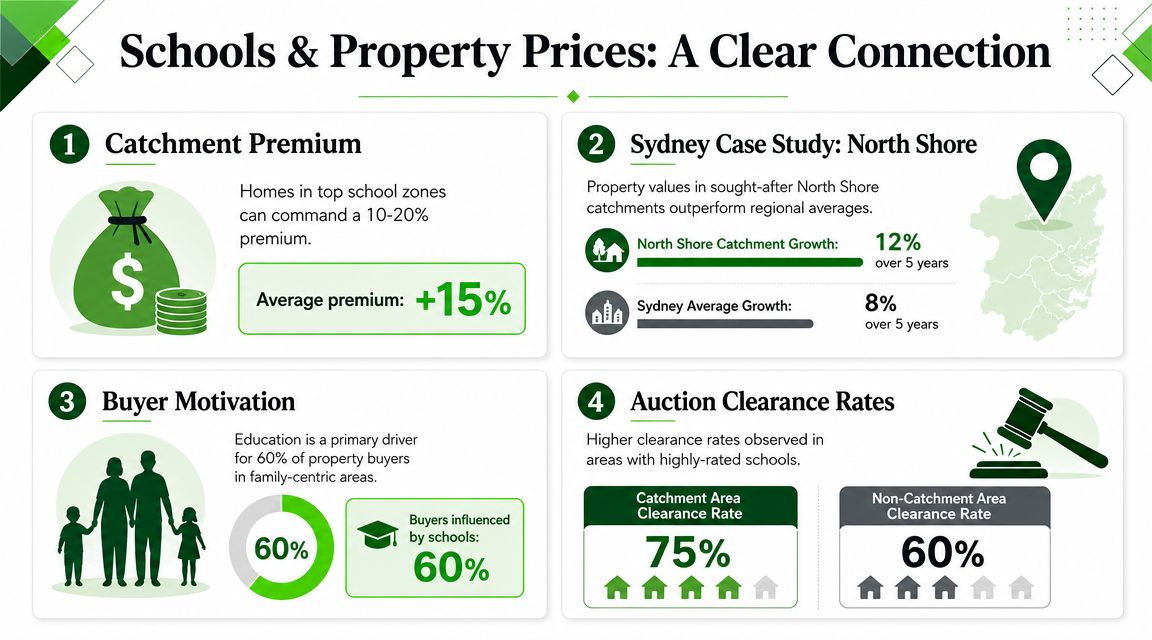
The common thread is competition for credible schooling. If you're trying to interpret that competition through an investor lens, this rental market analysis perspective is useful because school appeal doesn't just shape owner-occupier demand. It can also affect the quality and persistence of tenant demand in family-oriented pockets.
What investors often miss
Many investors focus on transport, land size, and renovation upside, which are all legitimate. But they underweight what I'd call educational infrastructure. In family suburbs, school quality and access help determine who wants to live there, how long they stay, and how emotionally committed buyers become at resale.
There's also a second-order effect. When an area offers multiple credible schooling paths, it can remain attractive even if one school's standing changes. That resilience matters. A suburb tied too heavily to one educational narrative carries more concentration risk.
The strongest education-linked markets aren't always the ones with the loudest ranking chatter. They're often the ones where the school ecosystem supports repeated waves of family demand.
Your Step-by-Step School Research Checklist
School research for homebuyers works best when it follows a sequence. Start broad. Narrow quickly. Then test your assumptions in the field. The biggest mistakes usually happen when buyers skip straight from an online ranking to an offer.
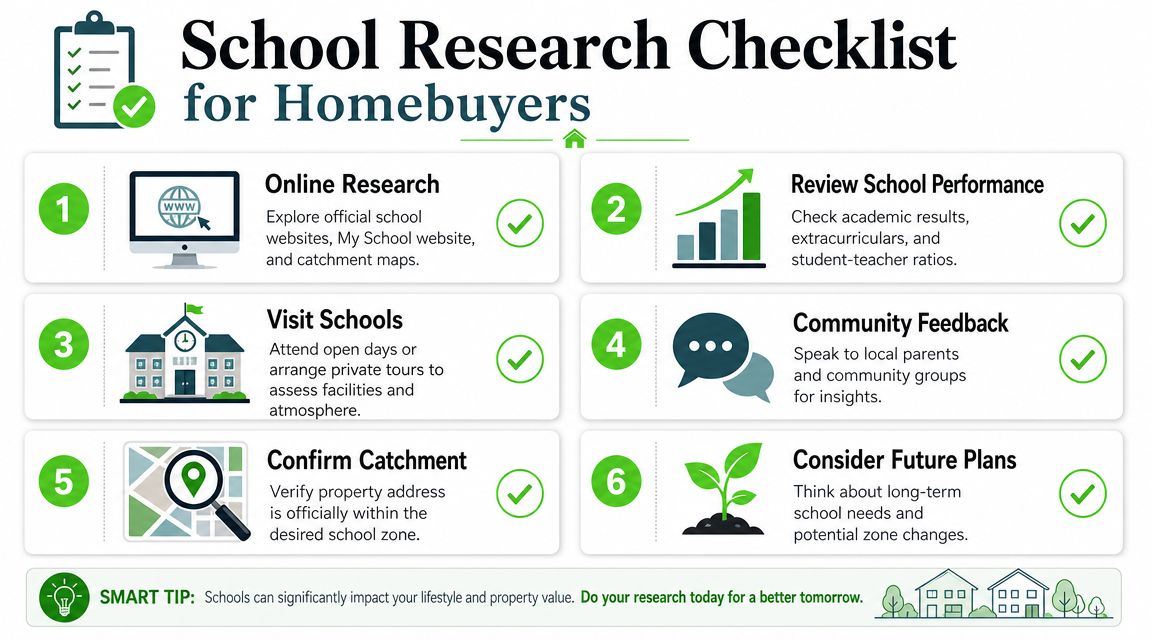
Start online and narrow the field
Build a shortlist around your likely suburbs and likely schooling model. Use official school websites, My School, and the NSW school finder. If you're relocating or can't inspect every campus immediately, digital tools can help with first-pass filtering. For example, some families use 360° virtual tours for learning to understand layout and environment before deciding which schools are worth an in-person visit.
Then move from school pages to property due diligence. This property search and tax records guide is relevant because school strategy only works when it's attached to a property you've checked properly at the title, planning, and location level.
Use this online shortlisting test:
- Map the pathway: Check primary and secondary options together, not in isolation.
- Filter by essential criteria: Support needs, commute, school philosophy, and likely access route.
- Read beyond marketing: Look for policy documents, enrolment rules, and parent information.
- Track fallback options: A suburb is safer when it offers more than one workable school outcome.
Test the school on the ground
Once you have a shortlist, visit at realistic times. Drop-off and pick-up periods tell you things websites don't. You'll see traffic friction, street parking pressure, student flow, and the school's relationship with the surrounding neighbourhood.
Attend open days if possible. Walk the streets nearby. Notice whether the school feels embedded in a settled family area or under pressure from rapid growth and strained local infrastructure.
Independent research warns that Sydney's schools are becoming increasingly segregated by socio-educational advantage, with a “clear relationship between aggregated social disadvantage and poor educational outcomes”, as argued in The State of Australia's Schools. For buyers, that means catchment research shouldn't stop at a school's current reputation. You also need to ask whether the surrounding area is becoming more stratified, and what that could mean for long-term demand stability.
Field note: The street pattern around a school can tell you almost as much as the brochure. Congestion, parent turnover, and the feel of nearby housing often reveal whether demand is durable or just fashionable.
Ask questions that reveal pressure points
When you contact a school, avoid generic questions. Ask questions that test resilience.
- How is enrolment pressure handled? This can reveal whether growth is stretching the school.
- What support exists inside mainstream classrooms? This gets closer to real inclusion than policy slogans.
- How do families transition from primary to secondary? It shows whether the pathway is coherent.
- What is the school community like in practice? Listen for specifics, not branding language.
A good checklist doesn't produce certainty. It reduces blind spots. That's the true goal.
Using a Buyer's Agent to Secure Your School Zone Home
When buyers chase a school-linked property on their own, the difficulty usually isn't understanding that schools matter. The difficulty is converting that insight into a clean purchase in a tight market.

Where buyers lose ground
They lose ground when they search suburb-wide instead of street-specific. They lose ground when they trust listing language on catchments without checking the official position. They lose ground when they become emotionally attached to one school narrative and overpay for a compromised asset.
This is also where presentation can distort perception. Vendors now use advanced marketing to sharpen appeal, including photorealistic listing enhancements, so buyers need a process that keeps school access, land value, and resale fundamentals separate from visual persuasion.
A specialist can help with three things that matter in school zones:
- Boundary literacy so you don't confuse nearby with eligible.
- Local pattern recognition so you understand which streets hold family demand better than others.
- Negotiation discipline so the school objective doesn't push you into a weak purchase.
What specialist support changes
A buyer's agent is useful here because the search problem is layered. You're not just finding a house. You're balancing school access, transport, future buyer appeal, and risk. A service such as what to look for when finding a buyer's agent in Sydney is relevant because buyers should assess whether an adviser can read both the property and the micro-market around the school.
Objectivity is often key. Families understandably become emotional when schooling is involved. A buyer's agent can separate the education goal from the asset quality question. If the right school comes attached to the wrong house at the wrong price, someone needs to say that plainly.
A short overview of the role is below.
The strongest school-zone purchases usually come from buyers who think in layers. First, is the schooling pathway workable. Second, is the property itself sound. Third, will the next family buyer want it for similar reasons. When those three line up, you're not just buying a home near a school. You're buying into an enduring demand pattern.
If you're weighing suburbs, catchments, and long-term resale in Sydney, We Are Buyers Agents can help you assess properties through both a family and investment lens, so the school decision supports the property decision rather than distorting it.