
You've found a property that looks right on paper. The layout works, the suburb fits your plan, and the photos suggest there's nothing urgent to fix. Then the contract lands, the clock starts, and a key question becomes simple: what are you truly buying?
For a first-time investor, this is the point where emotion can get expensive. Fresh paint hides movement cracks. New flooring can disguise moisture. A tidy garden can cover poor drainage or timber in contact with soil. A proper building and pest inspection isn't a box-ticking exercise. It's one of the few chances you get to test the property before you inherit its problems.
Table of Contents
- Why a Building and Pest Inspection Is Non-Negotiable
- What Inspectors Actually Look For
- Your Inspection Timeline and Key Milestones
- From Minor Flaws to Major Defects
- What a Standard Inspection Can Miss
- How to Negotiate After the Inspection
- The Buyers Agent Advantage in Due Diligence
Why a Building and Pest Inspection Is Non-Negotiable
The biggest mistake I see buyers make is treating the inspection cost as optional while treating the purchase price as fixed. That thinking is backwards. The inspection is the small spend that helps you avoid the large mistake.
In Australia, inspection data shows the issue clearly. 33% of homes were found to have incomplete construction, 25% showed evidence of structural cracking and movement, and 5% exhibited sagging or other critical signs of instability according to Australian building and pest inspection statistics. For a buyer, that means visible presentation tells you far less than you think.
A seller only needs the home to present well enough for open inspection. You need it to perform well enough for ownership. Those are not the same standard.
What this means for a buyer
A building and pest inspection protects you in three practical ways:
- It exposes hidden defects: Structural movement, moisture issues, termite activity, and water entry often sit behind finished surfaces.
- It changes your negotiation position: Once a qualified report identifies material defects, you stop arguing opinions and start negotiating with evidence.
- It helps you avoid the wrong asset: Some properties are still worth buying with defects. Others are future headaches with a nice façade.
Practical rule: Don't ask whether a property has defects. Most do. Ask whether the defects are understood, manageable, and priced correctly.
The real risk isn't only the defect
First-time investors often focus on the defect itself. Experienced buyers focus on uncertainty. A known minor issue is usually manageable. An unclear structural issue, unexplained damp pattern, or obstructed subfloor is harder because it limits your ability to price risk.
That's why a building and pest inspection matters even when a property looks “well renovated” or “move-in ready.” Cosmetic work can improve appeal and also reduce visibility. If the report finds nothing significant, that result has value. If it finds major defects, that result may save you from buying the wrong property or paying the wrong price.
What Inspectors Actually Look For
A good inspection is closer to a forensic review than a casual walk-through. The inspector isn't there to admire the renovation. They're there to identify signs of movement, decay, moisture, infestation, safety issues, and inaccessible risk zones.
For buyers, it helps to think about the process in two streams. One is the building condition. The other is timber pest and moisture risk.
Building inspection scope
On the building side, inspectors generally work from top to bottom and outside to inside. They'll assess elements such as the roof exterior, roof void, gutters, walls, ceilings, floors, windows, doors, subfloor areas if accessible, retaining structures, drainage clues, decks, balconies, and signs of previous repairs.
They're also looking for patterns, not just isolated faults. A crack on its own may not matter much. A crack combined with sloping floors, sticking doors, moisture staining, and poor surface drainage tells a different story.
Typical findings that deserve closer attention include:
- Movement indicators: Cracking around openings, separation at joints, or distortion in frames.
- Water-related clues: Staining, bubbling paint, musty smells, swollen skirtings, and failed sealants.
- Workmanship issues: Inconsistent finishes, patched areas, crude alterations, or signs of renovations without obvious care.
- External contributors: Soil levels too high against walls, poor falls around the dwelling, or vegetation crowding the structure.
If the property has a yard, don't ignore the site itself. Tree roots, retaining walls, drainage patterns, and old stumps can all affect moisture and structure over time. Where a block has recently been cleared or prepared, it's worth understanding tree stump removal expenses because leftover roots and stump zones can complicate future site work and moisture behaviour.
Pest inspection scope
The pest side isn't only about spotting live termites. A proper inspection also looks for the conditions that attract pests and the evidence they leave behind. That includes damaged timber, mud leads, conducive moisture, poor ventilation, timber-to-soil contact, and inaccessible zones where activity can go unnoticed.
Inspectors usually assess areas such as:
- Roof voids and timber framing
- Subfloors and bearers
- Decks, fences, outbuildings, and stored timber nearby
- Garden beds and external walls
- Moist areas around bathrooms, laundries, and kitchens
A buyer should care just as much about the environment that supports termite activity as about current activity itself. If the setting encourages future infestation, the risk doesn't disappear because no live termites were seen on the day.
The tools that matter
A competent inspection isn't limited to what the eye can see. Inspectors commonly combine a moisture meter, thermal imaging camera, and sounding tool to detect concealed dampness, thermal anomalies, and timber defects that can indicate water ingress or termite-related damage before they're visible on the surface, as outlined in this guide on tools used in building and pest inspections.
That matters because tools help separate a cosmetic issue from a hidden one. A stain on a ceiling might be old. It might also be active moisture. A wall can look fine and still show a thermal pattern worth chasing.
If an inspector can explain not just what they found, but how they verified it with tools and site context, the report usually becomes much more useful for a buying decision.
Your Inspection Timeline and Key Milestones
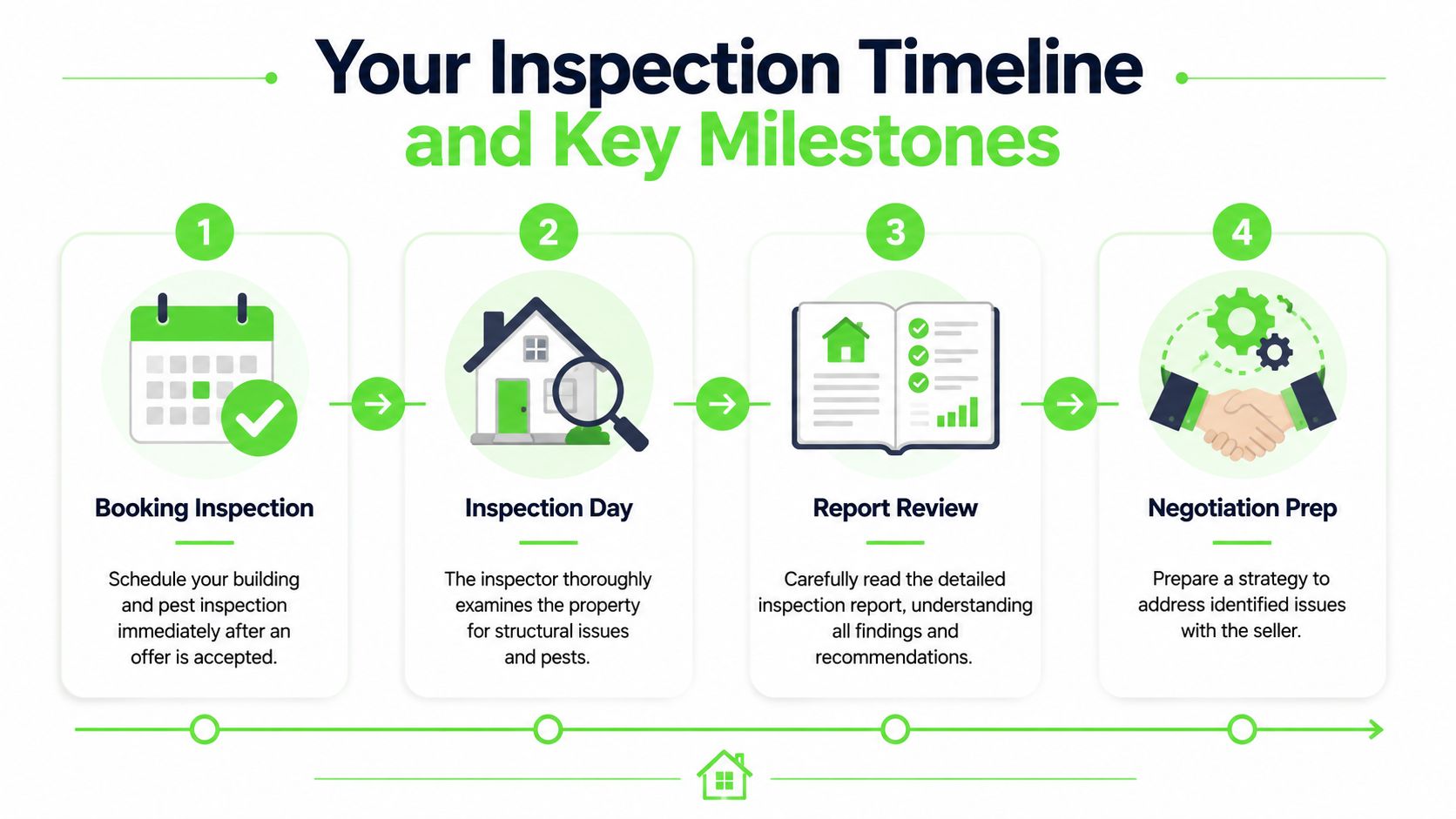
The inspection process moves quickly once your offer is accepted, and speed matters because your rights under the contract won't stay open forever. Most buyers feel less stressed once they treat the inspection as a sequence of decisions instead of a single event.
When to book
Book the inspection as soon as your offer is accepted or as soon as the contract structure gives you the right to investigate. Waiting narrows your options. It also leaves less time to review findings, obtain repair advice, and decide whether to renegotiate or exit.
The buyer usually pays for the inspection because the report is prepared for the buyer's reliance. That's exactly how it should be. You want an inspector working for your interests, not for the transaction.
A practical order of operations looks like this:
- Contract accepted: Confirm the time window for due diligence immediately.
- Inspector engaged: Choose someone independent and available quickly.
- Access arranged: The selling agent coordinates entry with the inspector.
- Supporting checks started: At the same time, gather title and planning context through resources such as property search and tax record checks.
What happens on the day
The inspector attends the property, works through accessible areas, documents findings, and notes limitations. If you can attend, do it. The live walkthrough often gives you more nuance than the written summary alone.
Ask practical questions on site. Which issues are common for a property of this age? Which findings are maintenance items, and which suggest deeper failure? What would make them escalate to another specialist?
What to do once the report arrives
Read the executive summary first, then the body of the report, then the limitations. Buyers often skim the photos and jump to the defect list. That misses the most important part, which is the pattern across the report.
Use this review sequence:
- Start with the high-risk findings: Structural movement, active moisture, active pest evidence, and safety hazards.
- Check the inaccessible areas: These often carry more weight than buyers realise.
- Call the inspector: Ask what they'd investigate further if they were buying it themselves.
A report is only the beginning. The useful part is what you do with it while you still have influence.
From Minor Flaws to Major Defects
Most reports look alarming to first-time buyers because they document everything. That's normal. A useful report doesn't try to make the house feel comfortable. It tries to classify risk.
The most helpful reports separate major defects, minor defects, safety hazards, and inaccessible or obstructed areas so the buyer can price risk properly, as explained in this overview of what a detailed building and pest report should include.
How to read the categories properly
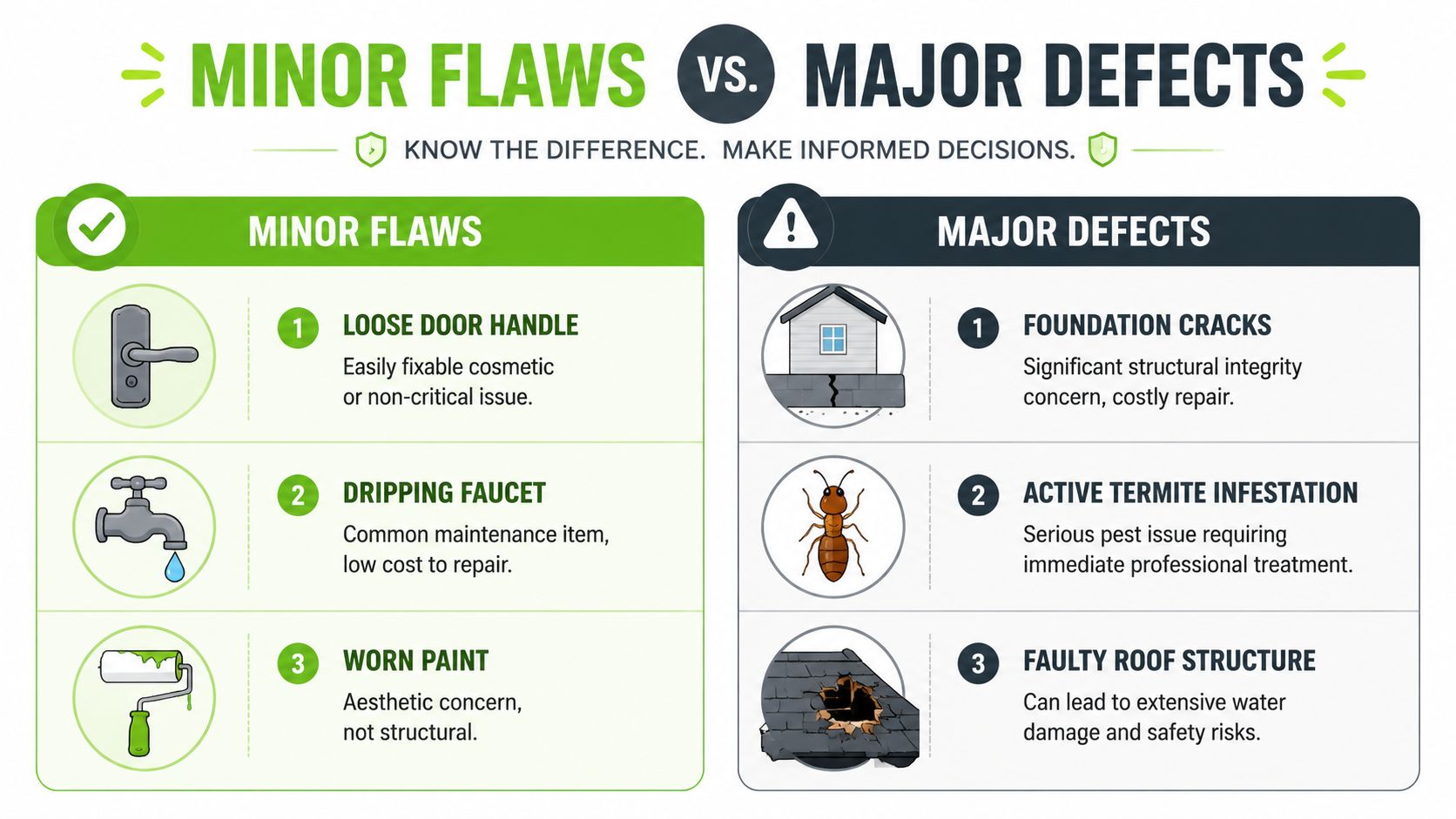
A minor defect is usually a maintenance item, cosmetic issue, or isolated fault that doesn't materially change the purchase decision on its own. Think loose hardware, worn paint, minor sealing issues, or non-structural cracking.
A major defect is different. It usually points to failure in structure, water management, timber condition, or another issue that can expand if ignored. The word “major” matters because it changes both repair scope and negotiation posture.
A safety hazard needs immediate attention regardless of your investment horizon. It might not always be the most expensive item in the report, but it can create urgency around occupancy, insurance, or further specialist checks.
Buyers get into trouble when they treat every defect as equal. A long report with mostly maintenance items can be far less risky than a short report with one unresolved moisture pathway.
A practical defect triage table
| Category | What it often looks like | Buyer response |
|---|---|---|
| Minor defect | Dripping tap, worn paint, sticking internal door, isolated cosmetic crack | Budget as routine maintenance and don't over-negotiate |
| Major defect | Ongoing moisture entry, structural cracking pattern, damaged roof structure, significant timber deterioration | Get repair scope clarified and use it as negotiation leverage |
| Safety hazard | Exposed risks, unstable elements, urgent conditions affecting safe use | Seek specialist advice fast and assess whether settlement timing still works |
| Inaccessible area | Blocked subfloor, locked room, crowded roof void, heavy stored goods against walls | Treat as unresolved risk, not as a clean bill of health |
Why inaccessible areas matter
Inaccessible areas are where many buyers switch off, but experienced investors pay attention. If the inspector couldn't access a roof void, subfloor, or wall line because of obstruction, the report is telling you there's a blind spot.
That doesn't mean there is definitely a defect there. It means you can't price the risk confidently without more information. In negotiations, that uncertainty matters almost as much as a confirmed problem. If access can be arranged before exchange or before your due diligence period expires, push for it.
What a Standard Inspection Can Miss
A standard inspection is useful, but it isn't magic. Buyers get into trouble when they read a clean summary as a guarantee that nothing expensive sits behind the finishes.
One of the biggest gaps is proof. Industry commentary notes that many reports rely on limited photos, while more detailed services document dozens of moisture and thermal images to show where moisture is coming from and why it matters, especially in weather-exposed areas such as Sydney and Byron Bay, as discussed in this inspection commentary on moisture evidence and reporting gaps.
Where standard reports fall short
The first limitation is that inspections are generally non-invasive. Inspectors usually won't open walls, remove finishes, or dismantle parts of the home. If a recently renovated bathroom has concealed waterproofing failure, surface presentation may look far better than the underlying condition.
The second limitation is context. A report might identify damp readings, but without enough visual evidence or tracing, the buyer still may not know whether the issue is a one-off event, drainage-related, plumbing-related, or an ongoing building envelope problem.
Common blind spots include:
- Recent renovations: New finishes can conceal older defects or poor workmanship.
- Complex drainage behaviour: Water can travel from one area and appear in another.
- Altered homes: Additions and remodels can hide quality or compliance issues behind completed surfaces.
- Obstructed areas: Stored items, limited clearance, or poor access can block meaningful inspection.
If drainage or concealed plumbing looks like part of the story, it's worth reading about preventing drain problems in Sydney because camera-based plumbing investigation can answer questions a standard visual building report won't.
When to escalate to a specialist
A standard building and pest inspection is often enough to screen a property. It isn't always enough to close out uncertainty. Escalate when the report suggests a major issue but doesn't fully define cause, extent, or repair path.
Bring in a specialist when you see any of the following:
- Structural uncertainty: Repeated movement indicators, distortion, or unresolved cracking patterns.
- Persistent moisture clues: Readings or staining without a clear source.
- Drainage suspicion: Water pooling, poor falls, or signs of recurring wetness near the structure.
- Renovation questions: Significant alterations with unclear quality or missing confidence in concealed work.
A clean report is useful. A report that leaves major unanswered questions is not clean enough for a serious buyer.
How to Negotiate After the Inspection
The report begins to prove its worth. Buyers often think the inspection is about discovering defects. In practice, it's about deciding which of three paths makes sense: proceed, renegotiate, or walk away.
The negotiation shouldn't be emotional. It should be written, evidence-based, and tied to risk and repair scope.
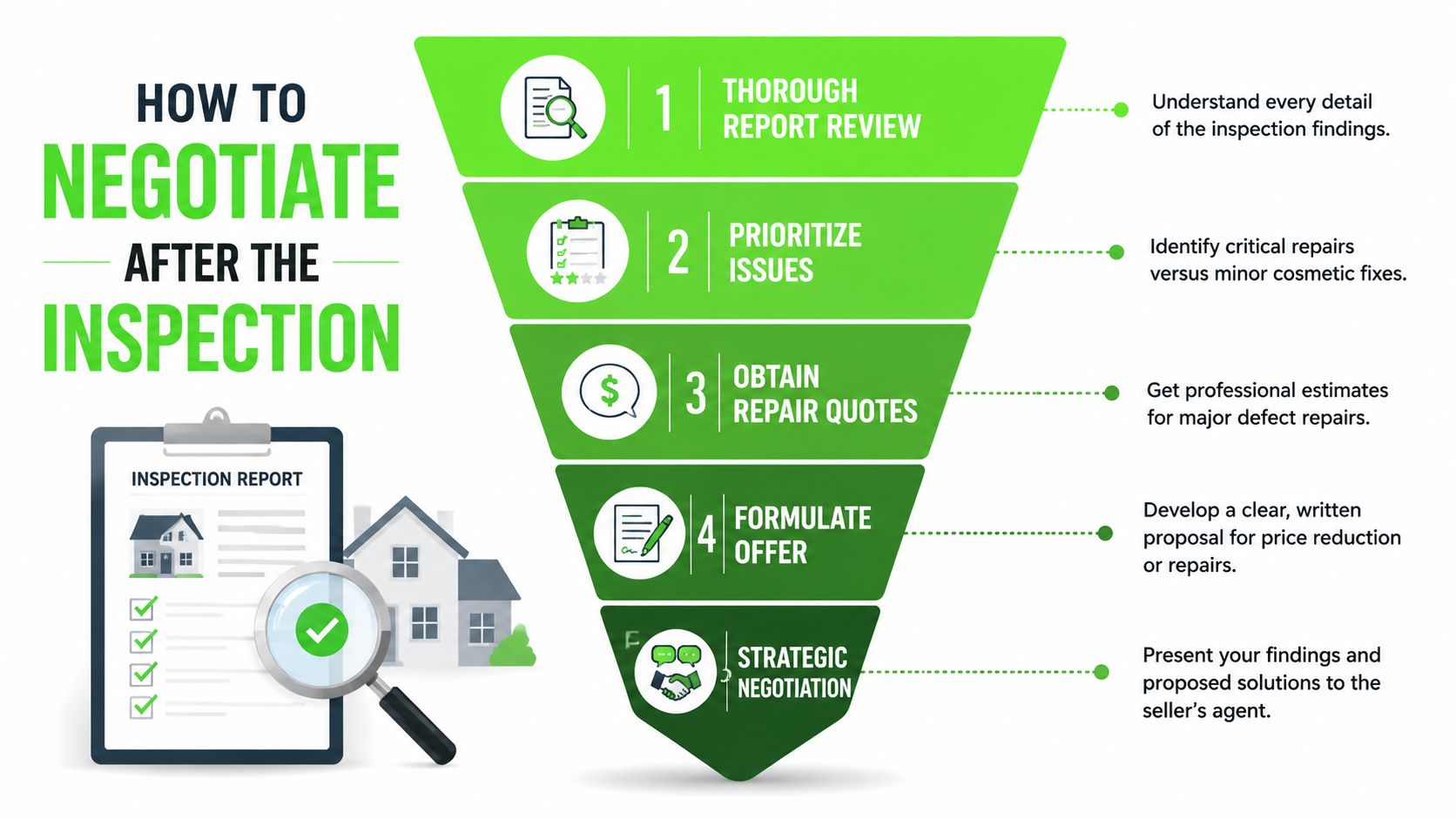
Start with the process below.
Path one proceed
Proceed when the report shows issues that are expected for the property's age and don't materially alter your holding costs or risk profile. Minor maintenance, isolated cosmetic defects, and manageable wear usually fall into this category.
That doesn't mean ignoring the report. It means adjusting your first-year maintenance budget and moving forward with clear eyes.
Path two renegotiate
Renegotiate when the property is still worth buying, but the condition no longer matches the agreed price or original assumptions. This usually happens when the report identifies major defects, unresolved moisture risk, pest treatment needs, or inaccessible areas that justify further allowance.
Use a simple structure:
- Identify the material findings: Stick to the items that affect value, safety, or future cost.
- Get specialist quotes where needed: The more specific your evidence, the stronger your position.
- Write the request clearly: Ask for a price reduction, a repair before settlement, or access for further investigation.
- Stay commercial: Don't pad the request with cosmetic items that weaken the case.
A short written submission often works better than a heated call. If you want to structure that communication cleanly, this guide on a home buying offer letter is a useful reference for presenting your position in a way the selling side can act on.
A quick visual summary helps when you're preparing that case:
Path three walk away
Walk away when the report reveals a problem you can't price confidently, can't investigate properly within the contract window, or don't want to own. That often includes unresolved structural concern, extensive hidden moisture suspicion, severe termite-related deterioration, or a pattern of defects that suggests poor overall stewardship.
Walking away isn't a failure. It's risk control.
The strongest negotiating position in property is being willing to leave a deal that no longer makes sense.
Buyers who regret inspections usually regret the cost on the day. Buyers who skip inspections often regret the purchase for much longer.
The Buyers Agent Advantage in Due Diligence
Due diligence gets messy when nobody is coordinating it. The inspector has one piece of the picture. Your solicitor has another. Trades give repair opinions from their own angle. The selling agent wants the deal moving. The buyer is left trying to turn technical comments into a financial decision.
That's where process matters.

What changes when someone manages the process properly
A buyer's agent helps by turning the report into action. That means selecting an independent inspector, spotting where the report is clear versus where it's incomplete, arranging follow-up quotes fast, and deciding whether the best outcome is to proceed, push harder, or step back.
For investors and homebuyers in Sydney and Byron Bay, that coordination is often where real value sits. A service such as buyer's agency support for Byron Bay off-market opportunities, due diligence and smarter negotiation can help tie inspection findings to decision-making, rather than leaving the report as a standalone document.
Good due diligence also keeps emotion out of the decision. That matters because buyers often overreact to harmless maintenance and underreact to unresolved moisture, drainage, or structural uncertainty. The report is technical. The purchase decision is commercial. Someone needs to connect those two.
If you're weighing a property in Sydney, Byron Bay, or elsewhere in Australia, We Are Buyers Agents can help coordinate the due diligence process, interpret inspection findings in plain English, and turn those findings into a smarter negotiation or a disciplined walk-away decision.