
The number that changes the Revesby story is not price. It's migration. In the SA2 covering Revesby, population rose from 17,664 in 2021 to approximately 18,856 in May 2026, a 6.7% increase driven overwhelmingly by overseas migration, which accounts for 82.8% of growth according to AreaSearch's Revesby profile. That matters because it shifts Revesby, NSW, Australia from being seen as a steady family suburb to being understood as a suburb with a durable demand engine.
For buyers, that changes the lens. You're not just assessing streets, schools, and train access. You're assessing whether the suburb can keep attracting residents, tenants, and owner occupiers even when broader Sydney sentiment softens. Revesby has enough maturity to feel established, but enough demographic movement to keep reshaping its market.
Table of Contents
- Why Revesby Is on Every Sydney Buyer's Radar
- The Revesby Lifestyle Community and Character
- Decoding the Revesby Property Market in 2026
- Transport Connectivity and Local Amenities
- Revesby as a Property Investment Pros and Cons
- How Revesby Compares to Neighbouring Suburbs
- Securing Your Revesby Property With a Buyer's Agent
Why Revesby Is on Every Sydney Buyer's Radar
A suburb does not post a $1,560,000 median house price, 4.39% annual house growth, and 179 house sales in 12 months by accident. Revesby has reached a level of buyer attention where demand is broad, repeatable, and supported by active resale evidence, as noted earlier in the article.
What makes that attention more durable is the buyer base behind it. Revesby sits within a part of Sydney shaped by ongoing household formation and high overseas migration, but the investment implication is often missed. New arrivals do not just add population. They add rental demand, create pressure for well-located family housing, and widen the pool of tenants and future owner occupiers who want established suburbs rather than speculative precincts.
That dynamic tends to support market resilience. In suburbs where demographic growth is tied only to one buyer cohort, demand can thin out quickly when borrowing conditions change. Revesby benefits from a more layered pattern. Local families, upgraders, investors, and newly arrived households are often competing for the same practical features, which helps keep both sales activity and rental interest from relying on a single source of demand.
For buyers, the takeaway is straightforward.
- Owner occupiers are not buying into a suburb that depends on a future story to justify current prices.
- Investors are assessing a market where demographic turnover can support a deeper tenant pool over time.
- Upgraders are looking at a location that still feels suburban and established, while remaining relevant to Sydney's broader housing demand.
Revesby draws serious attention because its appeal is measurable. Price growth, transaction volume, and demographic depth point to a suburb with more than short-term momentum.
This combination explains why Revesby now appears on the same shortlist as more heavily discussed middle-ring suburbs. If you are weighing the broader case for whether investing in Sydney property is a smart choice, Revesby is a useful example of how migration-linked demand can strengthen long-term market viability rather than merely lift near-term competition.
The Revesby Lifestyle Community and Character
Revesby feels settled because it is settled. The suburb isn't selling a reinvention. It's selling continuity, and for many buyers that's more valuable. Streets with long-held homes, local shopping strips, sporting grounds, and club-based social life all contribute to a suburb that functions well day to day rather than demanding future promises.

A suburb built around working households
The strongest evidence for Revesby's character sits in its household structure. The 2021 Census reported 5,928 total households in Revesby, with 47.7% of the population in the 35 to 54 age bracket, while the suburb's population grew from 14,176 in 2016 to 15,268 in 2021, according to In The Suburbs' Revesby profile. That isn't the profile of a transient pocket. It's the profile of a suburb anchored by working-age adults and family households.
You see that in the rhythm of the place. Morning activity centres on schools, stations, and local roads. Afternoons shift toward parks, errands, sport, and club facilities. Revesby Workers' Club remains one of the recognisable local institutions because it reflects what the suburb values: familiarity, repeat visitation, and spaces where different generations overlap.
A buyer walking Revesby on a Saturday should look for cues that don't show up in listings:
- School pickup traffic: it shows where family routines are concentrated.
- Main strip turnover: active cafés, grocers, and service retailers usually indicate repeat local spending.
- Park usage: a park filled with families tells you more than a brochure ever will.
Why diversity matters in everyday life
The standard line about Revesby is that it's diverse. That's true, but the better interpretation is economic and social. A multicultural suburb often supports a wider mix of household types, occupations, small businesses, and community networks. Those features can make a suburb feel more adaptive during market shifts because demand doesn't come from a single buyer profile.
Domain described Revesby as having “everyday amenities and a diverse population” in its newspaper coverage, a concise phrase that captures why the suburb feels grounded rather than trend-driven, as noted in Domain's article on Revesby. For a homebuyer, that often translates into stronger local identity. For an investor, it suggests a tenant pool that may remain broad rather than narrow.
Local reading: In Revesby, community isn't a branding line. It's visible in the age profile, the household count, and the way daily services are used.
Decoding the Revesby Property Market in 2026
Revesby's market splits in a way buyers need to understand early. Detached houses trade on land content, family usability, and the suburb's established position in South West Sydney. Units and townhouses sit at a lower entry point, but they still draw value from the same employment catchments, rail access, and local services. That difference matters because it creates two demand streams rather than one.
What the current numbers say
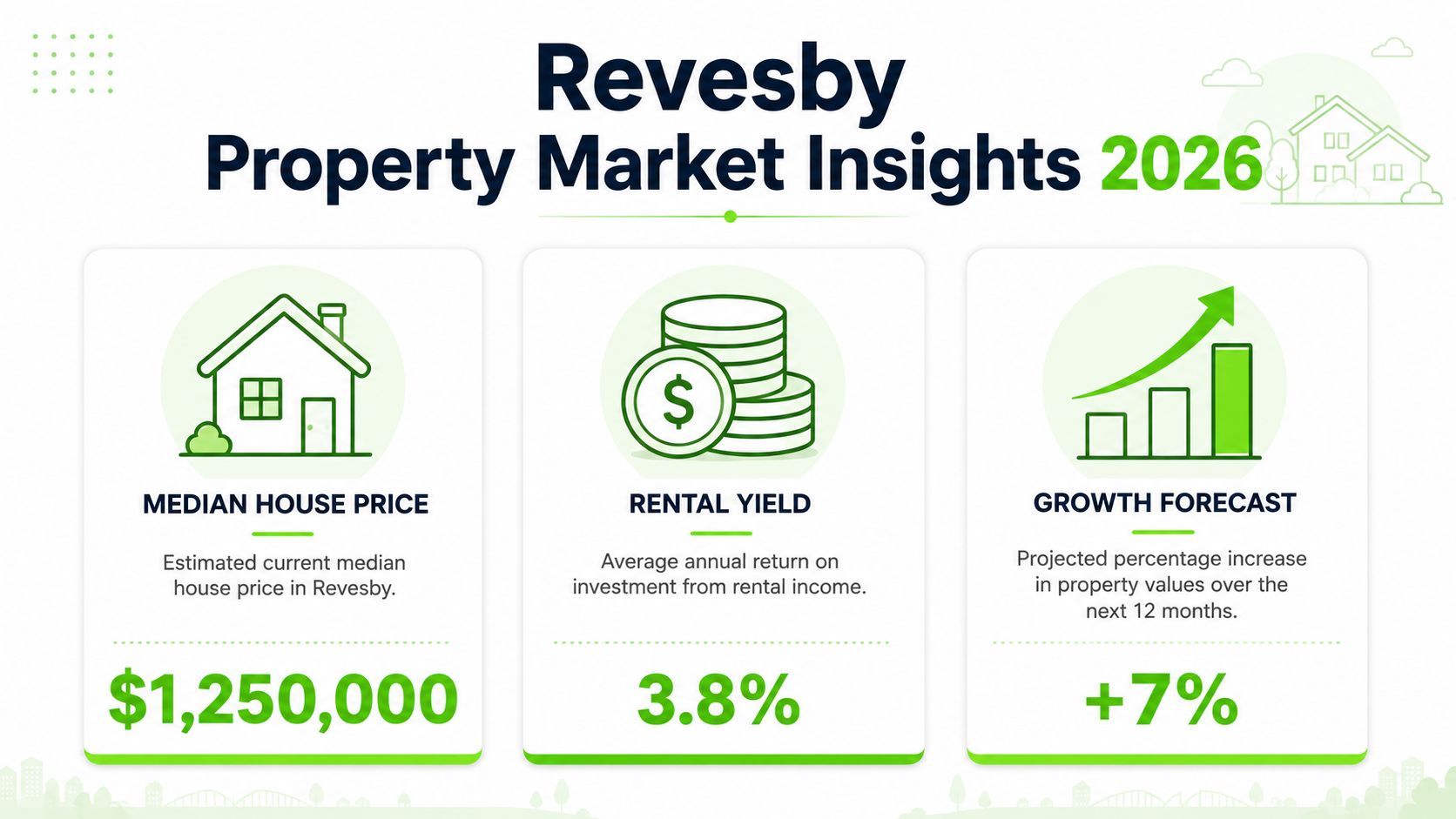
Recent market data published by Your Investment Property Magazine's Revesby suburb page indicates a median house price of $1,560,000, annual house price growth of 4.39%, 179 house sales over the past 12 months, and annual increases in asking rents for both houses and units.
Those figures point to a market that is active without looking overheated. Sales volume is high enough to give buyers usable comparable evidence. Price growth remains positive, but it does not read like a short-term spike driven by speculative sentiment. Rent growth across both housing types also supports a more durable interpretation of demand.
That rental story deserves more attention than it usually gets.
Revesby benefits from Sydney's broader population inflow because new arrivals rarely enter the housing market as immediate buyers. They rent first, test commuting patterns, and often prioritise areas with established services, family networks, and schools. In suburbs like Revesby, high overseas migration does not just add to population counts. It widens the tenant base across couples, family households, and multigenerational arrangements, which can reduce vacancy risk over time. Buyers comparing school catchments should also weigh access to well-regarded schools across Sydney because schooling demand often feeds directly into rental competition for larger homes.
For buyers who prefer a visual overview before drilling into comparables, this local video gives a useful sense of area context:
A tighter reading of the market looks like this:
| Property type | Verified market signal | What it suggests |
|---|---|---|
| Houses | Median price $1,560,000 | Buyers are paying for land and long-term family utility, not a discount entry |
| Houses | 179 sales in 12 months | There is enough turnover to judge pricing discipline street by street |
| Houses | 4.39% annual growth | Capital growth is present, but conditions still reward careful selection |
| Rentals | Asking rents increased for houses and units | Tenant demand is broad rather than concentrated in one product type |
What those numbers mean for buyers
Owner occupiers should read Revesby as a selection market. Median figures give a suburb-level reference point, but they do not protect you from overpaying for poor layout, inferior orientation, flood exposure, or expensive deferred maintenance. In this price bracket, land shape, parking practicality, and renovation scope can shift real value by more than the suburb median suggests.
Renovation cost discipline matters most in older stock. A practical guide to bathroom renovation prices in Sydney helps buyers test whether a “good buying opportunity” still makes sense after post-settlement works are priced properly. In Revesby, the mistake is often not the purchase price itself. It is the assumption that cosmetic or wet-area upgrades will stay within budget.
For investors, the stronger conclusion is about resilience. A suburb with rising rents, regular turnover, and a tenant pool refreshed by migration has a better chance of holding demand through different parts of the cycle. That does not mean every property will perform well. It means Revesby offers something more useful than a generic growth story. It offers evidence that income demand is supported by demographic change, and that is usually a firmer base for long-term investment than sentiment alone.
Transport Connectivity and Local Amenities
Revesby works best for buyers who measure convenience in repeated trips, not occasional ones. The suburb's appeal isn't just that you can get somewhere. It's that the daily sequence of station, school, shopping, recreation, and return home is relatively efficient.
How to assess daily convenience
Start with rail access. Revesby Station on the T8 line is a genuine asset because it connects the suburb into the broader Sydney network in a way many family-focused suburbs can't match. For commuters, the practical question isn't whether a station exists. It's whether the station is easy to reach from your actual property, whether parking or drop-off is manageable, and whether your work pattern suits rail over driving.
Then test the suburb on foot. A buyer should walk from the station through the shopping area and note where the suburb feels active, where it quiets down, and where convenience starts to thin out. Revesby Village Centre and the surrounding retail strip matter because they cover the ordinary spending that shapes liveability: groceries, services, casual dining, errands, and quick stops that save time.
Use this shortlist when inspecting homes:
- Train practicality: How long does it take from the front door to the platform at your normal pace?
- Errand efficiency: Can you do groceries, pharmacy, and small services in one local trip?
- School logistics: Are pickup and drop-off routes manageable, or do they create daily friction?
- Weekend amenity: Are parks, clubs, and dining close enough to use regularly rather than occasionally?
The amenity test buyers should use
The strongest amenity suburbs aren't always the flashiest. They're the ones that reduce friction. In Revesby, that means local schools, healthcare access, parkland, and community facilities all carry real weight because they support routines for families and long-term residents.
If schools are a major driver in your decision, this guide to schools in Sydney for property buyers and families is a useful companion when narrowing locations within the suburb and nearby areas.
A suburb becomes more valuable when its amenities are used often, not when they merely look impressive on a map.
That distinction matters in Revesby. Buyers aren't chasing novelty here. They're paying for repeatable ease.
Revesby as a Property Investment Pros and Cons
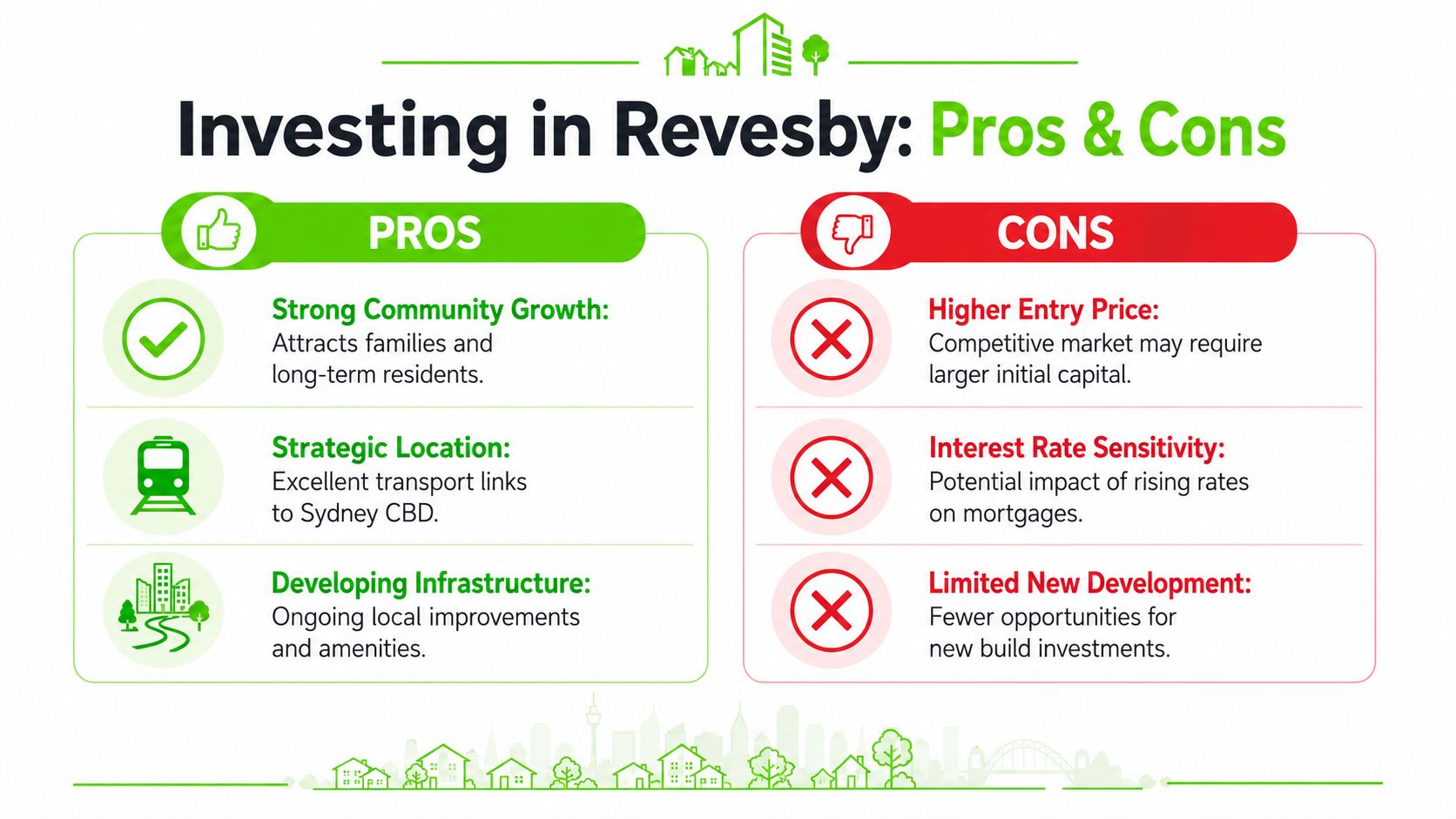
More than four-fifths of recent population growth in the Revesby area has been tied to overseas migration, as noted earlier in this article. For property investors, that matters because migration does not just add residents. It adds households with immediate housing needs, and many of those households favour established middle-ring suburbs where transport, schools, shops, and community networks already exist.
The investment case for demand resilience
Revesby's appeal to investors sits in the composition of demand, not in hype. A suburb with multiple sources of housing demand usually holds up better than one reliant on a narrow buyer profile. Revesby benefits from family households, local upgraders, and new arrivals looking for practical access to Sydney employment and services.
That has a direct rental implication. New migrant households often rent first, even when they intend to buy later. In suburbs with mature infrastructure, that tends to support tenant depth across different property types, from older apartments near the station to freestanding homes suited to extended families. The result is a rental market that is less exposed to a single economic or demographic trend.
Three investment positives stand out:
- Demand comes from several directions: owner occupiers, renters, family households, and new arrivals all compete in the same broad catchment.
- Established suburb appeal lowers leasing risk: tenants do not need to wait for future infrastructure or retail delivery for the area to function well.
- Local services support retention: households are more likely to stay in an area when daily needs are already met nearby, which can reduce vacancy pressure over time.
A practical investor should read this as durability, not acceleration. Revesby is more suited to buyers seeking consistent occupancy and long-term relevance than buyers chasing a fast sentiment spike.
Where investors should stay cautious
The risk is paying too much for the wrong asset and assuming any public spending will lift every pocket equally. Revesby has a $2.88M pedestrian safety upgrade in discussion, but investors should be careful about drawing a straight line from announced works to stronger tenant demand or higher resale appeal. Local political discussion around the project exists, including this public video reference, but the market impact is still a property-by-property question.
Buyers often mistakenly assume public spending automatically changes behaviour. It does not. A footpath, crossing, or streetscape improvement can help, but tenants and owner occupiers still respond to the lived feel of a street, the walk to the station, traffic conditions, and how safe the area feels after dark.
That is why selection discipline matters more here than suburb-level optimism. Two homes in Revesby can produce very different outcomes if one sits on a quieter, better-connected street and the other suffers from noise, awkward access, or a weaker immediate environment.
A balanced investor view looks like this:
| Pros | Cons |
|---|---|
| Migration-led population growth can support long-run rental demand | Entry pricing is meaningful for a middle-ring family suburb |
| Multiple demand sources reduce reliance on one buyer or tenant type | Public works do not guarantee stronger perception or resale performance |
| Established amenities make the suburb usable immediately | Micro-location and property type have a large effect on results |
Investor filter: Revesby suits buyers who want an established Sydney suburb with steady, multi-layered demand. It suits them less if they are relying on a quick uplift from one infrastructure story.
How Revesby Compares to Neighbouring Suburbs
Revesby becomes clearer when you compare what it offers, not just what it costs. Nearby options can suit different buyer priorities, but the trade-offs are real.
Revesby versus Padstow and Panania
Against Padstow and Panania, Revesby often appeals to buyers who want a suburb that feels established without feeling overly diffuse. Its village-style centre and station catchment are part of that appeal. For many families, the question is less about prestige and more about whether the suburb is easy to live in across weekdays.
Padstow can appeal to buyers with a similar brief, while Panania may attract those who prioritise a slightly different neighbourhood feel. Ultimately, the choice usually comes down to micro-location. In this cluster, small differences in walkability to station, shopping strip quality, and street atmosphere can outweigh broad suburb labels.
Revesby versus Bankstown
Bankstown offers a more urban, denser environment and a different type of activity base. Buyers who want intensity, larger-scale retail, and a more metropolitan feel may prefer it. Buyers who want a calmer family setting with a stronger suburban rhythm may lean toward Revesby.
That distinction matters for investors too. Revesby's relative advantage is not that it out-urbanises Bankstown. It doesn't. Its advantage is that it offers a more settled residential identity while still giving tenants and owner occupiers practical access to the wider city.
A useful comparison lens is:
- Choose Revesby if you want established family streets, a local-centre feel, and broad tenant appeal tied to daily convenience.
- Choose Bankstown if you want a denser urban environment with a larger-scale commercial backdrop.
- Choose Padstow or Panania if a specific street, school route, or property type there fits your brief better than Revesby does.
Securing Your Revesby Property With a Buyer's Agent
Revesby rewards precision. Buyer demand is broad, but resale and rental performance are not evenly distributed across the suburb. A house that sits well for station access, has a practical floor plan, and appeals to both families and incoming renters can outperform a similar home only a few streets away.
That matters more in Revesby than many buyers expect. The suburb's appeal is tied to everyday utility, not scarcity alone. In practical terms, that means acquisition mistakes are often ordinary rather than dramatic. Buyers tend to overpay for cosmetic presentation, miss drainage or layout constraints in older stock, or assume every freestanding house will attract the same tenant and resale audience.

A capable buyer's agent adds value by testing those assumptions against evidence. In Revesby, that usually means reading beyond the listing pitch and asking harder questions. Is the premium justified by walkability and block utility, or is it just recent styling? Does the home suit the kind of household that is steadily supporting demand in this part of south-west Sydney, including newer migrant families who often prioritise transport access, adaptable living space, and proximity to established community networks? That demographic shift has investment consequences. It tends to support a deeper rental pool and steadier tenant demand than a surface-level read of the suburb might suggest.
Good due diligence is specific.
A disciplined purchase process in Revesby should include:
- Street-level filtering: buyer and tenant demand concentrates around convenience, school access, and streets with a stronger residential feel.
- Renovation realism: older homes can carry meaningful costs in kitchens, bathrooms, drainage, electrical work, and inefficient layouts.
- Comparable sales judgement: suburb medians are a starting point, but bidding should rest on evidence from directly relevant sales.
- Exit analysis: the next buyer or tenant must also see the value. Liquidity matters as much as headline price growth.
Modern firms use technology more deliberately. Buyers interested in how data tools are shaping search and evaluation can review this roundup to compare top AI buyer agents alongside traditional agency models.
For a clearer view of how established professionals handle search, appraisal, and negotiation, this guide to finding the best buyer's agent in Sydney is a useful reference.
Revesby is not hard to like. It is harder to buy well in than its straightforward suburban profile suggests. The edge usually comes from selecting the right pocket, discounting presentation noise, and buying an asset that still works for the next household, not just the current one.