
You've probably done the same thing most buyers do at the start. You open Domain or realestate.com.au, save a dozen listings, attend two inspections in one Saturday, then realise you're reacting to stock instead of buying with a plan. In Sydney and Byron Bay, that approach gets expensive fast.
Finding the right agent is the first strategic move. A good buyer's agent doesn't just book inspections and send listings. They help you sharpen your brief, filter noise, access opportunities other buyers never see, and stay disciplined when the market gets emotional. That matters even more in tightly held pockets where the best homes don't always make it to the open market.
Table of Contents
- First Steps Before You Search for an Agent
- Building a Shortlist of High-Performing Agents
- Key Interview Questions to Ask a Potential Agent
- Verifying Credentials and Past Performance
- Recognizing Red Flags and Understanding Agreements
- Partnering for Success in Your Property Journey
First Steps Before You Search for an Agent
Most buyers start looking for an agent too early. They haven't pinned down suburb, property type, budget, or even whether they're buying for yield, land value, lifestyle, or future development upside. That vagueness makes it hard for any good agent to help.
In Sydney's Eastern Suburbs, an apartment brief can shift block by block depending on aspect, parking, noise, strata quality, and school catchment. In the Byron Bay hinterland, the same budget can buy very different things depending on access, flood exposure, privacy, and holding costs. If you can't explain your target clearly, you'll attract generic help.
Get clear on the property brief
Write a short brief you could hand to any prospective agent. Keep it practical.
Include:
- Location parameters: Exact suburbs, and which pockets you'll stretch for or avoid.
- Asset type: House, townhouse, apartment, acreage, duplex, or site with future potential.
- Non-negotiables: Parking, internal area, land size, school catchment, walkability, privacy, or renovation potential.
- Trade-offs you'll accept: Smaller courtyard instead of a larger block, older kitchen in a better street, or one bathroom if the floorplan works.
A simple way to tighten your brief is to compare your must-haves against a physical due diligence list. The Domicile Construction Inc. 2025 checklist is useful because it forces you to think beyond styling and ask whether the property itself stacks up.
Practical rule: If your brief is broader than your budget, your search will drift and your agent will spend time educating you instead of buying for you.
Set the budget before emotion takes over
Your buying budget isn't just the top number your broker says you can borrow. It's the all-in figure you're comfortable deploying after stamp duty, legal costs, inspections, moving costs, and immediate works. Buyers who ignore that usually end up compromising on the wrong thing after they've already become attached to a property.
Write down three numbers:
- Comfortable budget
- Maximum stretch budget
- Walk-away price
That last number matters most in competitive campaigns. Sydney auctions and Byron Bay prestige negotiations can both pull buyers past their original ceiling if there's no disciplined limit set in advance.
Decide what type of agent you actually need
A lot of confusion starts here. Some buyers say they need a “real estate agent” when what they really need is representation on the buy side, not someone whose core job is selling stock for vendors. If you're still sorting out the distinction, this guide on buyers agent vs real estate agent is worth reading before you start interviews.
The better your brief, the easier it is to judge whether an agent understands your goal. Serious agents respond well to serious buyers. If you can explain what you're buying, where, why, and on what terms, the conversation changes immediately.
Building a Shortlist of High-Performing Agents
The worst way to find an agent is to pick the person with the biggest personal brand, the flashiest social media feed, or the most signs in one postcode. Visibility isn't the same as fit.
Over 80% of an agent's business originates from referrals, with 88% of buyers stating they would use their agent again, according to these real estate referral statistics. That's why trusted recommendations are the right starting point. Not because referrals are fashionable, but because they usually surface agents who've already performed under real conditions.

Start with referrals, then widen the net
Ask people who've bought in your target market recently. Then ask adjacent professionals who see outcomes up close.
Good places to source names:
- Mortgage brokers: They know which agents keep deals together and which ones create chaos.
- Accountants and financial planners: Their clients talk candidly about who delivered.
- Property solicitors and conveyancers: They see how organised an agent is when pressure hits.
- Local trades and building inspectors: They know who works repeatedly in a patch and who disappears after one deal.
That second layer matters. Friends may recommend someone they liked personally. Professionals tend to recommend people who can execute.
Shortlist specialists, not generalists
Build a list of three to five agents who suit your exact brief. In practice, that means looking for alignment in geography, asset type, and buying style.
An agent who's sharp in Bondi semis may not be the right fit for a family acreage search in Bangalow. Someone who buys well under auction pressure in the Lower North Shore may not have the right network for off-market coastal stock in Byron Bay. Local nuance isn't a nice extra. It's part of the service.
Use these filters:
- Patch depth: Have they worked in your specific suburbs long enough to understand micro-markets? A useful benchmark is at least three years in the area, which helps separate local knowledge from surface-level familiarity.
- Property match: Do they regularly handle the type of stock you want?
- Buying orientation: Are they clearly representing buyers, or do they spend most of their time listing and selling for vendors?
- Network quality: Can they explain how they hear about properties before the broader market does?
If you're buying nationally or comparing states, this overview of a buyer's agent in Australia can help clarify the role and where specialist representation adds value.
A shortlist should feel tight. If you've got ten names, you haven't filtered hard enough.
Key Interview Questions to Ask a Potential Agent
An interview with an agent shouldn't feel like a casual chemistry check. It's a commercial assessment. You're trying to find out whether this person has the judgment, local reach, discipline, and loyalty to improve your buying position.
The strongest candidates answer directly. They don't hide behind jargon, and they don't get vague when you ask how they source opportunities.
Questions about local expertise
Start with the market itself. Not their biography.
Ask:
- What suburbs do you personally cover most often?
- Which streets or pockets in my target area do you rate, and which ones would you avoid?
- What usually causes buyers to overpay in this market?
- Where do you see value right now for my brief?
You're listening for specificity. In Sydney, a strong answer might separate east-facing apartments from west-facing stock in the same suburb, or explain why one side of a road trades differently because of traffic, school access, or walkability. In Byron Bay, it might cover flood sensitivity, holiday-let pressure, privacy, or road access.
Questions about process and access
Many buyers fail to recognize a critical edge. Buyers are rarely taught to vet for access to off-market properties, which now account for 27% of premium home sales, and top agents in Sydney and Byron Bay may source up to 60% of their inventory from private networks, according to this off-market discussion. In competitive markets, that capability isn't a bonus. It's one of the clearest competitive advantages an agent can bring.
Ask these directly:
- How do you access off-market listings?
- What percentage of your deals are off-market?
- Which selling agents call you before a property is advertised?
- How do you verify whether an off-market opportunity is worthwhile and not just overpriced silent stock?
- When a property is tightly contested, how do you position an offer so the vendor takes it seriously?
A weak agent says they “have a great network” and leaves it there. A strong one can describe the mechanics: repeat relationships with local listing agents, direct approaches, buyer databases, and how they pre-qualify opportunities before you waste time on them.
The right answer isn't “I can get you anything off-market.” The right answer is a credible explanation of where access comes from, how often it happens, and how they assess quality.
Questions about loyalty, communication and fit
Representation matters just as much as access. You need to know who the agent is loyal to, how they communicate, and whether they can stay calm when the buying process gets messy.
Ask:
- Do you, or does your agency, represent sellers in any of the properties you show buyers?
- How often will you update me, and by what method?
- When you think I should walk away from a property, how do you tell me?
- Who will I deal with day to day? You, or someone on your team?
- How are your fees structured, and what happens if I pause the search?
These questions do two things. They expose conflicts, and they reveal temperament. Good agents don't just help you buy. They stop you buying the wrong property at the wrong price.
For a broader set of prompts before a call or meeting, this list of questions to ask a real estate agent when buying is a useful prep sheet.
Essential Agent Interview Questions
| Category | Question to Ask | What You're Looking For |
|---|---|---|
| Local knowledge | Which micro-pockets in my target suburb do you prefer and why? | Street-level insight, not generic suburb talk |
| Property matching | What asset type do you buy most often for clients like me? | Relevance to your budget and brief |
| Off-market access | How do you access off-market listings? | A clear network-driven process |
| Opportunity quality | How do you decide whether an off-market property is worth pursuing? | Independent judgment, not blind enthusiasm |
| Negotiation | How do you handle multiple-offer situations? | Structure, calmness, and strategic positioning |
| Representation | Do you, or does your agency, represent sellers in properties you show me? | Clear loyalty and no ambiguity |
| Communication | How often will you update me? | A communication rhythm you can live with |
| Fees and terms | What exactly is included in your engagement? | Transparency and clean boundaries |
Verifying Credentials and Past Performance
A polished interview proves almost nothing on its own. Plenty of agents sound capable in a meeting. The ultimate test is whether their claims survive independent checking.
With 87% of real estate agents failing within five years, verifying an agent's track record, licensing status through state agency websites, and business systems is critical, according to this analysis of agent failure rates. That doesn't mean most agents are dishonest. It means turnover is high, experience varies wildly, and buyers need to do proper due diligence.
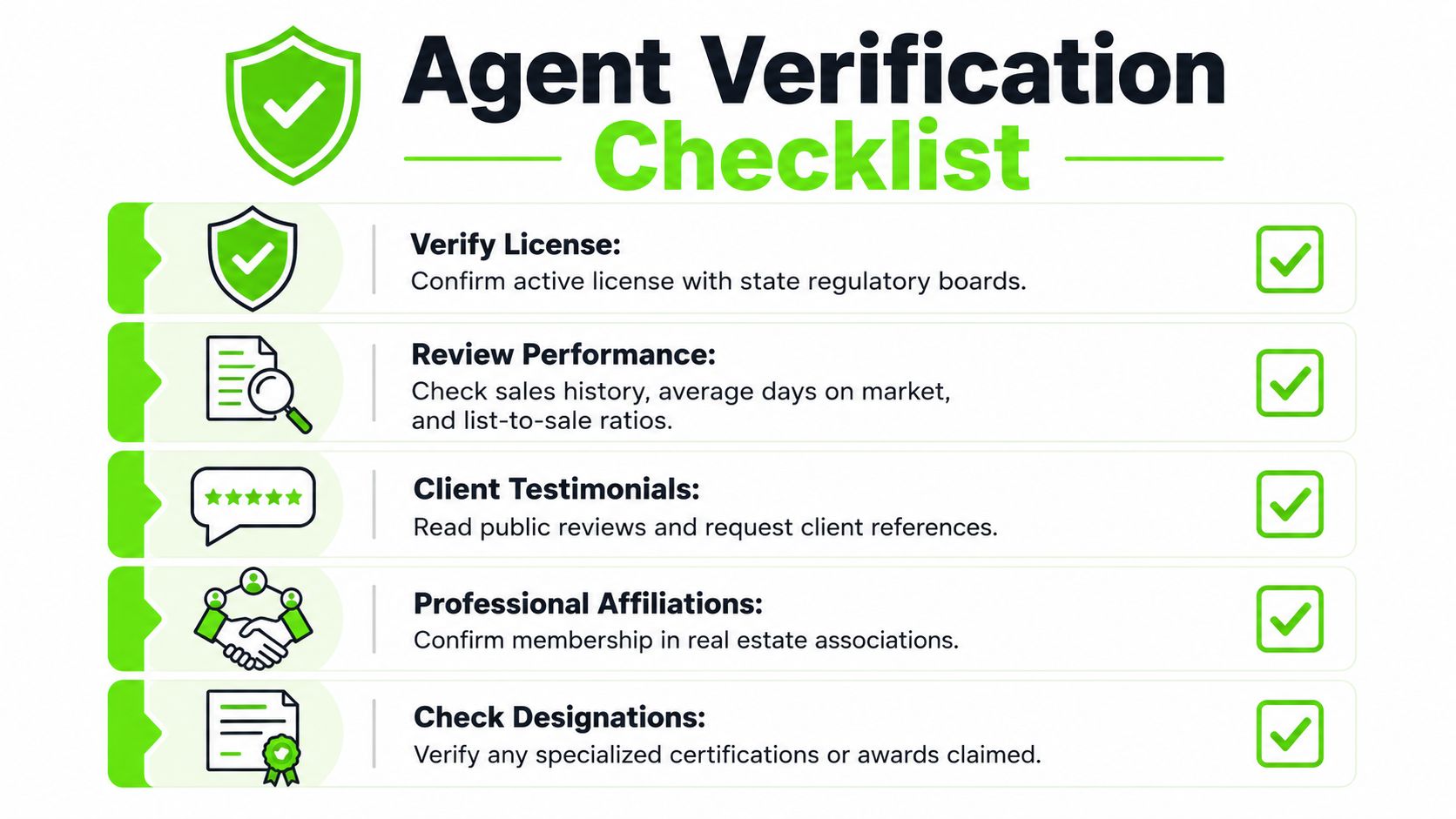
Check the licence first
In Australia, licensing is not optional. The path into the industry varies by state, but entry-level qualification commonly starts with the Certificate IV in Real Estate Practice (CPP41419), while running an agency or acting as licensee in charge requires the Diploma of Property (Agency Management) (CPP51122 or CPP50307), as outlined in this Australian licensing overview.
Start with the public register in the relevant state. In NSW, that means checking NSW Fair Trading. Confirm the person is currently licensed and that the name on the agreement matches the person you're dealing with.
Also pay attention to role and experience. In many Australian jurisdictions, agents need supervised industry experience before qualifying for a full licence. This guide to becoming a real estate agent in Australia notes that most Australian states require at least two years of continuous full-time experience before a full licence application.
Verify the track record independently
Don't rely on profile pages alone. Ask for a recent sales list and compare it with public records and portal history. When you review sold results, look for consistency with your brief.
Check for:
- Suburb relevance: Sales or purchases in your actual target area.
- Price-band match: Experience at your end of the market, not just prestige or entry-level stock if that's not your bracket.
- Asset similarity: Apartments are different from semis. Acreage is different from townhouses.
- Review patterns: Look at Google, Zillow, Realtor.com, and the Better Business Bureau if relevant to broader background checks, focusing on communication, negotiation, and problem-solving rather than generic praise.
HomeLight's vetting method is a good benchmark on this point. Their guidance on how to choose the right real estate agent recommends verifying the active licence, reviewing past sales through public records, checking reviews across platforms, and speaking directly with recent client references.
Verification habit: Ask for two recent clients whose situation resembles yours. Then ask those clients what happened when the deal got difficult.
That answer tells you more than any polished testimonial.
Recognizing Red Flags and Understanding Agreements
Some buyers think walking away from the wrong agent means losing momentum. Usually it means avoiding a mistake.
The most serious issue is conflicted representation. A critical red flag is the dual-agent pitfall. An agent representing both buyer and seller has a conflict of interest, and buyers should ask, “Do you, or does your agency, represent the seller of any properties you show me?” as highlighted in The Wall Street Journal's guidance on finding an agent.
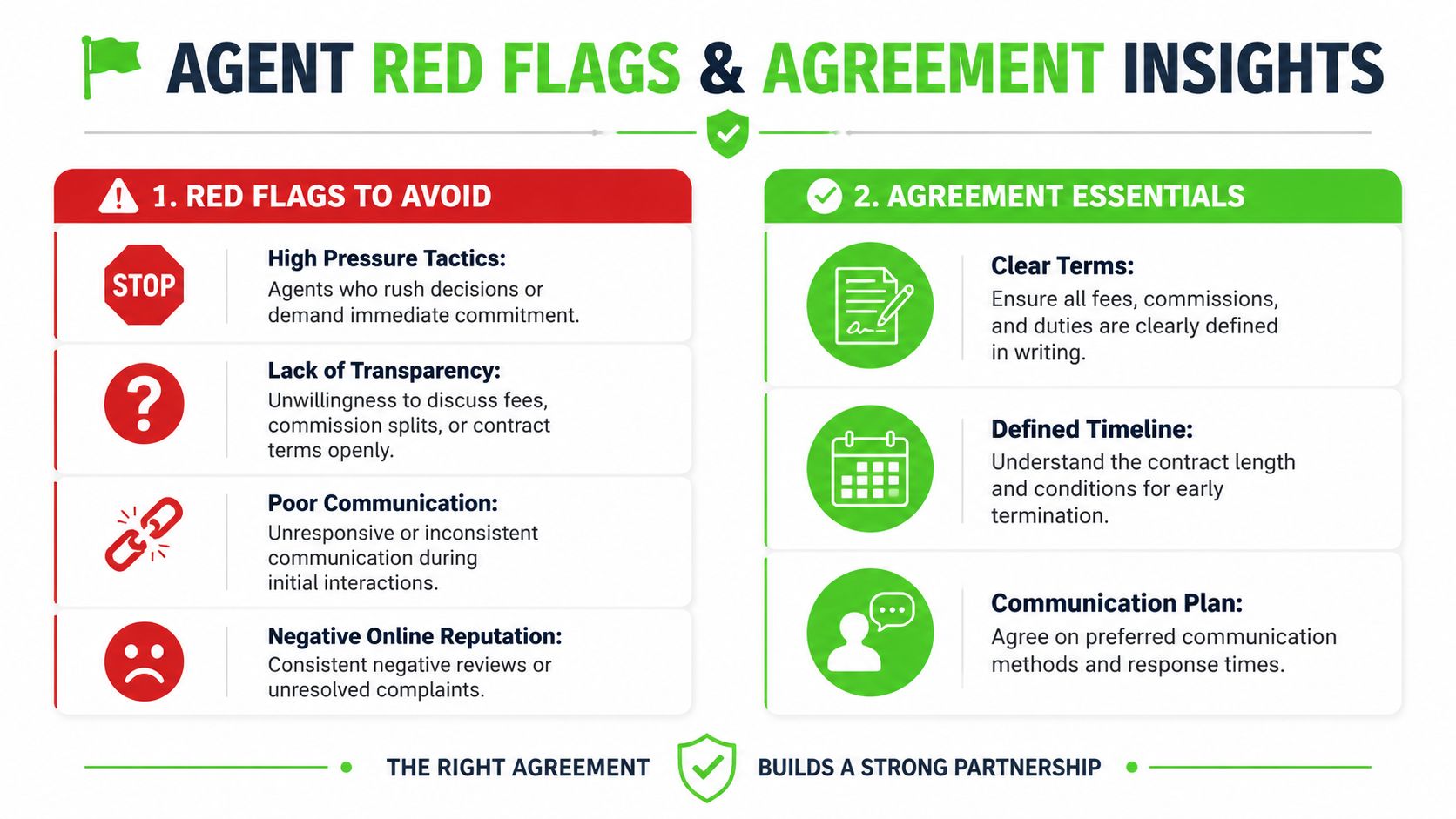
Red flags that should stop the process
These aren't minor concerns. They're reasons to pause or leave.
- Pressure before clarity: If an agent wants commitment before they've understood your brief, they're selling themselves, not serving your search.
- Vague answers about access: If they keep saying “we're very connected” but can't explain where opportunities come from, assume the network is thinner than advertised.
- Weak transparency: If fees, exclusivity, or scope of work stay fuzzy after you ask twice, don't sign.
- Poor responsiveness early: Communication rarely improves after you become a client.
- Thin digital footprint: A lack of verifiable track record, references, or professional presence makes proper due diligence harder.
If an agent becomes defensive when you ask basic questions about loyalty, fees, or process, that reaction is useful information.
What to read before signing
Most buyers skim the agreement and focus only on the fee. That's not enough. Read the entire engagement and make sure the commercial terms match the conversation you had.
Pay close attention to:
- Exclusivity: Are you tied to one agent for a set period?
- Duration: How long does the agreement run?
- Termination rights: Can you end it cleanly if the fit isn't right?
- Scope: Are they searching, inspecting, appraising, negotiating, bidding at auction, or doing only part of that?
- Fee structure: Fixed fee, retainer, success fee, or a combination.
If documents start getting dense, especially around title or legal attachments, tools that streamline property title examination can help you review technical paperwork more efficiently before you take anything to your solicitor for final advice.
A clean agreement should make the relationship safer, not more confusing. If the paper creates more uncertainty than confidence, keep looking.
Partnering for Success in Your Property Journey
If you want to know how to find a real estate agent who actually improves your outcome, stop treating the search like a directory exercise. The right process is sharper than that.
Start with a disciplined brief. Build a shortlist through trusted networks. Interview for substance, especially around suburb knowledge, negotiation method, and off-market access. Then verify everything independently before you sign. That sequence changes your position from reactive buyer to informed operator.
In Sydney and Byron Bay, the difference between an average agent and a strong one isn't cosmetic. It shows up in access, judgment, speed, and how well they protect you from bad stock and bad decisions. The best agents don't just open doors. They narrow your focus, tell you when something doesn't stack up, and give you a better chance of buying well in a market that rarely rewards hesitation.
Choose the person who gives you an edge, not the person who gives you the best pitch.
If you want experienced buyer-side representation in Sydney or Byron Bay, We Are Buyers Agents helps investors and home buyers secure the right property with strategy, due diligence, and negotiation support suited for competitive Australian markets.