
You're probably in one of two situations right now. You've found a property you like and you're worried about overpaying, or you haven't bought yet and the advice you're getting sounds blurred together. One person says you need a buyer's agent. Another says you need a consultant. A third sends listings and starts talking about suburbs before anyone has clarified your actual brief.
That confusion is common, especially for homebuyers and smaller investors in Sydney and Byron Bay where decisions are expensive, local nuance matters, and one wrong assumption can follow you for years. Real estate consulting services sit in that gap between broad market noise and a clean decision. They're not the same as buyer advocacy, and treating them as interchangeable usually wastes time and money.
Table of Contents
- What Are Real Estate Consulting Services
- Consultant vs Buyers Agent Making the Right Choice
- Core Offerings of a Real Estate Consultant
- The Consulting Process and What You Actually Get
- Calculating the ROI of Real Estate Consulting
- How to Choose the Right Consultant in Australia
- Real-World Success Stories
- Frequently Asked Questions
What Are Real Estate Consulting Services
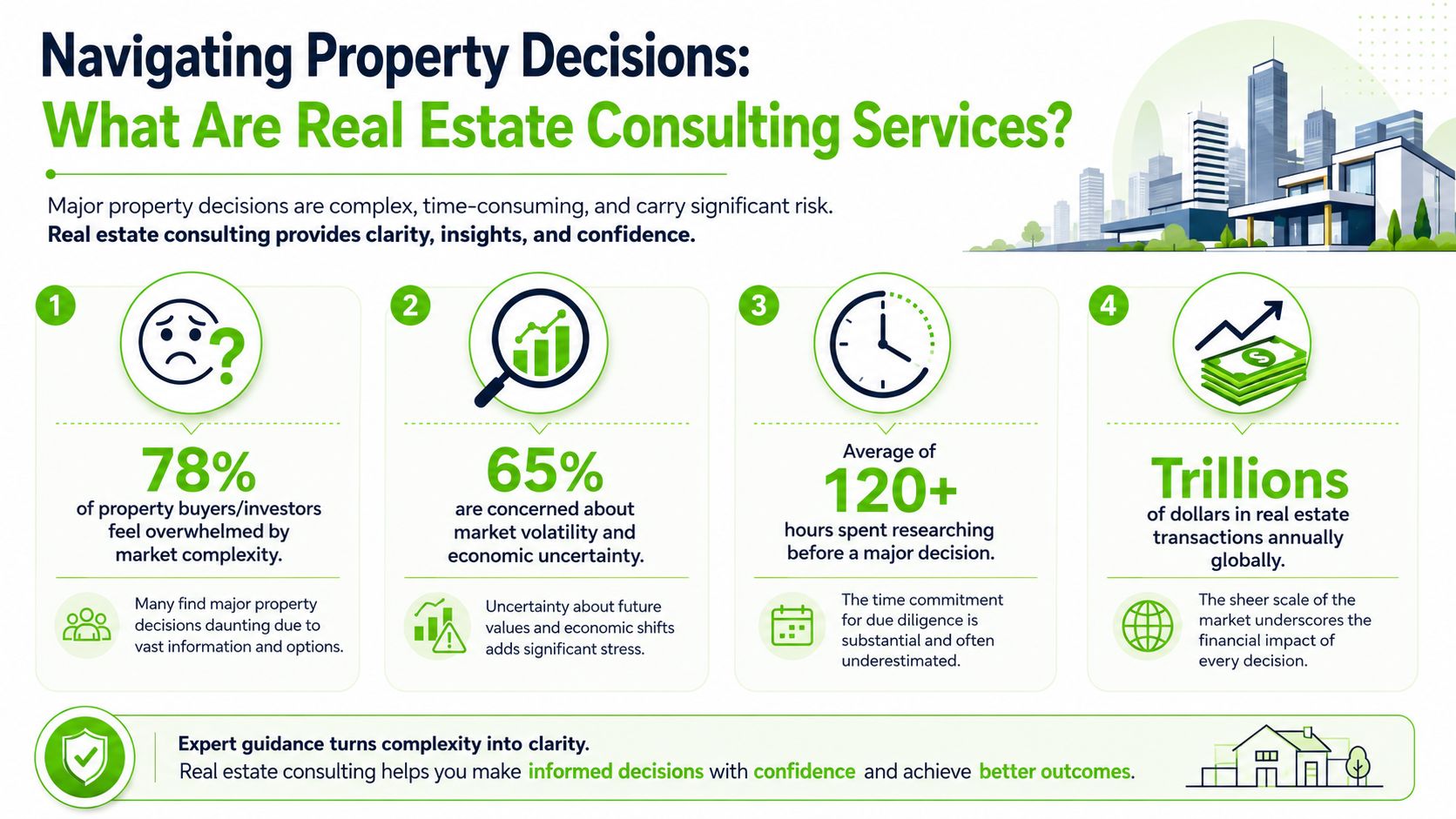
Real estate consulting services are strategic advisory services for property decisions. The consultant's job isn't to push a listing or get a deal done at any cost. It's to help you decide what to buy, what to avoid, how to assess risk, and whether a property fits your objectives.
For a homebuyer, that might mean pressure-testing a shortlist before you commit. For an investor, it can mean suburb selection, feasibility work, due diligence, or a second opinion on whether the deal makes sense at all. Good consulting reduces avoidable mistakes. That's the core value.
The field is growing because property decisions have become more layered. The global real estate consulting service market was valued at USD 14.7 billion in 2026 and is projected to reach USD 19.61 billion by 2030, expanding at a CAGR of 7.5%, according to Research and Markets. The same source attributes that growth to increasing complexity in property markets and rising institutional investor participation. Retail buyers feel that same complexity, even if they're buying one home instead of managing a fund.
What a consultant actually does
A consultant usually works upstream of the transaction. They help with:
- Clarifying your brief so you don't chase the wrong property type
- Testing assumptions around price, growth potential, planning issues, and risk
- Comparing options using evidence rather than emotion
- Building a decision framework you can use before you spend serious money
A buyer's agent might also provide some of this in practice, but the core consulting function is strategic analysis, not transaction management.
Practical rule: If your biggest problem is “I don't know what I should buy or whether this asset is right,” you're usually in consulting territory.
When it matters most
Consulting becomes more useful when the property isn't straightforward. Think split blocks, renovation potential, mixed-use edge cases, land with development upside, prestige homes where future buyer depth matters, or regional lifestyle markets where local rules can distort the headline story.
In those situations, “just buy the best house you can afford” isn't advice. It's a slogan. A consultant should give you a structured view of trade-offs so you can make a smart financial decision with open eyes.
Consultant vs Buyers Agent Making the Right Choice
A lot of buyers use these terms as if they mean the same thing. They don't. That confusion has a cost.
Market research indicates that 68% of individual investors in major markets like Sydney cannot distinguish between enterprise strategy consulting and investment advisory services, leading to significantly higher inquiry costs due to misaligned expectations, according to RCLCO. In plain English, people contact the wrong professional, ask for the wrong service, and pay for conversations that never fit the core need.
Real Estate Consultant vs. Buyer's Agent at a Glance
| Attribute | Real Estate Consultant | Buyer's Agent |
|---|---|---|
| Primary focus | Strategy, analysis, risk assessment, feasibility | Finding, evaluating, negotiating, and securing a property |
| Best for | Buyers who need clarity before acting | Buyers who are ready to acquire |
| Typical deliverable | Advice, reports, benchmarking, recommendations | Property search, inspections, negotiation, bidding, purchase management |
| Payment structure | Usually fee-for-service for advisory work | Commonly fee-based acquisition support, sometimes with staged service packages |
| Scope | Broad. Can include highest and best use, market positioning, due diligence, and portfolio thinking | Transaction-oriented. Usually tied to a specific purchase brief |
| Relationship to stock | Should be objective and less tied to any single listing | Usually active in market engagement and deal execution |
| Ideal client question | “Should I buy this, and why?” | “Can you help me buy the right property?” |
The cleanest way to choose
If you already know your budget, target area, asset type, and purchase criteria, a buyer's agent is often the right hire. They add value through sourcing, access, appraisal, negotiation, and execution. If you want a grounded explanation of the role, this guide on what a buyer's agent does is useful.
If your brief is still loose, or your options are unusually complex, consulting comes first. That's especially true when buyers are comparing very different paths, such as:
- Primary home vs investment-grade home
- Sydney apartment vs Byron Bay house
- Renovate now vs land-bank
- One premium asset vs two smaller assets over time
The wrong hire usually shows up early. If the professional starts talking properties before they've clarified your objectives, they may be solving the wrong problem.
Where people get this wrong
The most common mistake is hiring an acquisition specialist when the underlying issue is strategic uncertainty. Buyers then expect suburb strategy, planning analysis, development logic, tax-aware structuring conversations, and long-range portfolio thinking from a brief that was really designed to purchase one asset.
The reverse happens too. Some buyers pay for high-level advisory when what they really need is someone to inspect, shortlist, negotiate, and close.
A simple test helps. Ask yourself this question: Am I confused about the decision, or do I just need help executing it? If it's the first one, consulting is usually the better starting point. If it's the second, a buyer's agent is often the sharper tool.
Core Offerings of a Real Estate Consultant
Consulting sounds abstract until you break it into deliverables. In practice, most real estate consulting services fall into a small set of useful workstreams. The value comes from getting the right one at the right time.
Market and feasibility work
This is the pre-flight check. Before you commit to a suburb, site, or project, the consultant tests whether the idea holds up.
That can include supply pressure, buyer depth, resale appeal, development constraints, or whether your budget is misaligned with your objective. For a homebuyer, feasibility might mean comparing two family homes where one has better school-zone appeal and lower future downside. For a small developer, it might mean deciding whether a site is worth pursuing at all.
Pre-acquisition due diligence
Good advice prevents pain. A consultant looks past the sales story and checks what could affect value, usability, future resale, or execution. Examples include awkward planning overlays, overcapitalised renovation assumptions, flood or access issues, unsuitable layouts, and niche attributes that narrow your buyer pool later.
Good consultants also present findings clearly. If you're reviewing property reports, proposals, or online listings, the way information is structured matters. That's why practical resources like these UI/UX tips for real estate homepages are surprisingly relevant. Clear design helps buyers compare information faster and spot what's missing.
Highest and best use analysis
This sounds technical, but the question is simple. What is the smartest use of this asset?
For some properties, the answer is to hold and do nothing. For others, it may be renovate lightly, reconfigure, add value later, or avoid the asset because the upside is already priced in. In this respect, consultants differ from deal chasers. They should be willing to tell you that a property is fine, but not fine for you.
Portfolio and decision strategy
Not every client wants a single property recommendation. Some want a roadmap. A consultant can help sequence decisions so today's purchase doesn't block tomorrow's flexibility.
That matters when buyers are deciding between:
- Lifestyle first and accepting weaker investment fundamentals
- Yield first with less owner-occupier appeal
- Land content first with a longer hold horizon
- Diversification across city and regional markets
Good consulting narrows choices. If the process leaves you with more noise than you started with, the work hasn't done its job.
The Consulting Process and What You Actually Get
The consulting process is usually far more structured than buyers expect. When it's done properly, you're not paying for vague opinions. You're paying for a repeatable method that turns messy market information into a usable decision.
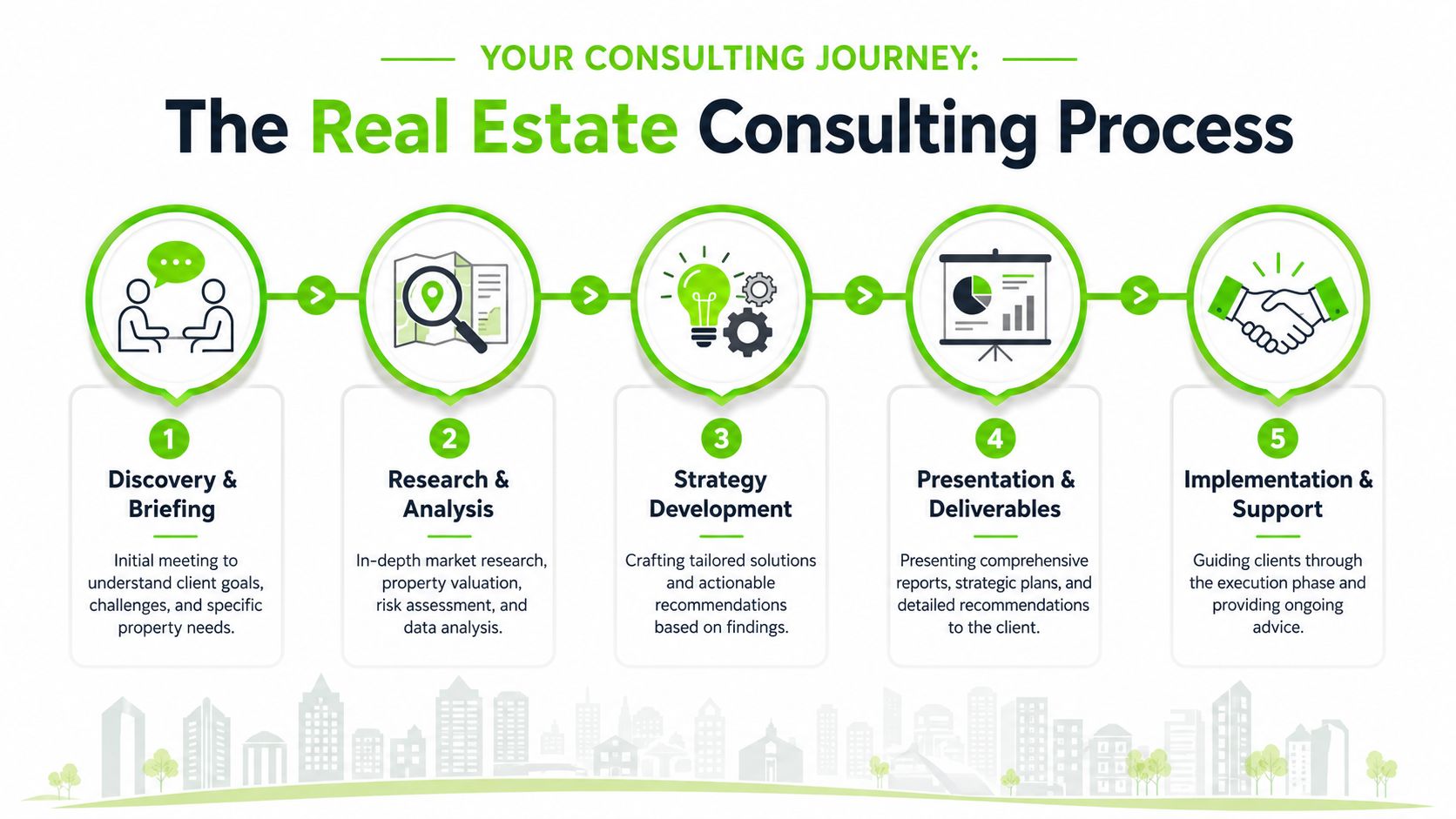
Stage one to stage three
It usually starts with a proper brief. Not a quick phone chat, a real brief. The consultant should pin down your goal, budget, risk tolerance, timeline, and what would make the purchase a success or a regret.
Then comes research and analysis. Methodology is critical. Consultants don't just glance at current listings and call it a day. They use comparative evidence, planning context, and local market patterns to test value and suitability. One useful benchmark approach is outlined by Suburban Real Estate, which describes a weighted comparative methodology using 1.0 for a recent exact match, 0.8 for a near match, and 0.6 for similar types with older data, based on closed transactions rather than asking prices.
That distinction matters. Listings show ambition. Closed evidence shows what buyers paid.
If you want to see how a transaction process differs once strategy is already set, this breakdown of a buyer's agency process from brief to settlement gives a useful contrast.
What lands on your desk
A proper consulting engagement should leave you with tangible output, not just a phone call summary.
That often includes:
- A written brief review with clarified goals and constraints
- Comparable property analysis based on settled evidence
- Risk notes covering issues that could affect value or usability
- Decision recommendations such as proceed, renegotiate, hold off, or redirect
- Scenario thinking if you're weighing more than one path
What good looks like
The best reports are direct. They don't hide behind jargon or swamp you with screenshots. They answer the questions that matter.
A useful report should tell you:
- What this asset is worth in context
- Why it suits or doesn't suit your objective
- What the main risks are
- What action makes sense next
If a consultant can't explain their view in plain language, they probably don't understand it deeply enough.
Calculating the ROI of Real Estate Consulting
Many buyers hesitate. They can see the value of advice in theory, but they can't see how to measure it, especially if the property isn't a rental.
That hesitation is real. According to John Burns Research and Consulting, 74% of individual investors in markets like Sydney rejected consulting for non-rental properties due to “unclear ROI metrics,” as noted by John Burns Research and Consulting. That makes sense. If you're buying a home, not an income stream, the return isn't just yield.
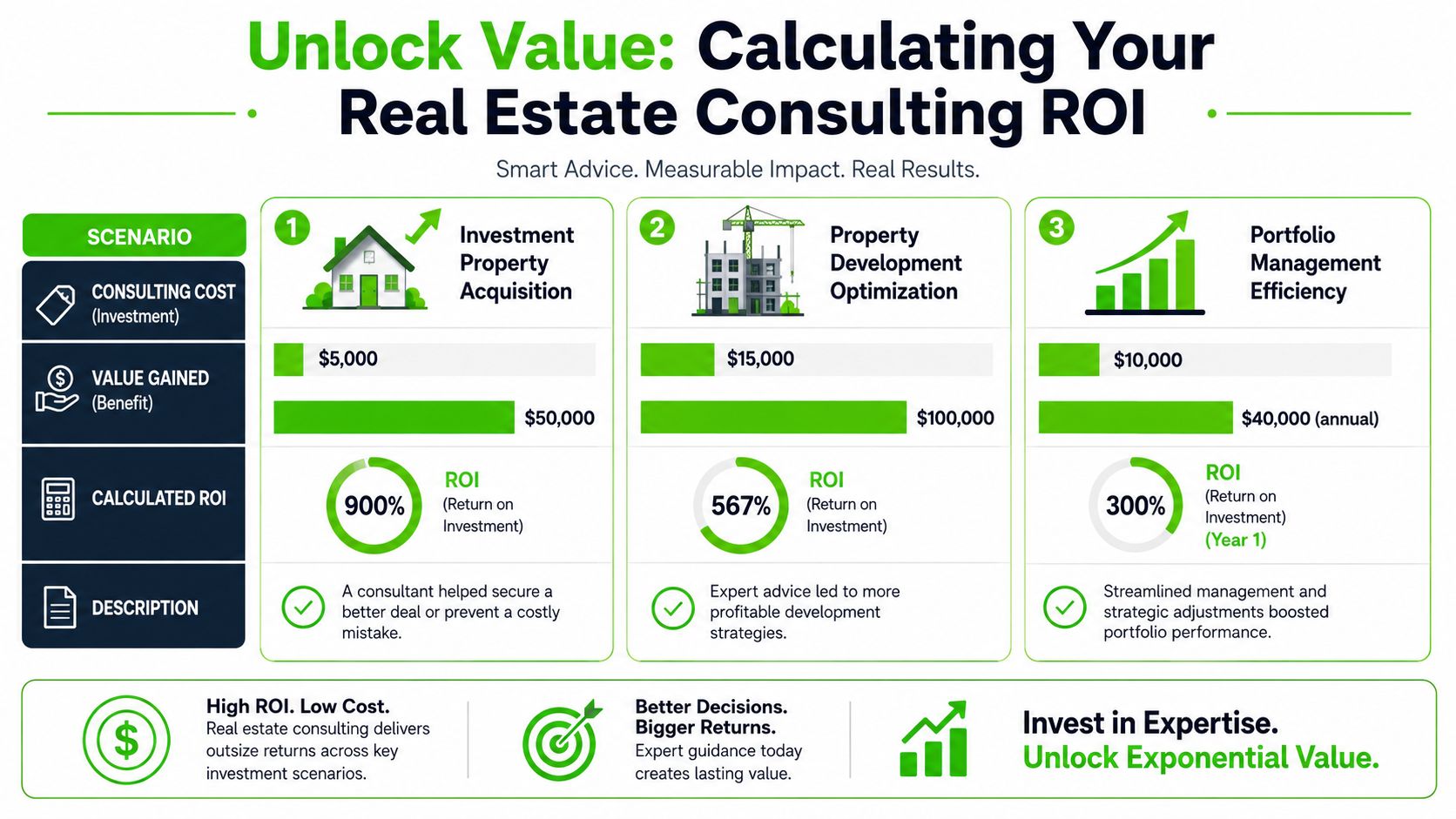
A simple framework helps. ROI from consulting usually shows up in one of three places: better buying, avoided loss, or improved decision timing.
ROI for an investor
For an investor, the calculation is usually easiest. If the consultant helps you avoid an overpriced asset, identify a stronger location, or challenge a bad assumption in your feasibility, the financial benefit can be estimated against the advisory cost.
You don't need a complicated model to start. You can compare:
- Expected purchase quality before and after advice
- Risk-adjusted upside between shortlisted options
- Likely cost of a mistake if a weak asset slips through
If you're assessing a rental purchase, practical tools for rental property ROI calculations can help you isolate the operating side of the deal. Consulting ROI sits on top of that. It's the value of making a better entry decision, not just a better spreadsheet.
ROI for a homebuyer
For an owner-occupier, the return often comes from cost avoidance and better long-term positioning. That could mean avoiding a property with poor resale depth, hidden constraints, or expensive future compromises.
A practical consideration to keep in mind:
- Cost avoided if due diligence uncovers an issue before purchase
- Negotiation advantage created by stronger evidence
- Resale protection if the selected property has broader future appeal
- Lifestyle fit that reduces the chance of an expensive early exit
The key is to treat your home as both a place to live and a large capital decision. Not every return shows up as rent.
Here's a useful mental model. If consulting changes your decision from a merely acceptable property to one that better holds demand over time, that's value. If it stops you buying a compromised asset because you were rushing, that's also value.
This short video explains the broader thinking around value and property decisions:
What doesn't work
What doesn't work is demanding a neat formula for every asset type. Some returns are measurable immediately. Others show up through mistakes you never make. Buyers get stuck when they only count rental yield and ignore downside protection, flexibility, and purchase discipline.
That's why the better question isn't “Will consulting guarantee profit?” It's “Will this advice improve the quality of a high-stakes decision enough to justify the fee?” In many cases, that's the right test.
How to Choose the Right Consultant in Australia
Australia has no shortage of property professionals. The challenge is sorting generalists from specialists and deciding who fits your brief.
The field is large. Australia's Real Estate Services industry comprises 45,522 businesses and grew at a CAGR of 1.3% between 2021 and 2026, according to IBISWorld's analysis of the Australian real estate services industry. That scale is useful context. It also means title inflation is everywhere. Plenty of people describe themselves as advisors. Fewer can show a disciplined advisory process.

Questions worth asking
Start with these before you hire anyone:
- What type of work do you mostly do? You want to know whether they mainly advise, mainly transact, or blur the two.
- What is your process? Good consultants can explain their research, benchmarking, and recommendation method clearly.
- What will I receive? Ask whether the output is verbal guidance, a report, a shortlist analysis, or ongoing advisory support.
- Where do you add the most value? The honest answer should be specific. Suburb selection, prestige homes, development sites, family homes, or portfolio planning.
- When are you not the right fit? This is one of the best filters. Serious operators know their edge.
If you're still deciding whether you need broad buying support across markets, this overview of a buyer's agent in Australia can help distinguish acquisition support from strategy-led consulting.
Sydney specifics
Sydney isn't one market. It's a collection of micro-markets with different buyer pools, school-driven demand, transport premiums, planning constraints, and resale behaviour. A consultant who's strong in the Inner West may not be the right advisor for upper North Shore family homes or eastern suburbs downsizer stock.
For Sydney, ask for evidence of experience in your exact segment:
- Family house markets where school zoning and land utility matter
- Apartments where supply, strata quality, and future competition matter
- Value-add opportunities where renovation assumptions need to be realistic
- Prestige stock where buyer depth can change sharply between streets
Byron Bay specifics
Byron Bay rewards local understanding. Lifestyle demand, holiday letting dynamics, local regulation, surrounding village differences, and buyer emotion all shape outcomes. A consultant who only knows metro logic can miss what makes a Byron property hold value or carry risk.
The strongest local advisors usually understand:
- Council and planning nuance
- Holiday letting sensitivity
- Lifestyle-driven buyer behaviour
- The difference between a great stay and a great long-term asset
A consultant doesn't need to know every postcode in Australia. They do need to know your market deeply enough to challenge easy assumptions.
Real-World Success Stories
A Sydney first-home buyer narrowed her search to two houses in neighbouring streets. On paper they looked similar. The consultant's work focused on the details that don't show well in listing copy: street position, future renovation practicality, and a planning issue affecting one property's long-term flexibility. The recommendation was to buy the less glamorous option because it had the cleaner risk profile and stronger family-buyer appeal for resale. The buyer skipped the prettier house, which had a hidden downside, and bought with more confidence because the decision was based on evidence rather than emotion.
A Byron Bay investor approached the market wanting “something with lifestyle appeal and decent income.” That's not a real brief. It's a wish list. The consulting work tightened the objective, tested nearby options, and separated properties that looked good on holiday platforms from properties that made sense as part of a broader wealth plan. The eventual recommendation wasn't the most photogenic asset. It was the one that balanced yield potential, local demand resilience, and the buyer's risk tolerance.
Why these examples matter
Neither story depends on a miracle suburb pick or a heroic off-market deal. That's the point.
The practical value of real estate consulting services often comes from:
- Asking better questions early
- Rejecting properties that don't fit
- Clarifying trade-offs before money is committed
- Creating confidence in the final decision
That's usually how smart property decisions are made. Methodically, and before the contract is signed.
Frequently Asked Questions
Can a real estate consultant also negotiate and buy the property for me
Sometimes, but not always. Some firms provide both strategic advice and acquisition support. Others stop at the advisory stage. Ask this upfront. If you need negotiation, bidding, and purchase management, make sure the service agreement includes those tasks rather than assuming they're bundled in.
Are real estate consulting services only for large investors
No. They're often most useful for individual buyers when the decision is unusually expensive, complicated, or hard to compare. A first-home buyer choosing between two very different Sydney options can benefit just as much as an experienced investor reviewing a development site. The trigger isn't portfolio size. It's decision complexity.
What happens after I receive the consultant's report
That depends on the brief. Some buyers use the report to make their own call. Others use it to renegotiate, abandon a poor option, refine their suburb list, or hand a clearer mandate to a buyer's agent. A good report should make the next step obvious. If it doesn't, ask for a direct recommendation in writing.
If you want experienced help buying well in Sydney, Byron Bay, or elsewhere in Australia, We Are Buyers Agents is a practical place to start. Their team works with property buyers and investors who want sharper strategy, clearer guidance, and support through the buying process.