
You're probably in one of two positions right now. You've spent weeks refreshing the portals, watching decent Sydney stock disappear before the first open, or you're trying to buy in Byron Bay and every listing seems either overexposed, overpriced, or already spoken for. The public market feels crowded because it is. By the time a quality property is visible to everyone, you're competing with everyone.
That's why serious buyers stop acting like browsers and start acting like source hunters. If you want to learn how to find off market properties, you need a method that fits how deals move in Sydney and Byron Bay. Some move through agent relationships. Some through landlord and vendor conversations before a campaign starts. Some now circulate in private digital channels. And some are available only to buyers who've done enough groundwork that an agent is willing, and able, to bring them into the room.
Table of Contents
- Why the Best Properties Are Not Listed Online
- The Ground Game Building Your Off-Market Network
- Direct Outreach Without Being a Nuisance
- How to Legally Access Agent-Exclusive Listings
- Digital Detective Work Finding Modern Off-Market Deals
- Your Off-Market Playbook Due Diligence and Negotiation
Why the Best Properties Are Not Listed Online
Buyers often assume off-market means rare, secret, or only available to insiders. That's the wrong frame. Off-market means the property is sold or offered outside the broad public portals and public campaign machinery.

Off market is not a myth
The easiest way to understand the scale is to stop thinking of it as a fringe tactic. Analysis of the comparable U.S. market shows that about 1.2 million homes sold off-market in 2024, which is why practitioners treat it as a recurring supply channel rather than a lucky exception, according to Property Onions summary of the cited market analysis.
That matters in Australia because the behaviour is familiar even if the local data is harder to access cleanly. In Sydney's inner ring and in lifestyle markets such as Byron Bay, many vendors value privacy, controlled inspections, and a quick decision more than a highly public campaign. Others test buyer appetite privately before committing to photography, styling, and a formal launch.
Practical rule: If you're waiting for a listing to become obvious, you're entering the process after the seller has already chosen maximum exposure.
What counts as off market in Sydney and Byron Bay
In practice, buyers usually encounter a few versions:
- Pre-market opportunities where an agent is sounding out selected buyers before a campaign starts.
- Quiet vendor sales where the owner will sell, but doesn't want a public campaign.
- Relationship deals passed through solicitors, property managers, builders, or repeat local operators.
- Direct-to-owner situations where a buyer identifies a likely seller before any agency launch.
Sydney and Byron Bay both reward local knowledge, but for different reasons. In Sydney, speed and clear buying criteria matter because agents filter quickly. In Byron Bay, discretion often matters more because owners may be testing demand without wanting to be seen as actively selling.
A public listing platform is useful for tracking value and stock movement. It's not a complete sourcing strategy. Buyers who consistently access better opportunities usually have a tighter process, stronger local relationships, and a clearer way to signal that they're ready to transact.
The Ground Game Building Your Off-Market Network
The off-market search still starts with people. Technology helps, but properties move because someone hears a landlord is tired, a family is preparing an estate sale, a builder knows a site owner is open to offers, or an agent has a vendor who wants a quiet deal.
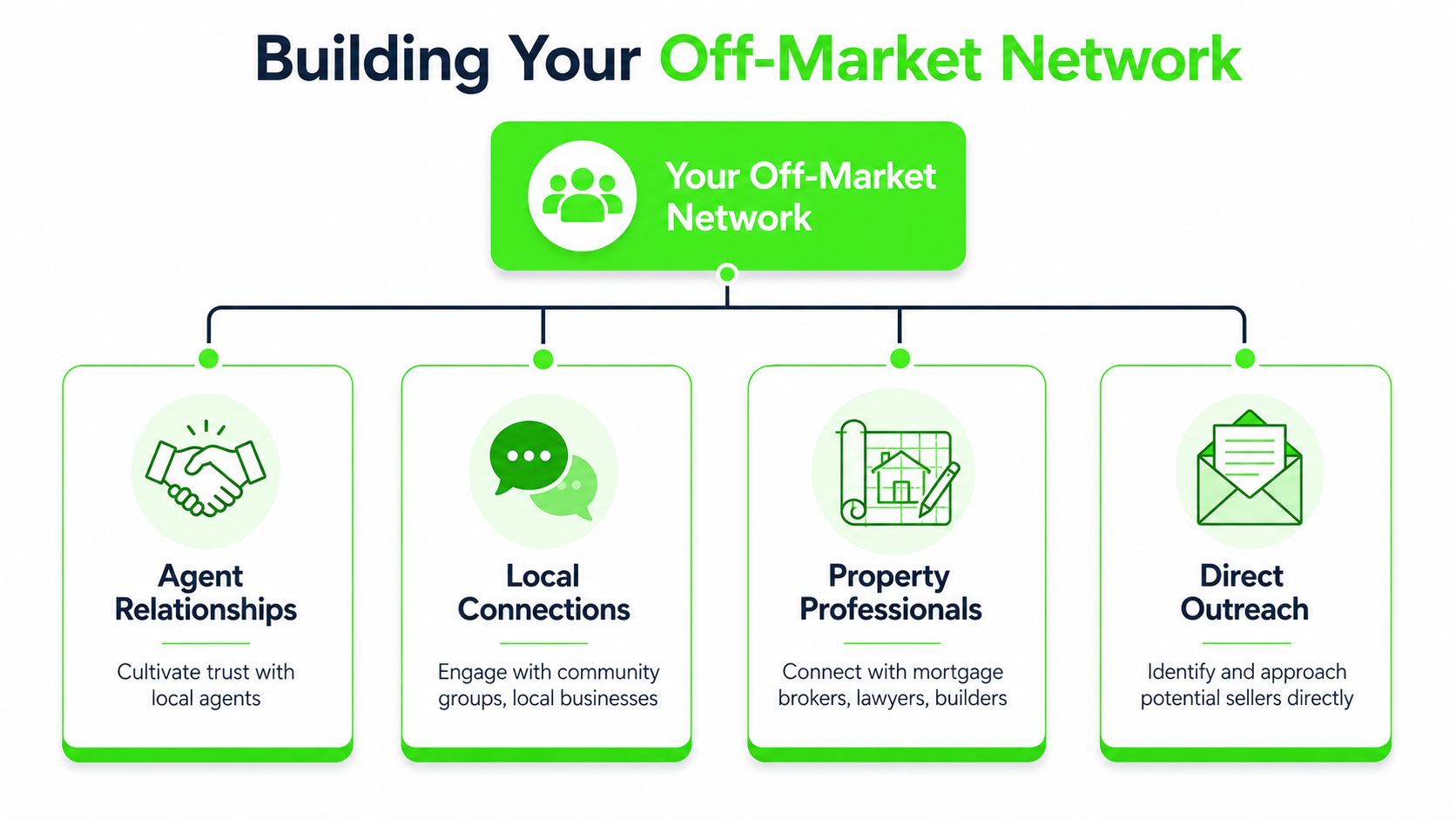
Who hears about a sale before the portals do
A lot of buyers make one mistake here. They only call sales agents. That's too narrow.
Use a wider contact map:
| Contact | Why they matter | What they may know |
|---|---|---|
| Sales agents | They hear vendor intentions first | Pre-market and selectively shared listings |
| Property managers | They speak with landlords regularly | Owners considering a sale at lease end or after maintenance issues |
| Solicitors handling estates | They know when families need a clean sale path | Probate-related opportunities and quiet sales |
| Builders and trades | They see distressed, inherited, or half-finished properties | Owners who may prefer a direct sale |
| Mortgage brokers | They hear borrower pressure and restructuring plans | Early signs of a coming sale |
The common thread is motivation. You're trying to identify who gets the earliest signal that a property might move.
A buyer who understands this will build a repeatable routine. Call the same people regularly. Be specific about suburb, property type, budget, and must-haves. Then make it easy for them to remember you.
What makes people actually send you opportunities
People don't send deals to vague buyers. They send them to buyers who look credible and easy to work with.
This is what helps:
- A tight brief: Give agents and referrers a one-page summary with suburbs, budget range, asset type, land preferences, renovation tolerance, and timing.
- Proof of readiness: Mention finance position, decision speed, and who is advising you.
- Useful follow-up: Don't just say “keep me in mind.” Check in with a short update when your brief changes.
- Professional data support: If you're building agent contact lists in a structured way, tools and list-building workflows like HarvestMyData's real estate agent guide can help organise outreach without turning it into random prospecting.
There's also a commercial reason this effort matters. A study by Bright MLS found on-market homes sold for 17.5% more on average than off-market properties, which helps explain why buyers and investors keep chasing private deals where a seller values speed, convenience, or privacy over maximum public competition, as outlined in Quicken Loans' review of off-market property dynamics.
Don't try to know every agent in Sydney. Know the right agents in your exact pockets, then become the buyer they trust to move quickly and cleanly.
For buyers who want a benchmark for how professionals handle this process, this Sydney buyer's agency explanation of hidden property sourcing is a useful reference point. It shows what a structured off-market search looks like when networking is treated as a system, not a one-off favour request.
Direct Outreach Without Being a Nuisance
Old-school door knocking still gets talked about because it sounds proactive. In Sydney and Byron Bay, it often lands badly unless the circumstances are unusually warm. Owners are more privacy conscious, and many can spot an opportunistic buyer within seconds.
A better approach is targeted, respectful outreach to owners who already show signs they may transact.
Target the owners most likely to move
The strongest direct outreach doesn't begin with a script. It begins with selection.
Look for owners in categories such as:
- Expired listings: These owners already tried to sell and may still be open to a private transaction.
- Properties showing neglect or vacancy: Think obvious deferred maintenance, uncollected mail, or signs the property isn't owner occupied.
- Development application activity: Planning changes can signal a future sale, a subdivision, or a shift in the owner's timeline.
- Estate and legal transition situations: These require tact, but they often involve practical sale decisions rather than aspirational pricing.
The key point is that expired listings are more effective than pure cold outreach because motivation is already validated. Data shows that 20-30% of owners whose listings have expired are still willing to sell via a private transaction if approached correctly, based on PropStream's overview of off-market sourcing methods.
A letter that sounds like a buyer not a spammer
Most direct mail fails because it sounds automated, aggressive, or too clever. Your letter should sound calm, local, and easy to ignore without offence.
A workable template is simple:
Hi [Owner Name],
I'm looking to buy in [Suburb/Street Pocket] and noticed your property may suit what I'm after.
If you've considered selling, either now or in the near future, I'd be happy to have a quiet, straightforward conversation. No pressure and no assumptions.
I'm not looking to waste your time. If a private discussion would be useful, you can contact me on [Phone/Email].
Regards,
[Name]
That works better than hype because it respects the owner's position. You're not pretending there's urgency. You're offering an option.
If you want to add SMS into the mix, do it carefully and only where you've got a lawful basis and a sensible process. Short, human follow-up performs better than hard selling. For practical messaging ideas, unlocking real estate SMS power is a useful tactical read.
What doesn't work well in these markets? Generic postcards, repeated unsolicited contact, and broad suburb-wide blasts with no targeting logic. They create noise, not deal flow.
How to Legally Access Agent-Exclusive Listings
Most buyers think they can ring an agent and say, “Let me know if you have anything off market.” Sometimes that gets you added to a database. It rarely gets you access to the best private opportunities.
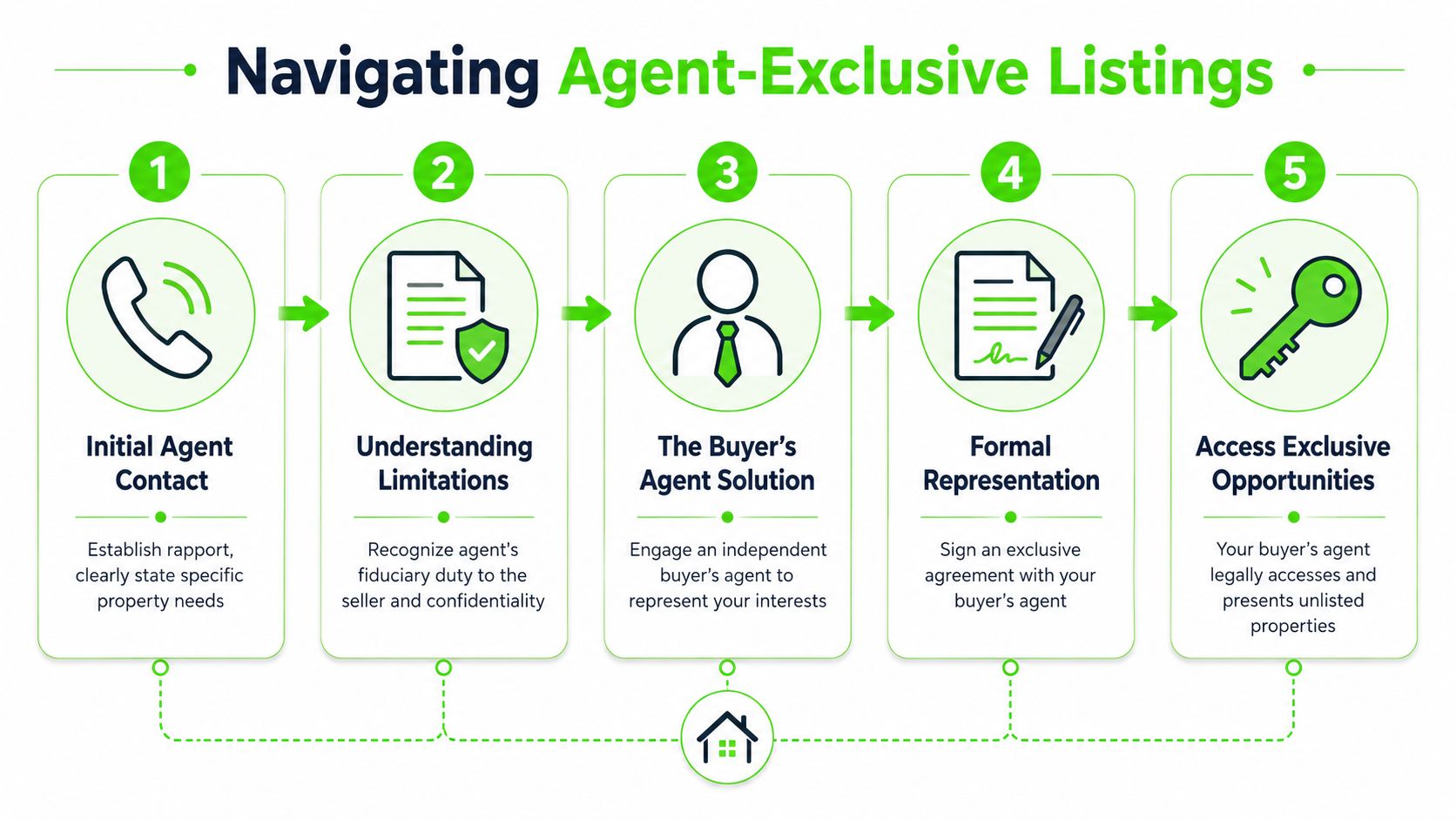
Why most buyers get brushed off
In competitive markets like Sydney, an estimated 70% of off-market deals are brokered through agent-to-agent or agent-to-mandated-buyer networks. That changes the access rules. An agent isn't withholding stock on a whim. They're working within vendor instructions, confidentiality obligations, and a professional duty to manage how the opportunity is shared.
For a DIY buyer, that creates a real barrier. If you're unknown, vague, or clearly just “seeing what's around,” many agents won't risk circulating sensitive opportunities to you. In quieter Byron Bay transactions, this is even more obvious. Vendors often want discretion, qualified buyers only, and minimal chatter.
The private market rewards buyers who are easy to verify, easy to brief, and easy to put in front of a vendor.
A proper explanation also matters legally. In Australia, agents are often prohibited from disclosing these opportunities to the general public unless the buyer has a signed mandate or sits within a formal representation framework. That's why casual callers often hear nothing useful.
This short video gives a practical overview of how the process works from a buyer representation angle:
How to become a buyer an agent can deal with
You don't need to become an insider. You need to become legible.
Prepare these before you ask for access:
A concise buyer brief
Include target suburbs, price range, asset type, minimum requirements, and what you'll compromise on.Your buying structure
Say whether you're owner-occupying or investing, whether finance is arranged, and who your solicitor or broker is.Your decision protocol
Agents need to know how quickly you inspect, assess, and respond.A formal mandate where appropriate
This is the point many DIY buyers miss. If an agent can see you're represented or formally mandated, they can often deal with you in a way they can't with an unverified enquirer.
For some buyers, appointing representation is the cleanest route. One option is We Are Buyers Agents, which states that off-market and pre-market access is part of its property search and acquisition work in Sydney and Byron Bay. That kind of arrangement doesn't magically create stock. It formalises your position so agents know who you are, what you need, and how to transact with you.
What doesn't help is asking every local agent for “anything off market” and hoping one will break process for you. Good agents won't.
Digital Detective Work Finding Modern Off-Market Deals
A lot of off-market activity has shifted online, just not onto the big portals buyers watch every day. The buyers who adapt well treat the internet less like a listings page and more like a pattern-recognition tool.
Where digital deal chatter now happens
In Australia, up to 38% of off-market deal chatter now occurs in private online forums and encrypted groups, which means a substantial slice of opportunity never appears in the normal portal workflow. That matters in Sydney investor circles and in Byron Bay networks where local operators, referrers, and connected buyers often hear about vendor intent before anything public happens.
That doesn't mean joining every group you can find and spraying messages around. It means entering the right circles in a credible way. Some are investor forums. Some are local business communities. Some are referral-heavy chat groups where people share quiet opportunities only with members they know.
If a digital group is full of noise, screenshots, and anonymous claims, treat it as entertainment, not pipeline.
How to read signals before a property is widely known
The better use of digital channels is often indirect. Instead of waiting for someone to post a property, watch for clues that a sale is becoming more likely.
Examples that matter:
- Repeated local discussion about a landlord exiting a suburb
- A builder or planner mentioning an owner has changed direction
- A property that disappears from one channel but keeps resurfacing in conversation
- Ownership and planning patterns that suggest a decision point is approaching
For this kind of work, public record analysis becomes useful. A practical starting point is this guide to property searches using tax and record data, which helps buyers move from gossip to verifiable lead research.
A serious buyer in Sydney might pair local Facebook community observation with planning portal checks and ownership records. In Byron Bay, the same buyer might watch for properties privately floated among local business contacts, then verify title, overlays, and transaction context before making any approach.
Digital sourcing works best when you use it to narrow attention, not replace judgment.
Your Off-Market Playbook Due Diligence and Negotiation
Finding an unlisted property is only half the job. Off-market deals can be cleaner than public campaigns, but they can also hide information gaps. You're often operating with less theatre, less transparency, and fewer public pricing cues.
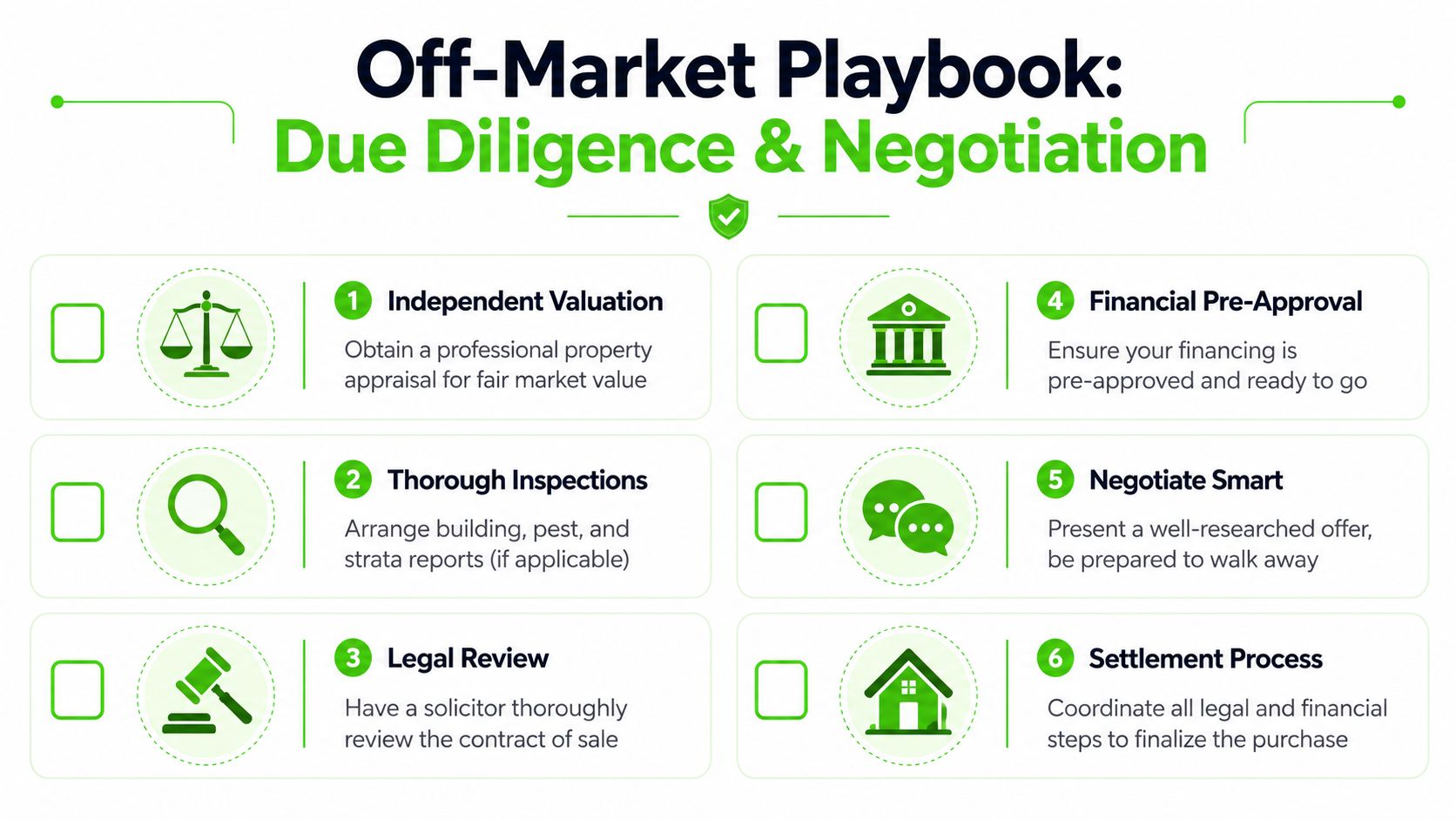
What to check when there is no public campaign
The due diligence list for an off-market property should be stricter, not looser.
Focus on the basics first:
- Contract review: Have a solicitor check title, easements, zoning issues, and any unusual special conditions.
- Building and pest: Off-market doesn't mean lower risk. It often means fewer eyes have looked.
- Approval history: Verify whether renovations, additions, decks, pools, or granny flats were properly approved.
- Comparable sales analysis: Build your own view of value rather than leaning on a sales pitch.
- Strata records where relevant: In Sydney apartments especially, this can reveal building issues that a quiet sale won't advertise.
- Settlement fit: Confirm timing, tenant status, inclusions, and access conditions before you negotiate hard on price.
If you're gathering listing and comparable information from multiple web sources, workflows built around webpage content extraction can help organise messy public data into something reviewable. It's not a substitute for legal or valuation advice, but it can reduce manual noise when you're checking multiple signals across a suburb.
How to negotiate when privacy and speed matter more than theatre
Off-market negotiation isn't always about squeezing the last dollar. Often, the key advantage is certainty.
A seller who avoids a campaign may care about one of these more than price maximisation:
| Seller priority | What your offer should show |
|---|---|
| Privacy | Limited inspections, controlled information flow, discreet terms |
| Speed | Finance readiness, short decision windows, clean communication |
| Simplicity | Fewer moving parts, realistic conditions, aligned settlement timing |
| Certainty | Strong deposit position, responsive solicitor, no performative renegotiation |
That changes how you present. A clean offer with clear terms can beat a slightly higher but messy one.
In Byron Bay especially, where lifestyle stock can attract emotional buyers, discipline matters. Don't overpay just because the property feels “special” and isn't publicly listed. In Sydney, don't assume off-market automatically means cheap. Some owners want discretion and still expect a full result.
Buy the property, not the story around the property.
For buyers weighing whether to handle the whole process alone, the sensible question isn't “Can I find an off-market property myself?” It's “Can I source it, verify it, value it, and negotiate it without missing a risk or overplaying my hand?” If that answer is uncertain, professional representation becomes a risk-management decision, not a luxury.
For a practical example of how this applies in a local market, this Byron Bay off-market and due diligence guide is worth reading. It's particularly relevant when a property looks attractive on access alone, but a significant advantage will come from what you uncover before exchange and how you structure the offer.
If you want help sourcing, assessing, and negotiating off-market opportunities in Sydney or Byron Bay, We Are Buyers Agents works with buyers who want a structured search process rather than more portal fatigue.