
Saturday morning. You're standing on the kerb outside a Sydney terrace or apartment block, contract already reviewed, deposit ready, family group chat going quiet because everyone knows what's about to happen. The auctioneer starts talking fast. A few buyers look calm. Most aren't. If it's your first auction, it can feel like the whole process is designed to make you panic and bid past your comfort zone.
It isn't random. It isn't magic either.
Knowing how to win an auction has less to do with bravado than most buyers think. The buyers who perform well usually do three things better than everyone else. They prepare harder, they price the property more accurately, and they stay disciplined when the room gets noisy. In Sydney, where emotion can push bidding well beyond what felt sensible at the first open, that discipline matters more than any dramatic bidding move.
A smart auction result isn't just “I bought it.” A smart result is “I bought the right property on terms that still make sense after stamp duty, legal costs, repairs, and settlement.” Sometimes that means bidding assertively. Sometimes it means making a pre-auction offer. Sometimes it means letting someone else overpay.
Auction Strategy: A Comprehensive Guide to Success
- The Reality of the Auction Floor
- Building Your Foundation Before the Fight
- Setting Your Unbreakable Walk-Away Price
- Mastering Auction Day Bidding Tactics
- The Professional Edge When to Hire a Buyer's Agent
- After the Hammer Falls What Happens Next
- Frequently Asked Australian Auction Questions
The Reality of the Auction Floor
Saturday, 3:15 pm, inner west Sydney. The crowd is tight on the footpath, the agent is working the neighbours, and a first-time buyer is holding a paddle with approval from the bank and a solicitor already lined up. Then bidding starts, pace picks up, and the actual pressure has very little to do with paperwork. It comes from noise, speed, body language, and the fear of losing a home you have already pictured yourself living in.
That is why auction results are never just about borrowing capacity. They are shaped by behaviour as much as price. Buyers who pause after every bid, look to family for reassurance, or react to the auctioneer's commentary often tell the market they are near their limit, even when they are not. Buyers who stay still, answer clearly, and keep their decisions tight tend to project control.
I see this every week. The auction floor rewards preparation you can carry under pressure.
A lot of first-home buyers assume winning comes down to bravery on the day. Usually, it comes down to whether they have already done the financial and strategic work before they raise a hand. That includes understanding the property well enough to separate genuine value from auction heat. Good due diligence is not just for investors. A proper comprehensive investment property analysis sharpens your read on risks, likely resale appeal, and the hidden costs that can turn a winning bid into an expensive mistake.
Practical rule: Look settled, bid clearly, and make every move look deliberate.
In Sydney, composure has a market effect. At a well-attended auction in Randwick or Dulwich Hill, one hesitant bidder can draw the auctioneer in and invite pressure. A composed bidder can do the opposite. They make it harder for casual competition to sense weakness and easier to stay anchored to a plan.
True skill is not getting swept up when the property feels personal. Sometimes the best auction result is buying well. Sometimes it is stopping one bid earlier and keeping your deposit, borrowing position, and future options intact. Walking away can be the right call if the numbers stop working. That is not failure. That is discipline.
Building Your Foundation Before the Fight
Auction wins are built long before the bidding starts. By the time you register, most of the important work should already be done.
What serious buyers do before auction week
Start with your firm limits.
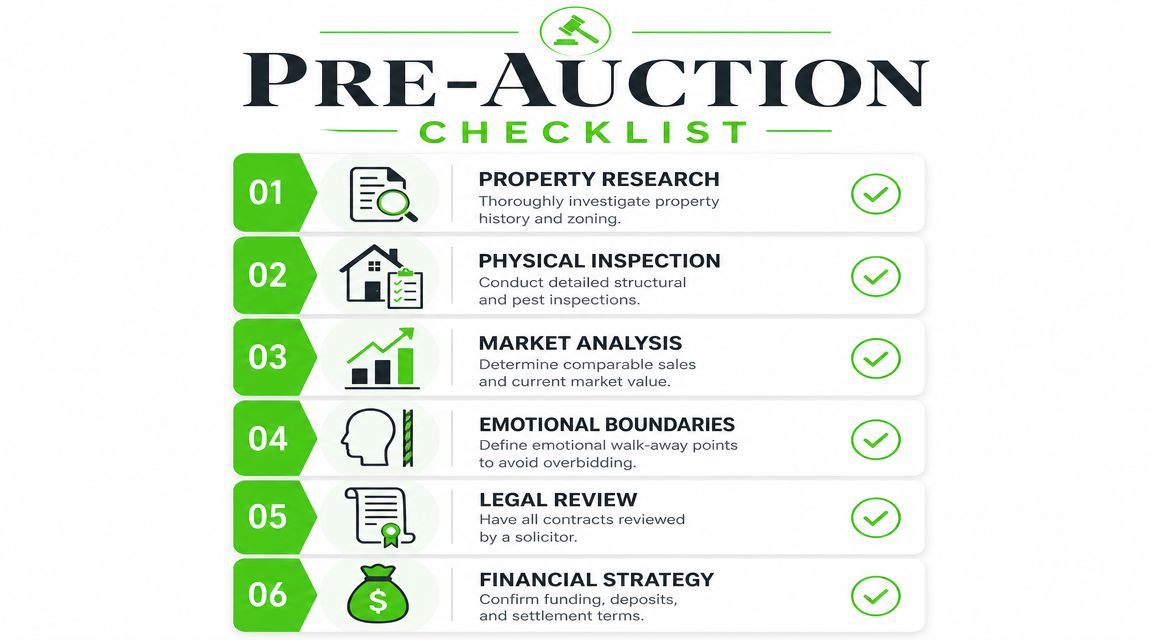
You need finance sorted, but finance alone isn't enough. A clean pre-approval doesn't protect you from a poor contract, drainage problems, a risky strata report, or a layout that limits resale. In the Australian auction system, especially in NSW, you need to behave as though the property becomes yours the moment the hammer falls. Because if you win, the contract is generally unconditional.
A strong pre-auction checklist usually includes:
- Contract review: Have your solicitor or conveyancer review the contract of sale, special conditions, easements, title details, and settlement terms.
- Building and pest due diligence: For a house, this is obvious. For an apartment, also look hard at strata records, upcoming works, and recurring defects.
- Comparable sales research: Don't rely on the guide alone. Study recent sales of similar properties in the same pocket.
- Local downside check: Main roads, future development, flood exposure, overshadowing, awkward parking, or noisy commercial uses all affect value.
- Deposit readiness: Confirm how the deposit will be paid on the day and who is authorised to sign.
- Emotional boundaries: Decide in advance what would make you walk, even if you love the place.
For buyers who want a broader framework, this comprehensive investment property analysis is a useful reference point for structuring your checks before you ever raise a paddle.
The cost that catches first-time buyers
Many buyers still make the same mistake. They calculate what they can bid, not what they can own.
That's a problem, because a major blind spot in auction advice is cost realism beyond the hammer price. Guidance on auction buying repeatedly points out that the winning bid is only one part of the true acquisition cost. Buyer's premiums, taxes, stamp duty, financing constraints, and other holding or improvement costs change the effective ceiling price, which is why the smarter question is whether the asset still works after the full cost is included, not whether you can technically win the bidding through all-in auction cost planning.
In a Sydney property context, that means looking beyond the auction number on the board and asking:
- What will stamp duty do to my cash position?
- Do I need immediate repairs or cosmetic work before moving in or leasing out?
- Will strata levies or council rates pressure my monthly budget?
- If I'm buying to invest, does the total acquisition still stack up after vacancy, maintenance, and finance costs?
Most first-time buyers don't blow up their budget because of one reckless bid. They do it because they ignored the costs sitting behind the bid.
If you're buying a house in the Inner West, a semi on the Lower North Shore, or an apartment in the Eastern Suburbs, the same principle applies. The auction result only tells you what the market agreed to in that moment. It doesn't tell you whether the purchase still suits your life and balance sheet six months later.
Setting Your Unbreakable Walk-Away Price
Your walk-away price is the most important number in the whole process. It's not the figure your broker says you might be able to stretch to. It's the number where the property stops being a good decision.
Your limit is not your pre-approval
A pre-approval tells you what a lender may support. Your walk-away price tells you what you should do.
That distinction matters because lenders don't live with the property's flaws. They don't care if the floorplan is compromised, if the block is harder to resell, or if the renovation will chew through your cash buffer. Buyers who confuse borrowing capacity with bidding strategy usually end up exposed.
Set your price by combining three things:
- Comparable sales evidence
- The property's specific strengths and weaknesses
- Your full acquisition costs and risk tolerance
Then write the number down.

Why hard ceilings beat emotional bidding
Auction theory is useful here because it removes some of the emotion. In many auction formats, the winning bidder pays the second-highest bid, not their own, and that structure creates a strong incentive to bid your true value rather than game the process. Raising a bid above your own valuation doesn't improve the outcome unless it changes whether you win, which is why a hard ceiling based on true value is the rational anchor, as explained in this overview of second-price auction theory and truthful bidding.
You don't need to become an economist to use that idea well. You just need the practical takeaway. Bid to your value. Don't bid to your ego.
A buyer who stops at the right number hasn't failed. They've priced risk correctly.
In Sydney auctions, the crowd often treats one extra bid as trivial. It never is. One extra bid can mean less buffer for repairs, less flexibility if rates move, or a more stressful settlement period. Good buyers don't decide their ceiling in the heat of battle. They decide it at the kitchen table, with the contract, the comparable sales, and a calm head.
Mastering Auction Day Bidding Tactics
Auction day usually turns messy at the exact moment buyers expect clarity. The auctioneer is calling fast, family members are whispering conflicting advice, and one confident bidder makes everyone else feel late. Buyers who perform well in that environment are rarely improvising. They are following a plan they decided on before they set foot at the property.
Tactics matter, but only if they protect your number instead of pulling you past it. The goal is not to look clever. The goal is to buy well, with full awareness of what the property will cost you after stamp duty, legal fees, immediate repairs, and the cash buffer you still need once the contract goes unconditional.
How to look composed even when you're not
Composure on auction day comes from routine.
Stand where the auctioneer can see you without searching. If you are bidding with a partner, appoint one bidder and make that clear before the auction starts. I see first-time buyers lose momentum when they turn every call into a committee meeting. Selling agents notice that straight away, and so do other bidders.
Keep your bids short and clean. Nod clearly or state the number. If the auctioneer asks for a rise, decide quickly. Long pauses can be useful, but only when they are deliberate. If every response is hesitant, the room reads uncertainty and the auctioneer will keep pressing.
A few habits give buyers more control:
- Stand in a visible position: Clear sight lines matter. Don't hide at the back or behind a crowd.
- Use one spokesperson: One bidder keeps the rhythm steady. The other person can watch the room.
- Keep reactions boring: No huddles, no flinching, no visible frustration after every counterbid.
- Choose increments before the auction starts: If you do not set your own pattern, the auctioneer will try to set it for you.
If you want more confidence in the figure you are defending, these property valuation methods are useful before auction day.
Some buyers also prefer to hand the live bidding to a professional, especially when they know nerves will affect decision-making. This overview of a Sydney auction bidding strategy service explains how that representation usually works.
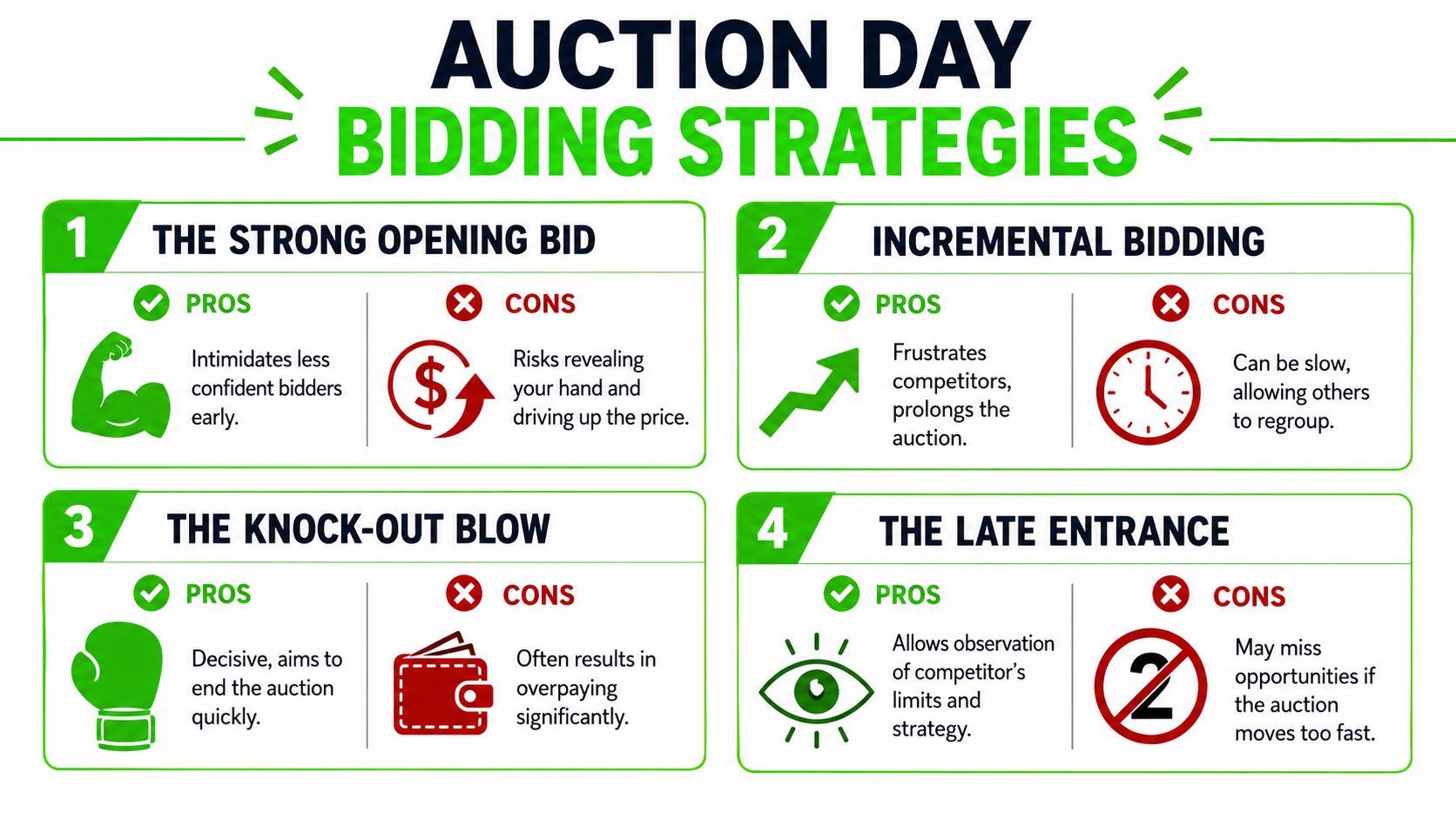
Auction Bidding Styles Compared
Different rooms call for different tactics. A quiet winter auction in the Inner West is a different contest from a packed Saturday campaign in a North Shore school catchment.
| Bidding Style | Pros | Cons |
|---|---|---|
| Strong opening bid | Can set the tone early and discourage hesitant buyers | Can reveal your intent too soon |
| Incremental bidding | Keeps you engaged without making large jumps | Can prolong the contest and invite more testing |
| Large knock-out bid | Can pressure one remaining rival and change the mood quickly | Often pushes price up faster than necessary |
| Late entry | Lets you observe competitors before showing your hand | Risky if the bidding moves fast or the property is called on the market early |
No style works every time.
A strong opening bid can be effective when the guide is underquoted, the campaign has drawn a large crowd, and you want to signal that you are not there to toy with the process. Late entry can work in a slower room where two other buyers are already testing each other. Big jumps are useful in narrow moments, usually when only one credible rival remains and you believe they are close to their ceiling. Used too early, they just burn your own money.
When to speed up and when to hold back
Reactive bidding is where buyers come undone. They hear a number, feel pressure, and answer too fast because silence feels dangerous.
Silence is not dangerous. Unplanned bids are.
Read the room. If there are still several active bidders, there is usually no advantage in racing the price upward with oversized jumps. Let the auctioneer do the work of drawing out weaker buyers. If the contest is down to you and one other party, a firmer move can sometimes test their resolve, but it only makes sense if the next bid still sits comfortably within your limit and your total buying costs.
This quick video captures the tempo you should expect on the day.
The practical version for an Australian property auction is straightforward:
- Open early when you want to show intent and stop a weak opening from inviting half the street into the contest.
- Bid in controlled increments when you want to stay engaged without overshooting.
- Pause with purpose when you want the auctioneer to work on the other bidder, not you.
- Stop cleanly the moment the number no longer makes sense for your budget and risk position.
Walking away can be the strongest move you make all day. I've seen buyers feel crushed after missing a property by $10,000, then feel relieved a month later when they avoid a stretched mortgage, a compromised renovation budget, or a purchase that no longer stacks up once every cost is counted.
The room will reward emotion if you let it. Disciplined buyers keep the property in perspective and the budget in charge.
The Professional Edge When to Hire a Buyer's Agent
There are buyers who should absolutely bid for themselves. There are also buyers who know the property but not the process, and that's where representation can change the result.
When representation changes the outcome

A buyer's agent is most useful when emotion, time pressure, or market complexity is likely to compromise your decision-making. That includes first-home buyers who know they'll freeze under pressure, busy professionals who can't inspect every listing thoroughly, and investors who need dispassionate acquisition rather than a personal attachment to one address.
In Sydney, that edge is often practical rather than glamorous. A good representative can assess campaign feedback, deal with selling agents before auction day, keep your search disciplined, and bid without the emotional leakage that first-time buyers often show. Some buyers also use an agent to avoid the auction floor entirely through earlier negotiation or alternate purchase paths. If you want to understand that broader role, this page on a buyer's agent in Australia outlines the service categories involved.
What an agent actually does on auction day
The main value on auction day is emotional insulation.
The agent doesn't fall in love with the kitchen, the school catchment story, or the thought of “finally getting one.” They work off the brief, the valuation, and the ceiling. That can be especially useful in a market where the last two bidders often aren't just competing on price. They're competing on pride.
A representative can also help when:
- You're buying interstate: You need someone local to inspect, evaluate, and execute.
- You're bidding on a compromised asset: Layout issues, strata concerns, or unusual title details require colder judgment.
- You've already missed out several times: Repeated auction losses often push buyers into overcorrection.
- You're balancing sale and purchase timing: Coordination matters when your own home sale affects deposit, settlement, or borrowing comfort.
Not every buyer needs one. But plenty of buyers benefit from taking themselves out of the firing line.
After the Hammer Falls What Happens Next
The hammer falls and the strategy gets tested immediately.
If you buy
If you win, expect to move fast. You'll usually sign the contract and pay the deposit straight away. In Australian property auctions, there's typically no cooling-off period once the property sells under the hammer, which is why the main work had to happen beforehand.
After that, your job is execution. Confirm your conveyancer has the signed paperwork, keep finance moving, and make sure any insurer, lender, and settlement contacts are aligned. If timing is tight between transactions, some buyers explore short-term funding options such as LendingXpress bridge loans, though the right structure depends on your own finance and legal advice.
If you don't buy
Not winning isn't always losing.
Practical auction strategy can include buying before auction, waiting for a pass-in, or walking away if the property becomes too competitive. That's an important shift in thinking. The higher-value outcome is securing the property on good terms or avoiding a forced overpay, not merely “winning” the public contest, as discussed in this practical take on buying before auction, pass-ins, and walking away.
If the property is passed in and you were the highest bidder, you may get the first chance to negotiate. That can be a strong position if the vendor is ready to do a deal. If another buyer wins above your limit, let them have it. Then review the campaign, tighten the process, and move to the next opportunity. If you want to see how that broader buying journey is usually managed from search through settlement, this guide to the Sydney buyer's agency process lays out the steps clearly.
Frequently Asked Australian Auction Questions
What is a vendor bid
A vendor bid is a bid made on behalf of the seller by the auctioneer. It's used to move bidding along before the reserve is met. It doesn't mean there's a genuine buyer at that number. Treat it as part of the auction process, not proof of market value.
Should I make a pre-auction offer
Sometimes, yes. A pre-auction offer can work when the property is likely to attract strong competition, when the vendor wants certainty, or when you want to avoid auction pressure. It only works if the offer is clean, credible, and backed by due diligence. A weak pre-auction offer often just helps the agent build momentum for auction day.
What does on the market mean
It means the reserve has been met and the property will sell to the highest bidder if no higher offer comes in. Before that call, the vendor can still refuse to sell. After that call, every bid matters differently because the decision point has changed.
Can I bid in odd amounts
Yes, and sometimes you should. Controlled, unconventional increments can interrupt rhythm and stop you from being dragged into automatic round-number jumps. Just make sure the amount is deliberate, not random.
What if I freeze on the day
Simplify the process before you arrive. One bidder only. Written ceiling. Planned opening move. If you know nerves will get the better of you, use a buyer's agent or a trusted representative who understands the brief and your cap.
If you want help buying in Sydney or Byron Bay without getting pushed into a bad auction decision, We Are Buyers Agents works with home buyers and investors on search, due diligence, negotiation, and auction representation. The value isn't just bidding on the day. It's making sure the property and the price both make sense before you get there.