
You're probably looking at Castle Hill for one of three reasons. You want a family suburb with less day-to-day friction. You want exposure to Sydney's north-west growth story. Or you're trying to work out whether the premium pricing is justified, rather than just emotionally appealing.
That's the right starting point. Castle Hill sells well in conversation because it's easy to like. It has established streets, major retail, schooling options, deep local identity, and transport infrastructure that changed the suburb's practical value. But buyers who stop there miss the harder questions. Does growth automatically equal a sound investment? Does more population mean durable rental demand? And do heritage and planning constraints shape what can, and can't, be built next?
Castle Hill distinguishes casual interest from serious due diligence. In Castle Hill, Sydney, Australia, the upside is real, but so are the trade-offs.
Table of Contents
- An Introduction to Castle Hill
- Castle Hill Property Market Deep Dive
- The Connectivity Equation Transport and Infrastructure
- Lifestyle Profile Schools Amenities and Community
- Investment Analysis Growth Drivers vs Yield Realities
- The Competitive Landscape Castle Hill vs Comparable Suburbs
- A Practical Action Plan for Buying in Castle Hill
An Introduction to Castle Hill
A typical Castle Hill buyer arrives expecting a simple family suburb. Then they inspect two properties ten minutes apart. One sits on a quiet, established street with older detached homes and a strong owner-occupier feel. The other is closer to the metro and retail core, surrounded by newer medium and high-density stock aimed at a different buyer altogether.
That gap matters.
Castle Hill sits about 34 kilometres north-west of the Sydney CBD and about 9.5 kilometres north of Parramatta, within Sydney's Hills District, according to the Castle Hill suburb profile. For buyers, those distances are less important than what they represent. Castle Hill is tied to the north-west growth corridor, but it also behaves like an established upper-middle suburban market with long-standing family demand. That combination supports prices. It also creates friction between growth, density, and neighbourhood character.
A suburb with two operating models
Castle Hill is best understood as two overlapping markets.
The first is the traditional family market. Buyers in this segment are paying for block size, school access, street appeal, and a suburb that still carries status within the Hills. The second is the transport-centred market around the commercial core, where apartments and newer stock appeal to buyers who value convenience, lower maintenance, and metro access more than land.
Those two markets do not move for the same reasons. They can also carry very different risk.
A house buyer may care most about school catchment durability and resale depth among owner-occupiers. An apartment buyer has to think harder about supply, tenant demand, strata quality, and whether convenience is enough to offset weaker scarcity. If you want a clearer framework for that side of the equation, our guide to rental market analysis for property investors is the right place to start.
Practical rule: Do not buy Castle Hill as a suburb label. Buy a specific pocket, a specific dwelling type, and a specific buyer or tenant profile.
Why the suburb still carries weight
Castle Hill did not emerge from a masterplanned release cycle. It has older roots, and that shapes buyer perception today. The suburb's early history, including its connection to the Government Farm period, still feeds into how the area is discussed locally and why established parts of Castle Hill are treated differently from newer north-west precincts.
That history has a market effect. Suburbs with long-standing identity often hold social status more firmly than newer estates, even when nearby infrastructure is similar. Buyers rarely state that directly, but they pay for it through stronger competition for better streets and more resistance to housing forms that alter established land use patterns.
The investment angle most suburb guides miss
Castle Hill has growth drivers that are easy to see. It also has constraints that are easy to gloss over.
Improved transport access, a major retail centre, and steady family demand all support long-term relevance. But the suburb is not a risk-free growth story. The more Castle Hill intensifies around its core, the more the market splits between scarce detached housing and repeatable attached stock. That can be positive for well-located houses. It can be less forgiving for apartments if supply runs ahead of tenant depth or buyer urgency.
For high-intent buyers, the key question is not whether Castle Hill is desirable. It usually is. The real question is which version of Castle Hill you are buying into, and whether that version matches your time horizon, cash flow tolerance, and exit strategy.
Different buyers will reach different conclusions:
- Family upgraders usually prioritise street quality, school access, and low-friction resale to other owner-occupiers.
- Apartment buyers often focus on walkability, transport, and price access, but need to assess supply-side risk more carefully.
- Long-term investors should separate durable demand from short-term excitement around infrastructure and new development.
Castle Hill earns attention because it sits at the intersection of maturity and change. That is its strength. It is also where buyers make expensive category errors if they treat the suburb as one uniform market.
Castle Hill Property Market Deep Dive
Castle Hill's market isn't one market. It's at least two. Detached houses appeal to established family buyers chasing land, schooling, and status within the Hills District. Units and newer apartment stock attract a different purchaser, often one who values transport access and lower maintenance over block size.
That split matters because broad suburb-level numbers can hide very different risk profiles by dwelling type.
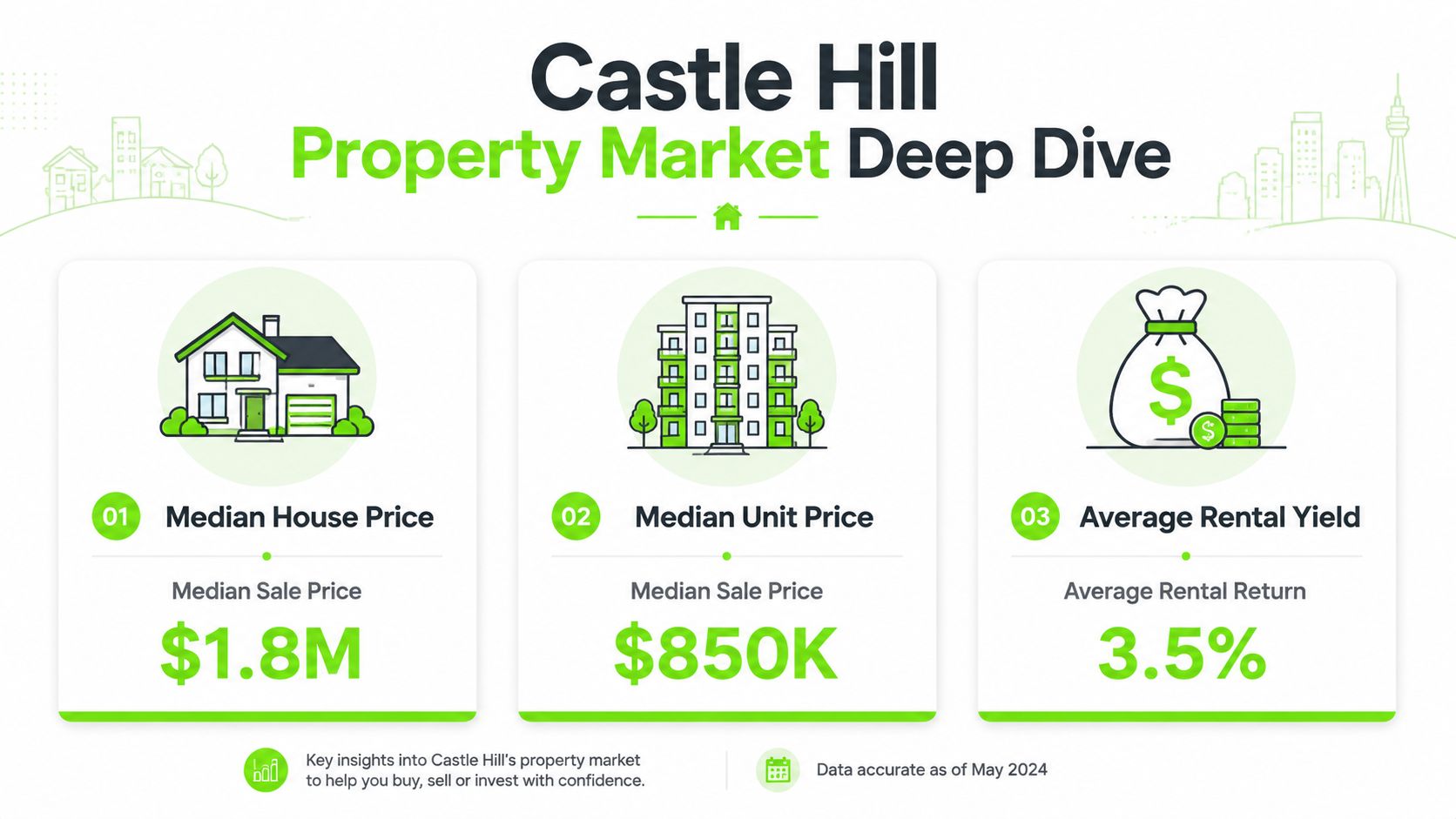
The current pricing picture most buyers see in market material is straightforward enough: houses command a premium, units sit at a lower entry point, and rental yield appears moderate rather than high. The problem is what many guides do next. They stop there.
What the headline prices don't tell you
A detached house in Castle Hill usually isn't competing with a unit in the same suburb. It's competing with houses in nearby family markets. A unit in Castle Hill often competes with other transport-oriented stock across the north-west. If you blur those together, you'll end up with the wrong conclusion.
A better way to read Castle Hill is through buyer intent:
| Segment | Typical buyer motive | Main upside | Main risk |
|---|---|---|---|
| Houses | Long-term family hold | Scarcity of well-located family stock | Very high entry cost |
| Units | Access and convenience | Lower buy-in and metro proximity | Supply competition and weaker uniqueness |
| Townhouse-style stock | Middle-ground option | Family appeal with less maintenance | Value can depend heavily on complex quality |
The supplied infographic points to $1.8M median house price, $850K median unit price, and 3.5% average rental yield. Those figures appear in the visual asset for this article and are useful as directional market framing, but the more useful question is how those figures behave under pressure. A high-priced house can still make sense if the local buyer pool remains deep. A unit can look affordable and still underperform if too much similar stock comes online.
The hidden supply question
Castle Hill gets more nuanced than many polished suburb guides admit. A key question for investors is how heritage constraints, such as those protecting historic horse-club grounds, affect future property density. While new subdivisions are common, these protections may limit high-density projects, potentially creating a bottleneck in land appreciation that isn't immediately obvious, as discussed in this local Castle Hill community discussion.
That cuts both ways.
If constraints limit future density in some parts of Castle Hill, detached land in the right pocket may become harder to replicate. That supports long-term scarcity. But if you buy near zones where apartment-style supply can expand more easily, you're in a different game entirely. Your competition isn't just the next seller. It's the next development cycle.
For investors trying to unpack that trade-off, a suburb-level snapshot isn't enough. A proper rental market analysis framework helps separate demand that's structurally stable from demand that looks strong during a growth phase.
Here's the embedded local market video worth reviewing before you form a view on buyer positioning:
Buyers usually overpay in Castle Hill when they assume every part of the suburb benefits equally from the same growth drivers. It doesn't.
My read on value
The strongest buying case in Castle Hill usually sits in assets with one of two traits. Either they're hard to replace, or they solve a practical lifestyle problem better than close substitutes. Everything else needs tighter scrutiny.
If you're buying a house, the street and land component do heavy lifting. If you're buying a unit, the building, floorplan, and exact walking relationship to transport and retail matter more than the suburb label alone.
The Connectivity Equation Transport and Infrastructure
Castle Hill changed when transport stopped being theoretical and became permanent. Before major rail investment, many buyers treated the suburb as car-first and family-heavy. After the metro shift, the suburb became more legible to a wider buyer pool, including professionals who wouldn't previously have looked this far north-west.
That matters because infrastructure doesn't just shorten trips. It changes who considers the suburb feasible.

The station tells you how serious the investment was
The best evidence of long-term infrastructure commitment isn't marketing copy. It's engineering. The Castle Hill Station, part of the Sydney Metro Northwest project, is an underground station constructed approximately 25 meters below ground level. This significant depth was an engineering decision to minimize surface disruption in the dense town centre, according to PERI's Castle Hill Station project summary.
That detail is more useful than it might first appear. A station built at that depth signals that planners and engineers treated Castle Hill as a serious urban node, not a token stop. In property terms, that tends to support long-duration demand rather than a short burst of speculative attention.
Cause and effect for buyers
Transport investment changes property performance through several channels at once:
- Buyer pool expansion: More purchasers can justify the location when rail access is practical.
- Time-cost reduction: Daily commuting becomes less punishing, which supports owner-occupier demand.
- Town-centre concentration: Retail, services, and higher-density housing cluster more tightly around the station.
- Resale resilience: Even in softer markets, well-connected stock usually remains easier to explain to the next buyer.
That doesn't mean every asset wins equally. It means location precision matters more.
Roads still matter here
Castle Hill is still a suburb where many households rely on cars for at least part of their weekly movement. Metro access is powerful, but so is road convenience. Buyers who need school drop-offs, business travel, family logistics, or cross-suburban movement still care about how easily they can move beyond the station precinct.
That creates an important split in the suburb:
| Location type | Best suited to | Likely strength |
|---|---|---|
| Near the metro core | Unit buyers, downsizers, commuters | Convenience and liquidity |
| Established internal streets | Family buyers | Space and neighbourhood feel |
| Busy-road edge stock | Budget-sensitive buyers | Lower emotional appeal |
Connectivity test: Ask whether the property works on both a rail day and a car day. In Castle Hill, the best assets usually do both.
The investment read-through
Transport upgrades often tempt buyers into broad optimism. That's where people get sloppy. Infrastructure can lift a suburb, but it can also create a sharper divide between prime and average stock. A well-positioned property near key movement corridors may benefit from stronger demand. A compromised property can remain compromised, even inside a stronger suburb.
Castle Hill's connectivity story is real. The analytical mistake is assuming that means every listing deserves the same premium.
Lifestyle Profile Schools Amenities and Community
Saturday at 8:30am tells you more about Castle Hill than any sales brochure. One parent is heading to sport, another is doing a Castle Towers run, and neither wants a suburb that turns ordinary errands into a half-day exercise. That buyer behaviour matters because it supports demand in a different way from pure investor hype. Castle Hill appeals to households paying for reduced friction in daily life, and that tends to hold up better than lifestyle marketing built on novelty.
That appeal has depth. Castle Hill has a longer local identity than many growth suburbs in north-west Sydney, and that history still shapes how residents view change. As noted earlier, the suburb's roots go back to the early colonial period. For buyers, that does not just add character. It usually means a more established civic structure, clearer neighbourhood identity, and stronger resistance to changes that feel out of step with the area.
Daily convenience is the real liveability test
The suburb's lifestyle case is strongest at the practical level. Families can combine school, shopping, health services, parks, and recreation without constantly leaving the district. Castle Towers is central to that pattern. It gives Castle Hill a level of self-sufficiency that reduces dependence on surrounding suburbs for basics, which is one reason owner-occupier demand stays broad.
That convenience is unevenly distributed, though.
Homes closer to the retail and service core suit downsizers, older owner-occupiers, and time-poor households who want easy access to shops and appointments. Deeper residential pockets often suit families better, particularly where the street feel is quieter and the housing stock is more consistent. Properties on compromised edges still trade at a discount for a reason. Amenity at suburb level does not cancel out noise, awkward access, or weaker streetscape at property level.
Schools influence bidding power
School demand is one of the suburb's clearest demand anchors, but buyers often misunderstand how it works. Good schooling options do not just attract families. They shorten decision timelines and make buyers less price-sensitive once they find a property that fits the brief.
That has a direct market effect. A family trying to solve schooling, commute, and house size in one purchase is rarely comparing Castle Hill with every suburb in Sydney on equal terms. They are narrowing to a handful of family districts, then choosing at street level. If you are still at the comparison stage, this guide to schools in Sydney is a useful starting point before you assess Castle Hill against competing family suburbs.
Here is how the lifestyle equation usually breaks down:
| Buyer type | What works in Castle Hill | Where the risk sits |
|---|---|---|
| Families | Schools, parks, shopping, established streets, sport and activity options | Entry price can force compromises on land, position, or housing condition |
| Downsizers | Access to retail, services, and lower-maintenance housing near the centre | Some stock feels too dense or lacks the privacy long-term locals want |
| Young professionals | Better fit near the centre, especially if they value convenience over nightlife | Parts of the suburb can feel too suburban and car-oriented |
| Investors | Broad owner-occupier appeal supports resale demand | Lifestyle strength does not automatically produce strong rental yield or tenant stickiness |
Community strength is real, but so are the constraints
Castle Hill benefits from something many newer precincts are still trying to build. It has community memory. Heritage assets, established clubs, long-running schools, and repeat local patronage all help create a suburb that feels known rather than assembled.
That matters because reputation affects resilience. In softer conditions, buyers usually cut fringe or interchangeable locations first. Established suburbs with a clear identity often retain a stronger buyer pool, even when budgets tighten.
There is a flip side. The same factors that support identity can also constrain change. Heritage considerations, neighbourhood expectations, and community resistance can slow or complicate redevelopment outcomes in some pockets. For owner-occupiers, that may protect character. For investors counting on a simple future upside story, it can limit flexibility.
Castle Hill Heritage Park is a good example of the suburb's appeal and its tension. It reinforces local identity and contributes to the area's sense of permanence. It also reflects the broader reality that Castle Hill is not an anything-goes growth precinct.
The buyer takeaway
Castle Hill's lifestyle offer is credible because it works in ordinary life, not because it photographs well. That is a meaningful advantage. It helps explain why family buyers and long-term owner-occupiers stay active here even when pricing pushes them to compare nearby suburbs.
Still, lifestyle quality should not be confused with universal asset quality. Some homes benefit from the suburb's community infrastructure and established appeal. Others merely borrow the postcode.
If you are improving a property in Castle Hill before resale, small practical upgrades often matter more than cosmetic trends. Keeping records also helps. This guide on documenting home upgrades for value is useful if you want buyers and valuers to recognise the work properly.
Investment Analysis Growth Drivers vs Yield Realities
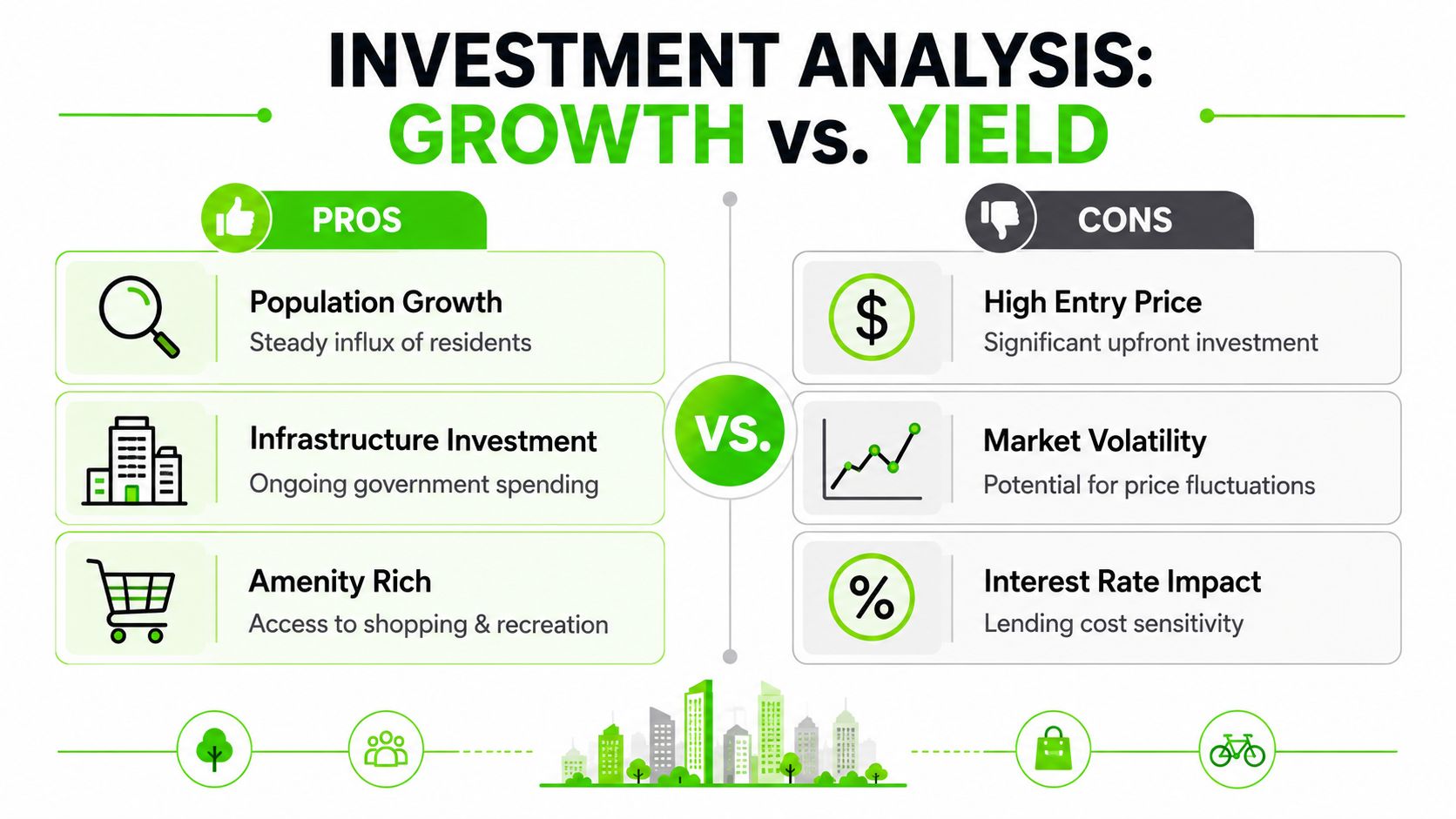
Castle Hill is easy to pitch as a growth suburb. That's the simple version. The harder version is more useful. Strong owner-occupier appeal, major infrastructure, and population attention can support prices, but none of that guarantees a clean investment result.
The key tension is this. Capital growth stories attract buyers fast. Rental performance is usually slower, less glamorous, and far more sensitive to stock type.
The bullish case is real
Castle Hill has several genuine demand supports. Families want the amenity stack. Commuters benefit from upgraded transport. The suburb also carries established-name recognition inside the Hills District, which helps demand persist beyond short-term sentiment.
There's also a broader growth narrative around the area. One local report on population pressure suggested the district is heading for significant growth. Consequently for investors, that conversation has already shaped buyer expectations.
The yield question most guides dodge
However, the suburb warrants a sharper lens. While Domain data shows Castle Hill is “booming”, a critical question for investors is whether the rapid population surge translates into rental yield stability. Some reports hint at churn that could undermine rental income, according to the 7NEWS Sydney population discussion on Castle Hill.
That single point changes the investment conversation.
Population growth sounds bullish. But if incoming demand includes renters who don't stay long, or if rental supply expands in ways that make stock easy to substitute, then yield stability can be less reliable than the headlines suggest. Investors who buy purely on “growth corridor” logic often discover too late that high interest from buyers doesn't always equal clean rental performance.
Investor filter: Ask whether your likely tenant is choosing Castle Hill specifically, or just renting there temporarily while the broader north-west expands.
Growth and cash flow don't automatically align
Castle Hill can suit a long-hold investor who accepts lower income efficiency in exchange for stronger owner-occupier-backed pricing support. It's less compelling for a buyer whose strategy depends on strong yield from day one.
That distinction matters because investors often lump all “good suburbs” into one category. In reality, there are at least three different investment cases:
| Strategy type | How Castle Hill fits | Main watchout |
|---|---|---|
| Long-term capital growth | Often a reasonable fit | You may sacrifice income strength |
| Balanced growth and yield | Possible, but stock selection is critical | Easy to overpay for average product |
| Cash-flow focused investing | Usually a tougher fit | Entry price can compress returns |
Where risk hides
Risk in Castle Hill doesn't usually look dramatic. It hides in assumptions.
A buyer assumes all infrastructure-led growth helps rents equally. It doesn't. A buyer assumes any asset near a desirable centre will be scarce. Often it isn't. A buyer assumes premium suburbs always produce premium investment outcomes. That depends entirely on what you paid, what you bought, and who will want it next.
For owners planning renovations before resale or lease-up, it also helps to think carefully about improvements that tenants and future buyers can see and verify. This guide on documenting home upgrades for value is useful because it addresses how improvements are recorded and presented, not just completed.
My bottom-line investment view
Castle Hill is stronger as a selective acquisition suburb than as a blanket investment recommendation.
The best investment logic usually sits in one of these situations:
- A quality family house where land and location create genuine replacement difficulty.
- A tightly chosen apartment or townhouse where the exact position, layout, and walkability give it an edge over nearby stock.
- A long-hold strategy where the investor accepts that yield may not be the headline strength.
The weaker logic usually shows up when buyers chase the suburb name alone. If the asset is ordinary, the floorplan is forgettable, or competing supply is too easy to replicate, Castle Hill's broad appeal won't save the deal.
The Competitive Landscape Castle Hill vs Comparable Suburbs
Castle Hill doesn't operate in a vacuum. Most serious buyers compare it with Baulkham Hills, Kellyville, and Cherrybrook before they commit. That comparison usually reveals more than a standalone suburb review ever will.
Castle Hill's edge is that it feels established while still benefiting from substantial infrastructure and amenity concentration. Its downside is that many buyers know this, so you often pay up for the comfort of certainty.
Castle Hill vs The Neighbours A 2026 Snapshot
| Suburb | Median House Price | Median Unit Price | Key Transport Link | Primary Appeal |
|---|---|---|---|---|
| Castle Hill | Higher than many nearby alternatives | Mid-to-high relative to outer Hills options | Metro access and major road connectivity | Established centre, family appeal, strong amenity |
| Baulkham Hills | Often compared by family buyers | More limited unit identity in some pockets | Road-based convenience | Established housing and proximity to broader employment corridors |
| Kellyville | Different value equation | More modern stock profile in parts | Metro-linked in broader district context | Newer housing and expansion appeal |
| Cherrybrook | Often tightly held | More limited unit-style identity | Rail access in the broader catchment conversation | School-driven family demand and leafy character |
I'm keeping this comparison qualitative because precise suburb-by-suburb medians weren't supplied in the verified dataset, and forcing false precision would weaken the analysis.
What buyers are really choosing between
In practice, the comparison usually comes down to four trade-offs:
- Castle Hill vs Baulkham Hills: Castle Hill often wins on centre-based convenience. Baulkham Hills can appeal to buyers who prefer a more road-connected, less town-centre-oriented feel.
- Castle Hill vs Kellyville: Kellyville can attract buyers chasing newer product or a different price relationship. Castle Hill tends to feel more mature and less speculative.
- Castle Hill vs Cherrybrook: Cherrybrook often appeals to buyers prioritising an established, leafy environment with strong family credentials. Castle Hill usually offers a more commercial core and broader shopping convenience.
The suburb you choose isn't just about upside. It's about which compromise you can live with for the next decade.
Where Castle Hill usually wins
Castle Hill tends to outperform in buyer perception when someone wants an all-rounder. It combines transport relevance, retail scale, family usability, and local identity in one package. That breadth is hard to replicate.
Where it can lose is on price tension. If your budget is already stretched, a nearby alternative may offer better flexibility, even if it gives up some prestige or convenience. That's why buyers shouldn't ask only whether Castle Hill is better. They should ask whether it's better enough to justify the premium they'll pay.
A Practical Action Plan for Buying in Castle Hill
If you're serious about buying in Castle Hill, don't start with listings. Start with your brief. The suburb is broad enough that the wrong brief leads you into the wrong product fast.
A family buyer, a downsizer, and an investor can all say they want “Castle Hill” and mean completely different things. One wants a quiet internal street. Another wants a lift-access apartment near retail. Another wants a property that still works if tenant demand softens.
Step one is to define the non-negotiables
Write the brief in decision language, not wish-list language.
- Choose the asset type first. House, townhouse, or unit changes the whole risk profile.
- Choose the location logic next. Metro proximity, school access, quiet street position, or redevelopment-adjacent location.
- Set your downside boundary. What would make this property hard to rent, resell, or hold?
If you're looking at sloping blocks, older retaining structures, or homes where site works may be needed, it's worth reviewing these essential Australian retaining wall regulations before you commit. That's the sort of due diligence buyers often leave too late.
Step two is to inspect for the risks that don't appear in the ad
Castle Hill stock can photograph well and still be strategically weak. During inspections, I'd focus on:
- Competing supply: If you're buying a unit, how easy is it for a tenant or future buyer to choose something similar nearby?
- Street hierarchy: Quiet and established usually resells better than busy and compromised.
- Functional layout: In higher-priced suburbs, bad floorplans are punished more harshly because buyers expect fewer compromises.
- Land utility: For houses, the value isn't just the land size. It's what the land can practically do.
Step three is to widen access before negotiating
A lot of Castle Hill buyers only compete on visible stock. That's a mistake in a suburb where better opportunities can sit outside the main portal cycle. Learning how to find off-market properties gives you a better shot at reducing emotional bidding pressure and seeing stock before the broader market piles in.
Who Castle Hill suits best
This is my practical read:
| Buyer type | Fit for Castle Hill | Reason |
|---|---|---|
| Family upgrader | Strong | Amenity, schools, space, suburb reputation |
| Long-term investor | Selective | Better for carefully chosen assets than blanket buying |
| Yield-focused investor | Weaker | Entry pricing can limit cash-flow appeal |
| Downsizer | Good in the right pocket | Convenience near the centre matters |
Castle Hill is a strong suburb. It isn't an automatic purchase. Buyers do best here when they stay disciplined, get specific, and avoid paying a prestige premium for an average property.
If you want experienced help building a Castle Hill strategy, shortlisting the right streets and assets, and negotiating without overpaying, speak with the team at We Are Buyers Agents. They work with Sydney buyers who want a sharper acquisition plan, including home buyers and investors who need clear-eyed advice rather than sales spin.